IT Company Meal Programs That Actually Work
Vancouver IT companies spend thousands on perks that don't move the needle. Here's how structured meal programs solve the daily lunch problem for dev teams, MSPs, and tech consultancies — at $10–15...
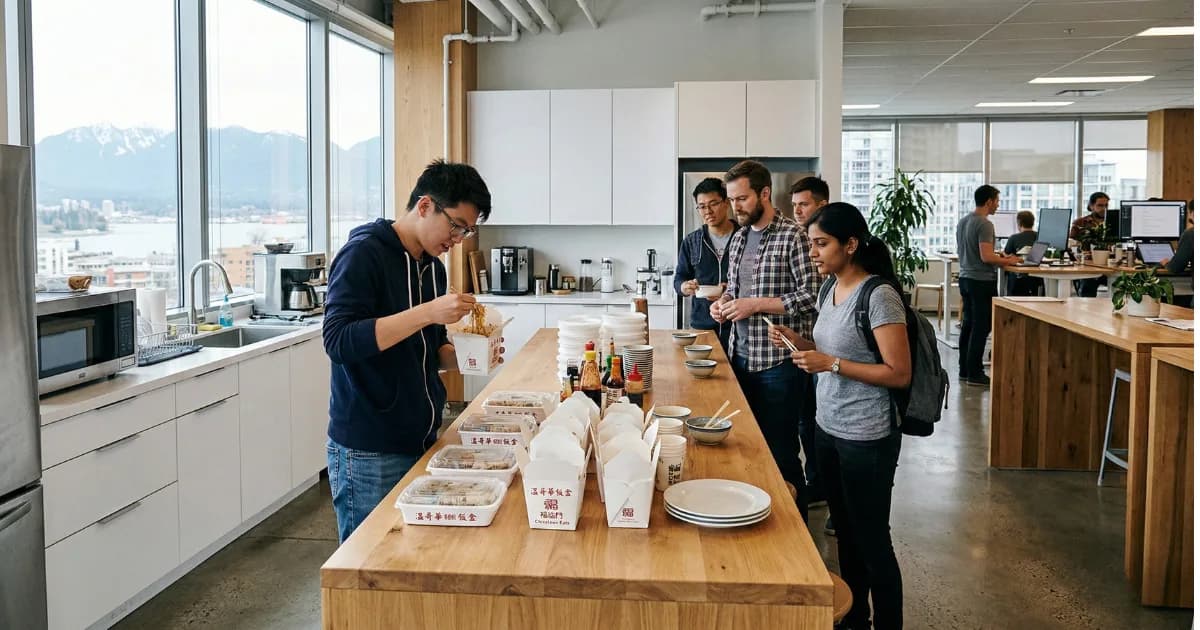
I've delivered to more IT offices across Metro Vancouver than any other industry segment. That's not because IT companies are uniquely food-obsessed — it's because there are more of them. Our Apollo data shows 155 IT companies in Vancouver with office managers or HR contacts actively managing teams of 15–50+ people. That's the largest single industry segment in our entire lead database, and after serving dozens of these offices, I've learned that IT companies have a specific relationship with food that differs meaningfully from law firms, real estate brokerages, or construction companies.
The core dynamic: IT workers are knowledge workers who forget to eat. A developer deep in a debugging session at 11 AM doesn't register hunger at noon. A systems administrator monitoring a server migration doesn't leave their desk for lunch because they can't leave their desk. A project manager back-to-back in sprint planning and client calls from 10 to 2 doesn't have a gap to go find food. By 3 PM, half the office is running on coffee and vending machine snacks, and afternoon productivity craters.
This isn't a perk problem. It's an operational problem. And the IT companies that solve it — with structured, reliable meal programs rather than ad hoc ordering — get measurably better afternoon output from their most expensive resource: their people.
Why IT Companies Are Our Largest Client Segment
Three structural factors make IT offices natural fits for meal programs:
1. Sedentary, focus-intensive work patterns.
IT professionals sit for 8–10 hours in roles that demand sustained cognitive focus. Software development, network architecture, security operations, data analysis — these aren't tasks you can do on autopilot. They require the kind of deep concentration that breaks easily and recovers slowly. A developer who leaves the office at noon to find lunch loses 15 minutes traveling, 15 minutes waiting, and then 20 minutes re-entering flow state when they return. A delivered lunch eliminates 50 minutes of disruption and replaces it with a 20-minute break at their desk or in the kitchen.
2. Hybrid and flexible schedules create coordination chaos.
Most Vancouver IT companies post-pandemic operate some form of hybrid arrangement. Developers work from home Monday and Friday, in-office Tuesday through Thursday. But not all developers — the DevOps team might be in-office Monday through Wednesday, while the QA team is there Wednesday through Friday. The result: daily office attendance fluctuates between 40% and 80% of total headcount, and nobody knows exactly who's eating in the office on any given day until that morning.
This is exactly the headcount variability our platform is built for. The office coordinator confirms the count by 9 AM, we deliver that number of meals. No waste from over-ordering, no shortages from under-ordering.
3. IT companies already spend on team culture — they just spend it badly.
The typical IT company in our client base allocates $3,000–$8,000 per month on "team culture" — a vague budget line that covers everything from Slack emoji packs to quarterly off-sites. A significant chunk goes to ad hoc food: pizza for late-night deploys, DoorDash orders for working lunches, snack walls that cost $500–$800/month in granola bars nobody appreciates.
A structured meal program at $2,400–$4,800/month (20–40 people, 3 days/week, $10–$12/person) replaces the ad hoc spending with a system that delivers daily visible value. The off-site still happens quarterly. The snack wall can stay. But the lunch problem — the daily, recurring, never-solved problem — gets solved once and runs automatically.
The IT Office Lunch Landscape in Vancouver
Let me map what I see across different IT company types, because "IT" covers a wide range of office environments:
Managed Service Providers (MSPs) — 10–30 people
MSPs are the unsung workhorses of Vancouver's IT landscape. They manage networks, help desks, and infrastructure for dozens of client companies. Their offices are high-stress, always-on environments where technicians rotate between field work and desk work.
What works: Simple, reliable daily lunch at $10/person. Two options (meat + vegetarian). No fuss. MSP teams are too busy to have opinions about menu variety — they want food that's there when they need it. Our Chinese-cuisine rice boxes are perfectly calibrated for this: filling, fast to eat, inexpensive.
Software Development Companies — 15–50 people
Dev shops range from 5-person startups to 50-person scale-ups. The bigger ones have distinct team cultures (frontend vs. backend vs. DevOps) that converge at lunch. These offices value variety more than MSPs and are more likely to have diverse dietary needs.
What works: Three options per delivery day at $12/person. Rotating menu across different restaurant partners weekly. Vegetarian option that's genuinely good (developers notice and complain when the veggie option is an afterthought). Team lunch aligned with standup or retro meetings.
IT Consultancies — 15–40 people
Consulting firms have the added wrinkle of client-facing work. Consultants are frequently at client sites, making daily headcount unpredictable. But when the team is in the office — typically for internal meetings, training days, and bench periods — they need meals that reflect the professional environment.
What works: Hybrid model — $10–$12 for regular team meals on 2–3 anchor days, $15 tier available for client meetings hosted at the office. Flexible headcount with same-morning adjustment.
Cybersecurity Firms — 10–25 people
Security operations teams work unusual hours. SOC analysts might work 7 AM–3 PM shifts, with handoffs at lunch time. These offices need food that accommodates shift patterns rather than a single noon delivery.
What works: Delivery timed to shift overlap (11:30 AM works for most SOC environments I've served). Food that holds temperature for 60+ minutes because not everyone eats simultaneously. Individual packaging with clear labels so the 7 AM shift can grab meals on their way out.
What IT Teams Actually Order
I'll share our ordering data patterns across IT clients because they're instructive:
Most popular items (by reorder rate):
- Teriyaki chicken rice box — the universal default
- Braised pork rice with vegetables — the filling option
- Curry chicken rice — the variety pick
- Vegetable curry rice — the go-to vegetarian
- Mapo tofu rice — surprisingly popular with non-vegetarians too
Patterns I've noticed:
- Dev teams skew lighter than you'd expect. Contrary to the pizza-and-energy-drinks stereotype, modern dev teams in Vancouver lean toward balanced meals. Heavy, greasy food gets negative feedback because developers feel sluggish during afternoon coding sessions.
- Burnaby IT offices consistently prefer lower-oil, lower-sodium options. I've seen this across enough Burnaby clients to consider it a genuine regional preference rather than coincidence.
- Noodle bowls are polarizing. Some teams love them; others find them messy to eat at a desk. Rice boxes are universally desk-friendly.
- Friday variety bump. IT teams that eat the same rotation Monday through Thursday want something different on Friday. We often rotate a different restaurant partner for Friday deliveries to reset the palate.
Dietary reality for IT offices:
Vancouver IT companies have some of the most culturally diverse teams in the city. Chinese, South Asian, Filipino, Iranian, Eastern European — the diversity is significant. Our standard menu structure handles this naturally:
- Daily vegetarian option covers most plant-based and some religious dietary needs
- Halal accommodation through specific restaurant partners for individual team members
- Gluten-free selections available (rice-based meals are naturally gluten-free)
What we don't handle: nut-free guarantees. Our restaurant partners operate kitchens where nuts are present. For individual team members with nut allergies, we select naturally nut-free dishes, but we can't certify the kitchen environment. This is a disclosed limitation, not a hidden one.
We also focus on regular dietary accommodations rather than highly specialized programs. Keto, AIP, FODMAP — these are beyond what a bulk-order platform manages efficiently. For teams with complex individual dietary needs, our article on handling multiple dietary restrictions in one office covers the practical approaches.
Summary: IT companies are our largest segment (155 Apollo leads) because knowledge workers forget to eat, hybrid schedules create ordering chaos, and existing culture budgets are spent inefficiently on ad hoc food. At $10–12/person, structured programs replace scattered DoorDash orders with reliable daily meals that preserve developer flow state.
Last reviewed: March 2026. Data current as of this date.
Introduction
Vancouver's IT sector employs thousands of professionals across managed services, software development, consulting, and cybersecurity — yet most IT offices still rely on ad hoc lunch ordering that wastes team time and disrupts the deep-focus work these roles require, according to BC tech industry workforce research.[1] With 155 IT companies in our Vancouver lead database alone, this segment represents the largest opportunity for structured meal program adoption in our entire B2B pipeline.
After serving IT offices from Gastown dev shops to Burnaby MSPs to Richmond data centers, I've learned that this industry's relationship with lunch is uniquely dysfunctional. The same teams that obsess over system uptime, code quality, and sprint velocity treat their own nutrition as an afterthought — defaulting to whatever's fastest rather than what's best. A development team that would never ship unreviewed code will happily run on gas station coffee and a granola bar through a four-hour afternoon debugging session. The irony isn't lost on their managers, who consistently tell me that afternoon productivity is their biggest performance gap.
My Great Pumpkin serves IT companies as part of our B2B platform connecting 120+ Vancouver restaurants with corporate clients. Our Chinese-cuisine-focused restaurant partners produce meals at $10–$15 per person that are filling without being heavy — a critical distinction for workers who need sustained energy, not a post-lunch crash. Individual packaging means a developer can eat at their desk without leaving their IDE open. And our headcount confirmation system handles the hybrid schedule reality that makes IT office attendance unpredictable from day to day.
What follows is a practical guide to building meal programs for IT companies in Metro Vancouver — the food that works, the logistics that fit, and the budget math that makes it an easy sell to whoever holds the operational budget.
Quick Answer: What Meal Program Works
Best for IT Companies?
The optimal IT company meal program delivers individually packaged meals 3 days per week on in-office anchor days, at $10–$12 per person, with 3 daily options (including vegetarian), flexible headcount adjustment by 9 AM, and desk-friendly packaging that doesn't require leaving a workstation — consistent with BC Tech Association guidance on competitive workplace benefits.[1] At My Great Pumpkin, we serve IT offices across downtown Vancouver, East Van, Burnaby, and Richmond with rotating menus from our 120+ restaurant network.
The honest answer is simpler than IT companies expect: don't overthink the food, solve the logistics. A development team doesn't need a different restaurant every day or a 15-item menu. They need 3 solid options that are reliably good, consistently available, and don't require anyone to leave their desk or spend mental energy deciding. Our most successful IT clients run a standing weekly rotation — same restaurant partners, rotating menu items — and the program becomes invisible infrastructure. Like a good CI/CD pipeline: it just works.
At the $10–$12 tier, our Chinese-cuisine rice boxes hit the requirements precisely: individually packaged (desk-friendly), filling without being heavy (no afternoon crash), and quick to eat (15 minutes, not 45). The $12 level adds a third daily option and slightly larger portions. For client-facing meetings or board presentations, the $15 tier is available through the same account.
Our platform handles the parts that waste office manager time: menu rotation, restaurant coordination, delivery logistics, dietary profiles, and consolidated monthly billing. The office coordinator's only daily task is confirming how many people are in the office — a 2-minute process that replaces the 30–60 minute daily ordeal of polling, compiling, ordering, and tracking that most IT offices currently endure.
Ready to simplify office meals?
Join 100+ Vancouver offices enjoying hassle-free lunch delivery. Free tasting, no contract.
Request a Demo →Building an IT Company Meal Program
The 3-Day Anchor Model
Most IT companies I work with land on a 3-day-per-week program aligned with their in-office anchor days. Here's the typical structure:
| Day | Purpose | Expected Attendance | Meal Tier |
|---|---|---|---|
| Tuesday | Core in-office day, team standups | 70–85% | $10–$12 |
| Wednesday | Mid-week collaboration day | 65–80% | $10–$12 |
| Thursday | Sprint planning / retro day | 60–75% | $10–$12 |
Monday and Friday are typically low-attendance days for hybrid IT teams. Running meals on those days means paying for infrastructure that serves 40% of the team. The 3-day model concentrates spending on high-attendance days where the communal value is highest.
Monthly cost for a 30-person IT company (3 days/week, 70% avg attendance = 21 meals/day):
| Price Tier | Per Meal | Daily Cost | Weekly | Monthly | Annual |
|---|---|---|---|---|---|
| $10 | $10 | $210 | $630 | $2,520 | $31,500 |
| $12 | $12 | $252 | $756 | $3,024 | $37,800 |
For comparison, what most IT companies currently spend on ad hoc food:
| Category | Monthly Estimate |
|---|---|
| Individual DoorDash/UberEats (15 people × $18 × 12 days) | $3,240 |
| Snack wall / coffee budget | $500–$800 |
| Pizza for late-night deploys (2x/month) | $200–$400 |
| Ad hoc team lunch orders (2x/month) | $400–$600 |
| Total ad hoc spending | $4,340–$5,040 |
A structured program at $2,520–$3,024/month is often less than the combined ad hoc spending it replaces — with dramatically better outcomes in terms of team satisfaction, time savings, and consistent nutrition.
Setup Process for IT Companies
Week 1: Discovery
- Confirm team size and hybrid schedule patterns
- Identify anchor days (highest in-office attendance)
- Collect dietary needs across the team (one-time survey)
- Set budget and decide on funding model (company-funded, hybrid, or employee-paid)
- Designate ordering coordinator (office manager, ops lead, or team lead)
Week 2: Configuration
- Select menu rotation from our restaurant network
- Set delivery schedule (time, building access, staging location)
- Test headcount confirmation workflow (9 AM daily via Slack/text/app)
- Configure billing (monthly invoice, expense coding)
Week 3: Pilot
- First delivery on one anchor day
- Gather feedback: portion size, meal variety, delivery timing, packaging
- Adjust based on real-world data
Week 4: Full launch
- Expand to 3-day schedule
- Program runs automatically from this point
- Coordinator confirms headcount daily (2–3 minutes)
- Monthly invoice processed by finance
The whole process mirrors what IT companies understand intuitively: discovery, configuration, testing, deployment. I've started framing it in those terms for IT clients, and the analogy resonates — they get that a meal program needs a proper rollout, not a "let's just order some food and see what happens" approach.
Delivery Logistics by Vancouver IT Zone
Downtown / Gastown / Yaletown
- Highest concentration of dev shops and tech consultancies
- Building access usually straightforward (office towers with reception desks)
- Delivery timing: 11:30 AM–12:15 PM standard window
- Parking can be tight; our regular drivers know the loading zones
Mount Pleasant / Main Street
- Vancouver's unofficial tech corridor
- Many IT companies in converted warehouse/loft spaces
- Usually street-level access, easy staging
- Less traffic congestion than downtown
East Vancouver / Railtown
- Emerging tech hub with lower rents attracting startups and scale-ups
- Industrial-mixed zoning means varied building types
- Generally easy access, ample parking for delivery
Burnaby (Metrotown / Brentwood / Willingdon corridor)
- Significant MSP and IT consultancy presence
- Avoid Willingdon Avenue bottleneck during lunch — our drivers route via Boundary Road
- Burnaby IT clients consistently prefer lighter, lower-oil preparations
Richmond
- Data centers, IT services, and tech companies serving the Asian market
- 11:45 AM–1:15 PM No. 3 Road congestion — 20-minute buffer built into every delivery
- Our Richmond-based restaurant partners provide the fastest, freshest deliveries here
Summary: The 3-day anchor model at $2,520–$3,024/month for 30 people costs less than what most IT companies already spend on ad hoc food ($4,340–$5,040). Setup follows a 4-week discovery→configuration→pilot→launch process that IT teams intuitively understand.
The Developer Flow State Argument
Why Lunch Delivery Is a Productivity Tool
Protecting developer flow state is the single strongest business argument for delivered meals in IT companies. Here's the math that resonates with CTOs:
A developer entering deep focus — flow state — takes an average of 15–25 minutes to reach productive concentration after any interruption. A lunch break that involves leaving the building, finding food, waiting, and returning creates a 45–60 minute gap in the middle of the workday. But the actual productivity cost is the gap plus the re-entry time: 60 + 20 = 80 minutes of effective lost output.
A delivered lunch reduces this to a 20-minute break at the desk or in the kitchen, with re-entry time of 5–10 minutes because the developer never fully left their mental context. Total impact: 25–30 minutes.
The difference: 50 minutes of recovered productive time per developer per meal day.
For a 15-developer team eating delivered lunch 3 days per week:
- 15 developers × 50 minutes × 3 days = 2,250 minutes/week = 37.5 hours/week
- At a blended developer cost of $60/hour: $2,250/week in recovered productivity
- Annual recovered productivity: ~$112,500
The meal program costs $2,520–$3,024/month, or ~$31,500–$37,800/year. Even if you discount the productivity recovery by 50% (accounting for developers who would have eaten at their desk anyway), the program pays for itself 1.5x over in recovered developer time alone.
I present this math to CTOs specifically because they think in developer-hour economics. A CTO who winces at a $3,000/month food budget doesn't wince at a $9,375/month productivity recovery. The framing matters.
The Afternoon Crash Problem
Every IT manager I've spoken to identifies the same performance gap: the 2–4 PM productivity crater. After lunch — or after not eating lunch — the team's output drops. Pull requests slow down. Bugs increase. Meeting energy flatlines.
The correlation between nutrition and afternoon cognitive performance isn't controversial — it's basic biology. What's specific to IT companies is the cost of that performance drop. A developer introducing a bug at 3 PM because they're mentally foggy creates downstream costs: code review time, QA cycles, potential production incidents. A systems administrator who misses an alert because their attention wavered at 2:30 PM creates incident response costs.
Delivered meals don't eliminate the afternoon energy dip, but they reduce its severity by ensuring the team has actually eaten a proper meal rather than subsisting on caffeine and willpower. The effect is most visible in the first two weeks after implementing a program — managers consistently report that the 2–4 PM window feels noticeably more productive.
Summary: A delivered lunch saves 50 minutes of productive developer time versus leaving the building — recovering ~$112,500/year in developer productivity for a 15-person team. The program cost of $31,500–$37,800/year is offset 1.5–3x by productivity recovery alone, before counting retention and morale benefits.
Conclusion
IT companies are our largest and most natural client segment for a reason: knowledge workers need consistent nutrition to maintain the cognitive performance their roles demand, hybrid schedules make ad hoc ordering chaotic, and the budget math overwhelmingly favors structured programs over scattered DoorDash orders.
At $10–$12 per person with our Chinese-cuisine-focused restaurant partners, a 30-person IT company runs a 3-day meal program for $2,520–$3,024/month — often less than the combined ad hoc food spending it replaces. Individual packaging means developers eat at their desks without breaking flow. Headcount confirmation handles hybrid schedules. Consolidated monthly billing eliminates receipt chaos. And the recovered productivity from reduced lunch disruptions pays for the program multiple times over.
We deliver to IT offices across downtown, Mount Pleasant, East Van, Burnaby, and Richmond with route-familiar drivers who know the building access, the delivery timing, and the Willingdon Avenue bottleneck to avoid. The program runs automatically after a 4-week setup, requiring 2–3 minutes daily from the coordinator.
I'll be honest about limitations: we don't guarantee nut-free environments, we handle regular dietary accommodations (vegetarian, halal, gluten-free) rather than highly specialized programs, and our $10–$12 tier is Chinese-cuisine-focused. For IT companies wanting daily sushi or Mediterranean variety, the $15 tier opens our broader restaurant network. But for the daily team lunch that keeps developers fed, focused, and in the office — the $10–$12 tier is exactly right.
Start Your IT Team Meal Program
Explore meal plans for Vancouver IT companies: https://www.mygreatpumpkin.com/demo
Summary: IT companies are the largest and most natural segment for B2B meal programs: knowledge workers need consistent nutrition, hybrid schedules break ad hoc ordering, and $2,520–$3,024/month structured programs cost less than the ad hoc spending they replace while recovering $112,500+ in annual developer productivity.
Looking for Vancouver's Asian-fusion meal partner?
The Storm Cafe delivers fresh bento boxes, rice bowls, and catering platters across Metro Vancouver — from Richmond to North Van. Retail orders, family meals, and corporate lunches all in one place.
References
[1] BC Tech Association (WeAreBCTech), "BC Technology Industry Workforce Report," 2026. Data on Vancouver IT sector employment, workplace benefits, and talent retention benchmarks. https://wearebctech.com/
[2] CompTIA, "IT Industry Outlook: Workforce Trends and Technology Services," 2026. Research on IT professional work patterns, productivity factors, and corporate technology services market. https://www.comptia.org/
Frequently Asked Questions
Our developers work different hybrid schedules — how do you handle varying daily headcount?
This is the most common IT company challenge and our platform is built for it. Your coordinator confirms the actual in-office count by 9 AM each day. If 18 people are in on Tuesday and 25 on Wednesday, we deliver 18 and 25 respectively. You only pay for meals ordered. We set a standing baseline (say, 20) that adjusts up or down with a quick morning message — the whole process takes 2 minutes. For IT companies with very irregular patterns, we recommend slightly over-ordering by 2–3 meals as buffer; at $10–12 per buffer meal, it's a trivial cost to avoid having someone arrive without food.
Can developers eat at their desks without making a mess?
Yes — this is a core design requirement for our IT client meals. Individual rice boxes with sealed lids and included utensils are completely desk-friendly. No dripping sauces, no assembly required, no shared platters that require getting up. A developer can open the container, eat with one hand while reading code with the other (I've watched this happen), and close it in 15 minutes. The containers are leak-proof and stackable, and everything is disposable — no washing up, no kitchen cleanup required.
We already spend $800/month on a snack wall — should we redirect that budget?
Keep the snack wall but reduce it. In my experience, about $300–$400/month covers what people actually consume from a snack wall (the rest is waste or items that sit untouched). Redirect $400–$500 toward a meal program, add the difference from the broader culture budget, and you get a structured lunch program that delivers more daily value than granola bars ever could. The snack wall is background noise — nobody thanks you for it. Team lunch is a visible, appreciated daily benefit that people mention in job interviews and Glassdoor reviews.
What about late-night deploy meals when the team is working overtime?
Our standard delivery window is lunch (11:30 AM–12:30 PM), and that's where our restaurant network and driver routes are optimized. For planned after-hours work — a scheduled deploy, a sprint crunch — we can arrange dinner delivery with 24-hour notice through our account manager. What we can't do is same-hour emergency dinner orders at 9 PM when an incident fires. For those situations, delivery apps are honestly more practical because they have driver availability at those hours and we don't. We solve the daily lunch problem; ad hoc late-night needs are a different operational challenge.
How does your per-meal pricing compare to what we'd pay ordering through UberEats?
At $10–$12 per meal through our platform versus $15–$20 per individual UberEats order (after delivery fees and 25–30% platform commission), you save $5–$8 per person per meal. For a 20-person team eating 3 days/week, that's $300–$480/week — or $15,000–$24,000 annually — in savings versus individual app ordering. But the bigger savings come from eliminating the 30–60 minutes per day someone spends managing ad hoc orders, and from avoiding the 15 separate DoorDash deliveries arriving at different times that turn your reception area into a staging ground.
Related Articles

Office Catering in Downtown Vancouver Financial District
Daily office catering for Downtown Vancouver. Delivery to Burrard, Granville, and Waterfront offices

Set Catering for Film Productions in Vancouver
Film set catering in Vancouver. Union-compliant meals, 6 AM call times, on-location delivery for cre

Lunch Programs for Coworking Spaces in Vancouver
Add a daily lunch program to your Vancouver coworking space. Boost member retention and upsell premi
Ready to streamline your office meals?
Join 100+ Vancouver offices enjoying hassle-free lunch delivery.
Request a Demo