Construction Site Lunch Delivery: Feeding Crews of 50+
Feeding 50+ construction workers on Vancouver job sites requires volume, speed, and logistics most caterers can't handle.
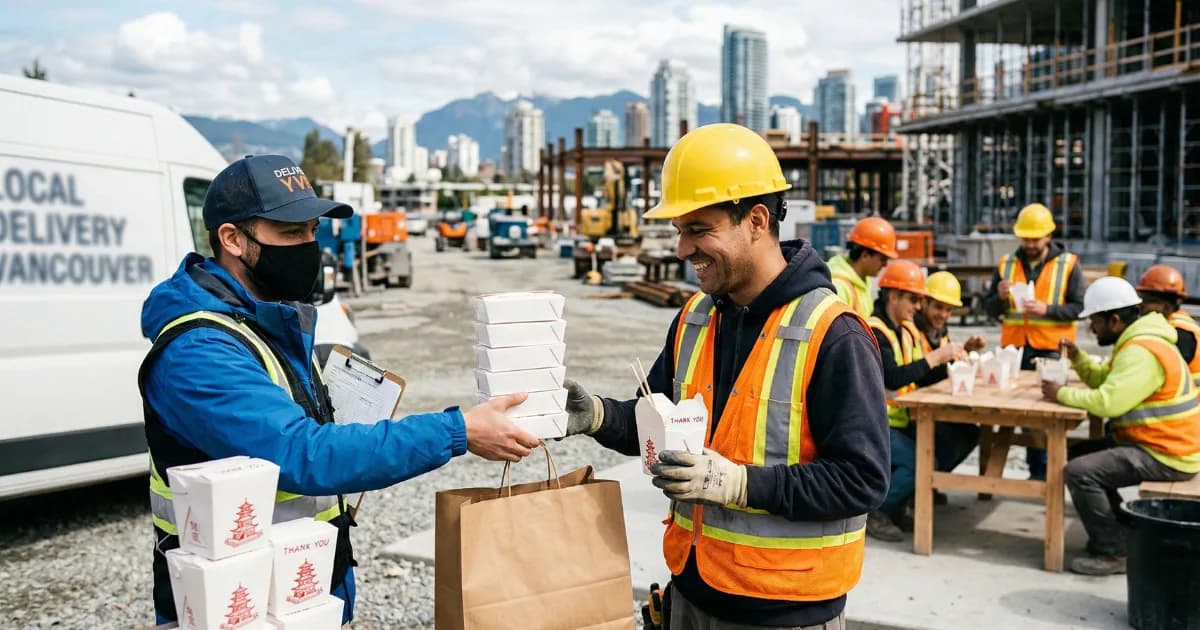
I've delivered to construction sites across Metro Vancouver — from the Oakridge redevelopment zone to the Marine Drive corridor in Burnaby, from Richmond's Garden City developments to downtown tower projects along Burrard Inlet. Construction crews are the most logistically demanding catering clients I work with, and also the most straightforward about what they need: hot food, enough of it, on time, every single day. No boardroom protocols. No silent setup rituals. Just feed the crew so they can get back to work.
Here's what I've learned about making that happen reliably at scale.
The Math Nobody Talks About: Why 50+ Crew Meals Break Normal Catering
Most corporate caterers are built for office orders — 12 salads, 8 sandwiches, a couple of vegetarian options. That's a $200 order with predictable logistics. A construction site feeding 50 workers at lunch needs $500–$750 worth of food delivered to a location that may not have a proper address, a loading dock, or even a paved road to drive on.
The scale difference isn't just about volume. It's about everything around the volume:
- No refrigeration on site. Food that arrives needs to be consumed within the lunch window or it's wasted. There's no break room fridge to store leftovers.
- Staggered breaks. Not every crew member eats at the same time. Concrete finishers might break at 11:30, framing crews at noon, and electricians at 12:15. The food has to hold temperature and quality across a 45-minute window minimum.
- Access challenges. Half the sites I deliver to have security gates, construction fences, or muddy unpaved lots that a standard delivery car can't navigate. I've had drivers park three blocks away and cart food in on dollies because the only site entrance was blocked by a crane delivery.
- Weather exposure. There's no covered dining area on most active sites. Between October and April, Vancouver's rain season means crews are eating under tarps or in partially enclosed structures. Food packaging has to survive that environment.
The right food, at the right temperature, at the right place, at the right time. That's the job for any catering operation. Construction sites just test every single one of those variables harder than an office ever will.
What Construction Crews Actually Want to Eat
I'll save you the guesswork, because I spent my first year getting this wrong.
What doesn't work:
- Fancy plating or individual portions. Nobody on a job site wants to unwrap four layers of packaging with dusty gloves. They want to grab food and eat.
- Salad-heavy menus. A framing crew that's been hauling lumber since 6 AM doesn't want arugula. They want protein and carbs that actually fuel physical work.
- Complicated dietary menus with twelve options. Construction supervisors don't have time to poll every worker's preference. They need three to four solid options that cover the majority.
What works:
| Meal Type | Why It Works | Typical Crew Reception |
|---|---|---|
| Rice boxes with protein | Hot, filling, easy to eat standing up | Consistently the top request |
| Noodle bowls (sealed) | High calorie, satisfying, fast to consume | Strong, especially with Asian crews |
| Hearty stews with bread | Holds temperature well, feels substantial | Great in cold/wet months |
| Wraps and burritos | Portable, one-handed eating possible | Popular for crews who eat on the move |
Here's a detail that matters more than most caterers realize: construction sites in Metro Vancouver have some of the most culturally diverse workforces in the city. Filipino, Chinese, South Asian, Eastern European, Indigenous — the crews I feed reflect Vancouver's demographics. A lunch program that only offers burgers and sandwiches is ignoring half the people it's supposed to serve.
Our Chinese-cuisine-focused restaurant network is actually a strength here. Rice-based meals with protein — char siu, braised chicken, mapo tofu, curry — are crowd-pleasers across cultural lines, they're filling, they hold temperature well in our insulated carriers, and they hit the $10–15 per person sweet spot that construction project managers care about.
I should be honest about a limitation: we don't offer nut-free guarantees. Our restaurant partners operate kitchens where nuts are present, and I can't certify an entirely nut-free environment across a 120+ restaurant network. For individual nut-allergy accommodations, we can select specific dishes from partners whose menus are naturally nut-free, but a blanket guarantee for a 50-person crew order? I won't make that promise because I can't keep it. If a site has workers with severe nut allergies, that needs to be flagged individually so we can route their specific meals through verified partners.
The Delivery Logistics That Kill Most Vendors
Let me walk you through what a typical construction site delivery actually looks like, because this is where generic caterers and delivery apps fall apart.
Scenario: 55-person crew at a Burnaby highrise project, lunch at 12:00 PM.
- 10:00 AM: Restaurant partner begins prep. Fifty-five meals isn't a "fit it in between regular orders" situation — it's a dedicated production run. Our partner kitchens know the volume coming and block prep time accordingly.
- 11:15 AM: Food is packed into compartmentalized insulated carriers. Temperature logged. Each carrier holds 12–15 meals, so we're loading four to five carriers into the van.
- 11:25 AM: Driver departs. This is a Burnaby route, and the driver knows the Kingsway corridor. If they're heading to a site near the Brentwood development zone, they're avoiding the Willingdon Avenue bottleneck and routing via Boundary Road instead.
- 11:45 AM: Arrive at site. Security check-in at the gate. The driver has the site supervisor's direct cell number and a pre-issued visitor badge — we arranged this during onboarding, not five minutes before lunch.
- 11:50 AM: Food staged at the designated break area. No searching for the right floor, no asking random workers where to put things.
- 12:00 PM: Crew starts eating. Hot food, right temperature, right location, on time.
Now here's what happens when a construction company tries to use DoorDash or UberEats for this same scenario:
- Random driver assignment. The algorithm sends whoever's closest. That person has never been to this site, doesn't have the gate code, doesn't know that the access road floods after rain, and definitely can't carry 55 meals from a parking spot three blocks away.
- No volume coordination. A 55-meal order through a delivery app means the restaurant is scrambling because there's no advance production planning. Quality drops. Timing slips.
- 25–30% commission on a $700+ order. That's $175–$210 going to the platform, which either inflates the price the construction company pays or shrinks the portions the restaurant can afford to provide. Either way, the crew notices.
- Zero site knowledge. No gate codes, no supervisor contacts, no understanding that this particular site requires hard hats past the fence line and the break area is on the second floor of an unfinished structure.
Seasonal Challenges: October Through April
Vancouver's construction industry doesn't stop for rain. Between October and April, we get roughly 1,150mm of precipitation, and active job sites are fully exposed to it.
What this means for meal delivery:
- Packaging must be moisture-proof. Cardboard containers that work fine in July become soggy, structural failures in November. We use sealed containers with moisture-resistant outer wrapping specifically because I learned this lesson the hard way during a November delivery to a Marine Drive site where every single box was water-damaged by the time crews opened them.
- Hot food temperature drops faster in cold, wet conditions. A meal that holds at serving temperature for 60 minutes in summer might lose critical heat in 30 minutes during a January rain. Our insulated carrier system — the same one we developed for law firm deliveries during rain season — maintains temperature for 90+ minutes, which covers the staggered break windows that construction sites require.
- Driver access gets harder. Unpaved construction lots turn to mud. Puddles hide potholes. Visibility drops. Our drivers who run regular construction routes know which sites become access nightmares after heavy rain and plan accordingly — parking closer, using alternate entrances, or coordinating with site supervisors to stage food at a covered location near the gate instead of the usual break area deeper on site.
The rain season isn't just a logistics challenge — it's when crews need hot food the most. A framing crew that's been working in 5°C drizzle since 7 AM doesn't want a room-temperature sandwich. They want something hot and filling. That's when our Chinese-restaurant-partner network shines: congee for breakfast orders, hot rice bowls at lunch, braised dishes that are designed to be eaten warm. This food was built for cold, wet conditions — that's what southern China's winter cuisine evolved around.
Pricing Reality: What 50+ Crew Meals Actually Cost
Let me be transparent about pricing because construction project managers are some of the most cost-conscious clients in our network.
Our range: $10–$15 per person for a complete lunch meal.
At 50 workers, that's $500–$750 per day. Over a five-day work week, $2,500–$3,750. Over a month, $10,000–$15,000.
That's real money. And every project manager I've worked with does the same mental calculation: "Can I just give each worker $12 and let them figure it out?"
Here's why that usually fails:
- Crew scatter. Fifty workers dispersing to find individual lunches means a 30-minute lunch break turns into 45–60 minutes. On a project billing labor at $50–$80/hour per worker, that lost productivity across a full crew costs far more than the catering premium.
- Inconsistent return times. Some workers come back on time, others get stuck in a Subway line. The site supervisor loses coordination control.
- No healthy options near most sites. Construction zones in the Marine Drive corridor, East Van industrial areas, or Richmond build zones are not surrounded by restaurants. The nearest food might be a 10-minute drive, which means workers need vehicles, parking, and time — all of which eat into the lunch break.
The sweet spot I've found is recurring weekly programs at the $12–$13 per person level. At that price point, with a rotating menu of four to five options, crews are well-fed, project managers keep lunch breaks tight, and the daily logistics are handled entirely by us. The project supervisor's only job is confirming headcount by 9 AM, which takes about 30 seconds.
Volume pricing: For crews over 50, we build in a per-meal discount because the delivery logistics are essentially fixed — whether I'm sending 40 meals or 60 to the same site, the driver, the van, and the route are the same. The marginal cost per additional meal is just the food, which lets us pass that efficiency along.
What I Tell Construction Project
Managers on the First Call
Same as with every industry I serve, the first conversation isn't about food. It's about logistics.
- What's the site access situation? Gate codes, security protocols, parking, road conditions. If there's no paved access within 50 meters of the break area, I need to know that before the first delivery, not after a driver gets stuck in mud.
- How does the break schedule work? Single lunch window or staggered? If staggered, how many groups and what's the gap between them? This determines our food-holding requirements.
- What's the daily headcount range? If the crew fluctuates between 40 and 70 depending on the construction phase, I need to build that flexibility into the ordering system. A fixed 55-person order doesn't work if Thursday's concrete pour brings in 15 extra workers.
- Who's my contact when things go sideways? Site supervisor cell. Not the project manager's office line. Not a general reception. The person who can walk my driver from the gate to the break area in three minutes if something's off.
The menu conversation comes after. Because if we can't get the food to the site — intact, hot, on time — the menu doesn't matter.
Why Construction Companies Switch to Dedicated Catering
The pattern I see is almost identical every time. A construction company has been handling crew meals one of three ways:
- Workers buy their own lunch. Lunch breaks run long, productivity drops, crews complain about options near the site.
- The supervisor orders through delivery apps. Works for a 10-person crew. Completely breaks down at 50+. The supervisor is spending 30 minutes a day managing food logistics instead of managing construction.
- A generic caterer handles it. The food is fine for the first month. Then late deliveries start because the caterer doesn't understand construction site access. Or the menu stagnates because they're not set up for daily variety. Or the caterer can't flex headcount on short notice because their operation isn't built for daily recurring volume.
The switch to a dedicated platform like ours usually happens after a specific failure event. A major delivery that was 40 minutes late during a concrete pour, and the crew lost their entire lunch break. A delivery app driver who showed up at the wrong site address because the GPS pointed to a residential block, not the construction entrance around the corner. A caterer who sent 50 sandwiches in cardboard boxes during a rainstorm.
What we offer isn't more food or better food in some abstract sense. It's operational reliability calibrated to construction site realities. Daily recurring delivery with route-familiar drivers. Flexible headcount adjustments with same-morning notice. Packaging that survives Vancouver weather. Pricing that works within construction project budgets. And a single point of contact that handles everything so the site supervisor can go back to supervising the site.
Summary: Feeding 50+ construction workers daily requires solving logistics problems most caterers never face: no refrigeration, staggered breaks, restricted site access, and weather exposure. At $10–15 per person with Chinese-cuisine-focused menus that satisfy diverse crews, the key is operational reliability — route-familiar drivers, moisture-proof packaging, and flexible headcount — not fancy food.
Last reviewed: March 2026. Data current as of this date.
Introduction
Construction companies across Metro Vancouver spend significant portions of project budgets on crew meals, yet most lack systematic approaches to feeding large teams efficiently, according to BC construction industry workforce management practices.[1] For a 50-person crew working a 12-month project, unstructured lunch logistics can cost thousands in lost productivity annually — and that's before counting the food itself.
After delivering to construction sites from downtown tower projects to Richmond's Garden City builds, I've learned that this segment has been overlooked by corporate caterers for a simple reason: it's hard. The sites are messy. The access is complicated. The volume is high but the per-meal budget is tight. Most caterers would rather serve a 12-person law firm lunch at $25 per head than a 55-person construction crew at $12 per head — even though the construction contract is worth more annually.
My Great Pumpkin was built to handle exactly this kind of operational complexity. As a B2B platform connecting 120+ Vancouver restaurants with corporate clients, we maintain daily delivery routes to construction zones across downtown, East Vancouver, Burnaby, and Richmond. Our Chinese-cuisine-focused restaurant partners produce meals that are filling, culturally relevant to Vancouver's diverse construction workforce, and priced at the $10–15 per person range that project budgets require. But I want to be upfront about what we don't do: we're not a food truck pulling up to the curb with a griddle. We're a logistics-driven delivery operation, and that distinction matters because it means our strength is consistency and scale, not on-site cooking flexibility.
What follows is a breakdown of what actually works for large crew meal delivery in Metro Vancouver — the logistics, the food, the pricing, and the seasonal challenges that separate operators who understand construction from those who don't.
Quick Answer
How Do You Feed 50+ Construction Workers Reliably?
Reliable large-crew meal delivery requires four elements: advance production planning with restaurant partners, route-familiar drivers who know construction site access protocols, insulated packaging that maintains temperature across staggered break windows, and flexible headcount adjustment with same-morning notice — capabilities that align with WorkSafeBC guidelines on construction site welfare provisions.[1] At My Great Pumpkin, we deliver daily to construction sites across Metro Vancouver at $10–15 per person, with rotating menus from our 120+ restaurant network.
The honest answer is that most catering setups fail construction sites because they're built for office environments. An office has a reception desk, a kitchen, consistent headcount, and a predictable schedule. A construction site has a muddy lot, a security gate, a crew size that changes daily based on the project phase, and breaks that don't align across trades. The food itself is almost secondary to whether you can actually get it there, hot, in the right quantity, at the right time.
What works at the 50+ crew level is a system, not a series of one-off orders. Daily recurring delivery with the same driver running the same route, so site security recognizes the van and the break area staging is automatic. Restaurant partners who block dedicated prep time because they know 55 meals are coming every weekday at 10 AM. Headcount flexibility built into the ordering system so a supervisor can text "62 today instead of 55" at 9 AM and the kitchen adjusts without a phone call.
I should be honest about our constraints. Our regular dietary focus means we handle standard accommodations — halal, vegetarian, gluten-free selections — but we don't provide nut-free guarantees across the board. Our kitchens use nuts. For individual crew members with severe allergies, we route their specific meals through naturally nut-free menu options, but a blanket site-wide nut-free certification isn't something we can deliver. That transparency matters more than pretending we can do everything.
For the food itself, our Chinese-cuisine-focused network hits the sweet spot: rice boxes with protein, noodle bowls, braised dishes — meals that are calorie-dense, hold temperature well, satisfy culturally diverse crews, and cost $10–15 per person. That's not gourmet, and it's not trying to be. It's construction fuel that respects the budget and the workforce.
Ready to simplify office meals?
Join 100+ Vancouver offices enjoying hassle-free lunch delivery. Free tasting, no contract.
Request a Demo →Why Construction Sites Are Different from Every Other Corporate Client
The Access Problem
Construction sites present unique delivery challenges that standard corporate catering operations — designed for office buildings with lobbies and elevators — are fundamentally unprepared for.[2] I learned this distinction through experience, not theory, delivering to active sites across Metro Vancouver:
- No fixed address. Half the sites I deliver to are referenced by intersection or lot number, not a street address. GPS sends drivers to the nearest residential building, not the construction entrance around the corner.
- Security gates and check-in. Large projects require visitor badges, hard hat zones, and sign-in protocols. A driver showing up without pre-authorization wastes 15 minutes at the gate — and those 15 minutes come directly out of the crew's lunch break.
- Moving break areas. As construction progresses through phases, the designated eating area shifts. What was the break zone last month is now a concrete pour area this month. Drivers who don't maintain regular communication with the site supervisor deliver food to the wrong location.
- Seasonal road conditions. Unpaved construction lots in Vancouver between October and April are mud pits. I've had a delivery van nearly stuck at a Marine Drive site after two days of rain because the access road hadn't been graveled yet.
This is why delivery apps fail catastrophically at construction sites. DoorDash assigns a random driver based on proximity. That driver has never been to the site, doesn't have the gate code, doesn't know the hard hat requirement, and is trying to find a "building" that doesn't exist yet. At a law firm, a confused driver costs five minutes. At a construction site, a confused driver might not find the crew at all.
Our approach is simple but labor-intensive to set up: we onboard every construction site like a client account, not a delivery address. During the first visit, our driver maps the access route, photographs the break area, records the security protocol, and gets the site supervisor's direct cell. That information goes into our delivery notes permanently. Every subsequent delivery follows the same verified path. It's not glamorous work, but it's the difference between food arriving and food being lost.
The Volume Challenge
A single construction crew lunch order often exceeds what most restaurants prepare for their entire lunch rush from individual customers. Fifty-five meals at noon isn't an order — it's a production event.
| Order Size | Restaurant Impact | Coordination Need |
|---|---|---|
| 10–15 meals | Fits normal workflow | Minimal |
| 25–35 meals | Requires partial dedicated prep | Moderate |
| 50+ meals | Dedicated production run | Full advance coordination |
| 75+ meals | May require multi-restaurant sourcing | Complex logistics |
Our restaurant partners know the volume coming because we coordinate production schedules, not just orders. A 55-meal daily order means the kitchen is prepping dedicated batches starting at 10 AM, with specific ingredient quantities set aside the night before. This isn't something you can do through a delivery app that treats every order as an independent transaction.
For crews over 75, we sometimes split across two restaurant partners — not because one can't cook the volume, but because a single kitchen producing 80 identical meals can bottleneck on plating and packaging, which delays the entire delivery. Two partners producing 40 each, with synchronized pickup, keeps quality consistent and timing reliable. It's more logistically complex on our end, but the crew on site never knows the difference.
The Budget Reality
Construction project managers operate on tight per-worker meal budgets that premium corporate caterers won't touch. This is the fundamental economic barrier that keeps most professional caterers away from the construction segment:
A law firm pays $20–30 per person for a partner lunch. A tech company pays $15–20 for team meals. A construction project manager has $10–15 per person, and that's when the general contractor is subsidizing meals at all — many crews are expected to bring their own lunch or buy it individually.
At $12 per person for 55 workers, the daily order is $660. That's good revenue — but the operational cost of delivering to a construction site is higher than delivering to a downtown office tower. No elevator to a climate-controlled boardroom. Instead, it's a muddy lot with no parking within 100 meters.
The math works for us because of two factors:
- Daily recurring volume. A construction site orders every working day for months or years. That consistency lets us optimize routes, negotiate better rates with restaurant partners, and amortize the onboarding cost of mapping a site across hundreds of deliveries.
- Chinese-cuisine cost structure. Our restaurant partners specializing in Chinese cuisine produce rice-and-protein meals at a cost basis that supports the $10–15 retail price point while maintaining quality. This isn't about cutting corners — it's about cuisines where the ingredient economics naturally align with construction budgets. A char siu rice box with vegetables is filling, flavorful, well-balanced, and costs materially less to produce than a Western catered lunch at the same quality level.
I won't pretend that $12 per person gives you the same experience as a $25 law firm lunch. It doesn't. The packaging is functional, not presentation-grade. The menu is rotating but not extensive. What it is: hot, filling, reliable, and culturally appropriate for Vancouver's diverse construction workforce. For a crew that's been hauling concrete forms since 6:30 AM, that's exactly right.
Summary: Construction sites break standard catering through access challenges (no fixed address, security gates, mud), volume demands (50+ meals requiring dedicated kitchen production runs), and tight budgets ($10–15/person). These constraints eliminate generic caterers and delivery apps, leaving space for operators with site-specific logistics knowledge and cost-efficient cuisine partnerships.
The Menu That Works: What 50+ Crews Actually Eat
Why Chinese Cuisine Dominates Construction Crew Preferences
This might surprise caterers who default to sandwich platters, but across our construction site clients in Metro Vancouver, Chinese-style rice boxes consistently outsell every other cuisine category by a wide margin. The reasons are practical, not cultural:
- Calorie density per dollar. A braised pork rice box at $12 delivers more sustaining energy than a $12 sandwich. Physical laborers need fuel, not garnish.
- Temperature resilience. Rice-and-protein meals hold serving temperature longer than sandwiches (which are temperature-agnostic) or salads (which wilt). In our insulated carriers, a braised chicken rice box maintains safe serving temperature for 90+ minutes.
- One-container eating. Everything is in one box. No assembly required. No spreading mayo with dirty gloves. Pick up, open, eat with provided utensils, done.
- Cultural familiarity. Metro Vancouver's construction workforce includes significant Chinese, Filipino, and South Asian populations. Rice-based meals aren't exotic — they're comfort food for a substantial portion of the crew.
Sample weekly rotation (55-person crew):
| Day | Option A | Option B | Option C |
|---|---|---|---|
| Monday | Char siu pork rice | Braised chicken with vegetables | Mapo tofu rice (vegetarian) |
| Tuesday | Curry chicken rice | Beef stew with noodles | Stir-fried vegetable rice |
| Wednesday | Soy sauce chicken rice | Braised pork belly with greens | Egg and tomato rice |
| Thursday | Kung pao chicken rice | Beef brisket noodle bowl | Braised tofu with mushrooms |
| Friday | BBQ pork chop rice | Teriyaki chicken bowl | Vegetable curry rice |
Three options per day covers 95%+ of crew preferences in my experience. The third option is always vegetarian, which handles dietary restrictions without requiring individual meal customization across 55 people.
I should note a limitation: this menu rotation works for regular dietary needs — standard meals, vegetarian options, halal-friendly selections from specific partners. We handle those well. What we don't do is manage complex individual dietary programs across a 50-person crew. If three workers need gluten-free and two need halal, we can accommodate those specific meals. But a construction-site-scale operation with fifteen different dietary requirements per order? That pushes beyond what bulk crew delivery is designed to handle efficiently. We're transparent about that boundary.
Portion Sizes That Actually Satisfy Physical Workers
This is where office caterers consistently underdeliver — literally. A portion size calibrated for someone sitting at a desk all day will leave a construction worker hungry by 2 PM. Our restaurant partners producing crew meals use what I call "labor portions":
- Rice: 350g minimum (versus 200–250g in a typical restaurant single serving)
- Protein: 150g minimum of meat or equivalent
- Vegetables: included but not the star — workers want fuel, and they want to see protein when they open the box
The cost difference between a desk-worker portion and a labor portion is roughly $1.50–$2.00 per meal. That's built into our $10–15 per person pricing. When construction project managers compare our price to what a standard office caterer quotes, they're sometimes comparing different products — our portions are 30–40% larger by weight because they need to be.
Summary: Chinese-style rice boxes dominate construction crew preferences for practical reasons: calorie density, temperature resilience, one-container eating, and cultural familiarity across Vancouver's diverse workforce. At $10–15 per person with labor-sized portions (350g rice, 150g protein), the menu delivers construction-grade fuel, not office-grade aesthetics.
Delivery Logistics for Active Construction Zones
Route Planning: Why Generic Delivery Fails
Construction zone delivery in Metro Vancouver requires route knowledge that delivery app algorithms cannot replicate. Here's what our drivers deal with daily across the region's active construction corridors:
Downtown Vancouver:
- Tower cranes block normal delivery approaches. Street closures for concrete pours redirect traffic without notice.
- Parking enforcement is aggressive. A delivery van can't idle on Burrard Street while a driver searches for the site entrance.
- Loading dock access requires advance booking at most downtown towers under construction.
East Vancouver / Marine Drive Corridor:
- Industrial mixed-use zones with poor signage. GPS accuracy drops in areas where new roads are being built simultaneously.
- The Marine Drive corridor between Knight Street and Boundary Road has construction vehicle traffic that slows passenger vehicles to a crawl during work hours.
Burnaby (Brentwood / Metrotown zone):
- The Willingdon Avenue bottleneck during lunch hours can add 15 minutes to routes that Google Maps estimates at 8 minutes.
- Highrise construction clusters in the Brentwood area mean multiple sites within a few blocks — efficient for multi-site route planning, but confusing for a driver who doesn't know which tower at which address.
Richmond:
- The 11:45 AM to 1:15 PM gridlock on No. 3 Road and Westminster Highway is the single biggest delivery risk in our network. We build a 20-minute buffer minimum into every Richmond lunch delivery, period.
- Garden City development zones have temporary road configurations that change monthly as construction phases advance. A route that worked three weeks ago may be blocked today.
Our drivers run the same construction routes repeatedly. That repetition builds knowledge that no algorithm can substitute: which access roads flood, which gates need which codes, which supervisors prefer a text versus a call, which sites moved their break area last week. This is the operational advantage that makes daily crew delivery work — and it's the exact advantage that's impossible to replicate through a platform that dispatches random couriers.
Packaging for Construction Environments
Standard corporate catering packaging — designed for climate-controlled offices — fails immediately in construction site conditions. Our packaging requirements for crew delivery:
| Requirement | Why It Matters | Our Solution |
|---|---|---|
| Moisture-proof outer layer | Rain, puddles, mud on site | Sealed moisture-resistant containers in thermal bags |
| Stackable containers | Carrying 55 meals from van to break area | Rigid containers that stack 8-high without crushing |
| Easy-open lids | Workers wearing gloves | Pull-tab lids, no twist mechanisms |
| Disposable everything | No wash facilities on site | Containers, utensils, napkins — all included, all disposable |
| Temperature retention | 45-minute staggered break windows | Insulated carriers maintaining 90+ min hold time |
The pull-tab lid detail sounds minor until you've watched a concrete finisher try to unscrew a twist-lock container with hands covered in wet concrete dust. Every packaging decision cascades into on-site usability. We learned most of these through failure — the first generation of containers we used had snap-lock lids that required clean, dry fingertips to open. That lasted exactly one delivery before the feedback was clear.
Summary: Construction zone delivery requires route expertise that generic services can't match — downtown crane closures, East Van industrial confusion, Burnaby's Willingdon bottleneck, Richmond's noon gridlock. Combined with moisture-proof, glove-friendly packaging and insulated carriers holding temperature for 90+ minutes, the logistics infrastructure is what makes 50+ crew feeding possible.
Cost Analysis: Dedicated Catering vs. Alternatives
The Three Options Construction Companies Actually Consider
After working with dozens of construction companies across Metro Vancouver, every project manager evaluates crew meals through the same three-option framework:
Option 1: Workers buy their own meals
- Cost per worker: $0 to the company (workers pay)
- Hidden cost: Extended lunch breaks (45–60 min vs. 30 min), reduced afternoon productivity, crew coordination loss
- At $50–80/hour labor cost per worker, 15 minutes of excess lunch break across 50 workers = $625–$1,000/day in lost productivity
- Total real cost: Higher than any catering option when productivity loss is counted
Option 2: Delivery apps (UberEats, DoorDash)
- Cost per worker: $15–20 (after platform markup)
- Platform commission: 25–30% absorbed by restaurant or passed to buyer
- Failure rate: High for construction sites (access issues, driver unfamiliarity, no volume coordination)
- Supervisor coordination time: 20–30 minutes/day managing orders, tracking deliveries, handling failures
- Total real cost: Premium pricing for unreliable service
Option 3: Dedicated B2B catering platform (My Great Pumpkin)
- Cost per worker: $10–15
- Delivery reliability: 98% on-time with route-familiar drivers
- Supervisor coordination time: 2 minutes/day (headcount confirmation by 9 AM)
- Total real cost: Lowest per-meal price with lowest coordination overhead
The math isn't subtle. But what tips the decision for most project managers isn't the per-meal price — it's the supervisor time. A site supervisor spending 30 minutes a day managing lunch logistics is a site supervisor not managing the job. That's where the value equation gets obvious.
Volume Pricing Structure
I'll be transparent about how our pricing works because construction project managers appreciate directness over sales language:
| Crew Size | Per-Person Range | Delivery Included | Minimum Commitment |
|---|---|---|---|
| 20–35 | $13–$15 | Yes | 5 days/week, 2-week minimum |
| 36–50 | $12–$14 | Yes | 5 days/week, 2-week minimum |
| 51–75 | $10–$13 | Yes | 5 days/week, 4-week minimum |
| 76+ | Custom quote | Yes | Monthly contract |
The minimum commitment exists because construction site onboarding — mapping access routes, setting up security credentials, coordinating with restaurant partners for dedicated production — has a real cost. A one-time 50-person order doesn't justify that setup. A four-week daily commitment does, and the per-meal economics improve for everyone.
What's not included at these prices:
- Premium menu upgrades beyond the standard rotation (available at additional cost)
- Weekend or statutory holiday delivery (available but priced separately)
- Events or celebrations beyond daily crew meals (quoted individually)
I'd rather list the exclusions upfront than have a project manager discover them on an invoice. Transparency isn't a marketing strategy — it's how you keep a construction client for the full duration of a multi-year project.
Summary: When construction companies factor in lost productivity from extended lunch breaks ($625–$1,000/day for 50 workers) and delivery app markup (25–30% commission), dedicated B2B catering at $10–15/person delivers the lowest total cost. The real deciding factor: supervisor time drops from 30 minutes/day to 2 minutes/day.
What I Tell Construction Project
Managers on the First Call
When a construction company reaches out, I ask five questions before we discuss food:
What phase is the project in, and how long until completion? A foundation-phase site has different access than a finishing-phase site. And a 6-month project justifies different onboarding investment than a 24-month one.
What's the daily headcount range? Not the average — the range. If you swing between 35 and 70 depending on subcontractor schedules, I need to build that flexibility into our production planning. A fixed 50-meal order when you only have 35 workers means waste. A fixed 50 when 65 show up means unhappy crew members.
How does site access work? Gate codes, security sign-in, hard hat requirements, where can a delivery van park, how far is the break area from the nearest vehicle-accessible point? Every answer shapes the delivery protocol.
What's the break schedule? Single 30-minute window or staggered across trades? Staggered breaks mean our food needs to hold temperature longer and the staging area needs to accommodate multiple pickup waves.
Who's my day-of contact? Not the project manager's office. Not an email address. The site supervisor's cell phone — the person who can solve a delivery problem in real time at 11:50 AM when it matters.
The menu conversation comes last. Because the best char siu rice box in Vancouver doesn't matter if it arrives cold, to the wrong gate, 20 minutes after the crew's break ended.
Getting Started
Setting up crew meal delivery typically takes 3–5 business days from first call to first delivery:
- Day 1: Initial call covering the five questions above
- Day 2–3: Site visit by our driver to map access, photograph break area, test route timing
- Day 3–4: Menu selection and production coordination with restaurant partner
- Day 5: First delivery (pilot day with supervisor on-site for feedback)
After the pilot delivery, we adjust based on real-world feedback — portion sizes, timing accuracy, packaging, site access flow. Most accounts stabilize within the first week and then run automatically for months.
For construction crews of 50+ across Metro Vancouver, contact us to discuss your project's specific requirements: https://www.mygreatpumpkin.com/demo
Summary: First calls with construction project managers focus on logistics — project phase, headcount range, site access, break schedules, day-of contacts — before any food discussion. Setup takes 3–5 business days including a site visit and pilot delivery, with most accounts running automatically within the first week.
Conclusion
After delivering to construction sites across Metro Vancouver — from the downtown tower craze to Burnaby's Brentwood corridor to Richmond's expanding development zones — I can tell you that feeding 50+ crews is a logistics problem first and a food problem second. The caterers who fail at this aren't failing because the food is bad. They're failing because they don't understand construction site realities: no fixed address, no refrigeration, staggered breaks, mud, rain, and a workforce that needs genuine fuel, not desk-worker portions.
My Great Pumpkin serves this segment because our operational model was built around exactly these challenges. Route-familiar drivers who know every gate code and access road. Chinese-cuisine-focused restaurant partners who produce filling, temperature-resilient meals at $10–15 per person. Insulated packaging tested against Vancouver's seven-month rain season. And flexible headcount systems that let a supervisor adjust crew count at 9 AM without a phone call.
I'll be honest about what we're not: we're not a food truck that shows up with a griddle and cooks on site. We're not a premium caterer charging $25 per head for presentation-grade plating. And we don't guarantee nut-free environments across our kitchen network. What we are is a daily delivery operation optimized for construction-scale volume, construction-site access, and construction-project budgets — and after running these routes across Greater Vancouver, that operational specificity is exactly what makes 50+ crew feeding reliable rather than aspirational.
The construction companies that switch to dedicated catering consistently report the same three outcomes: shorter lunch breaks, happier crews, and supervisors who get their time back. That's not a food achievement — it's a logistics one. And logistics is our job.
Feed Your Crew Reliably
Discover how My Great Pumpkin delivers daily meals to construction crews of 50+ across Metro Vancouver: https://www.mygreatpumpkin.com/demo
Summary: Feeding 50+ construction crews reliably is a logistics achievement, not a culinary one. Route-familiar drivers, Chinese-cuisine-focused partners at $10–15/person, rain-tested packaging, and flexible headcount systems solve the problems that eliminate generic caterers from construction sites across Metro Vancouver.
Looking for Vancouver's Asian-fusion meal partner?
The Storm Cafe delivers fresh bento boxes, rice bowls, and catering platters across Metro Vancouver — from Richmond to North Van. Retail orders, family meals, and corporate lunches all in one place.
References
[1] WorkSafeBC, "Construction Industry Workplace Health and Safety Guidelines," 2026. Construction site welfare provisions including worker break facilities, access safety, and site management requirements. https://www.worksafebc.com/
[2] BC Construction Association, "Industry Workforce Management Practices," 2026. Metro Vancouver construction workforce demographics, project management standards, and subcontractor coordination guidelines. https://www.bccassn.com/
Frequently Asked Questions
What's the minimum crew size for construction site delivery?
We start construction site delivery programs at 20 people minimum. Below that threshold, the site onboarding cost — mapping access routes, setting up security credentials, coordinating dedicated kitchen production — doesn't amortize well across the order volume. For crews of 10–15, a delivery app or local restaurant pickup is honestly more cost-effective. Our sweet spot is 35–75 workers, where the daily volume justifies dedicated logistics and the per-meal pricing drops to the $10–13 range that makes project managers comfortable.
How do you handle fluctuating crew sizes when subcontractors come and go?
This is probably the most common operational challenge in construction catering. We build a headcount buffer into every account — typically 10–15% above the baseline crew size. Your site supervisor confirms actual headcount by 9 AM each day via a simple text or app update, and our restaurant partner adjusts production accordingly. If 15 extra subcontractors show up unannounced, we can usually flex up same-day for orders confirmed by 9 AM. Beyond that window, menu options narrow but we'll still get food there. The system is designed for the reality that construction headcount is never static.
What happens if it's pouring rain and the break area is exposed?
Vancouver construction sites deal with rain roughly 170 days a year, so this isn't an edge case — it's the default. Our packaging is moisture-sealed, and our insulated carriers protect food temperature even when staging areas are exposed. We coordinate with site supervisors on wet-weather staging locations — sometimes that means delivering to a covered parking structure or a shipping container repurposed as a break room instead of the usual outdoor area. Our drivers who run regular construction routes know which sites have weather contingencies and which ones don't, and they adjust staging accordingly without being told.
Can you deliver to multiple construction sites on the same route?
Yes, and this is actually where our model gets more cost-efficient. If a general contractor has three active sites along the Marine Drive corridor in East Van, we can run a single route with staggered delivery times — Site A at 11:30, Site B at 11:45, Site C at noon. The per-site delivery cost drops because the driver and van are already on the route. We serve several construction companies that operate multiple simultaneous projects across Metro Vancouver, and the multi-site routing is one of the main reasons they consolidated with us instead of managing separate vendors per project.
Do you handle breakfast delivery for early-start construction crews?
We can handle breakfast for crews starting at 7 AM or later with delivery at 6:30–6:45 AM. Our restaurant partner network for early morning is more limited than lunch — not every kitchen is operational at 5 AM for prep — but we have partners who specialize in congee, dim sum items, and hot breakfast boxes that work well for construction crews. For crews starting at 6 AM or earlier, our breakfast options are currently limited and I'd rather be upfront about that than overpromise. This is an area we're actively expanding, but right now lunch is our strongest service window for construction sites.
Related Articles
Shift Meal Solutions for Call Centers in Vancouver
Call center meal programs in Vancouver. Feed rotating shifts without disrupting phone queues. Plans
Meal Delivery for Warehouse Staff in Vancouver
Feed your warehouse team in Vancouver. Hot meals delivered to loading docks and break rooms. Shift-f

Set Catering for Film Productions in Vancouver
Film set catering in Vancouver. Union-compliant meals, 6 AM call times, on-location delivery for cre
Ready to streamline your office meals?
Join 100+ Vancouver offices enjoying hassle-free lunch delivery.
Request a Demo