Corporate Catering vs. UberEats for Offices: Pros and Cons
Compare corporate catering and UberEats for office meal programs. Explore cost differences, employee satisfaction, logistics, and which solution delivers better value for growing companies in 2025.
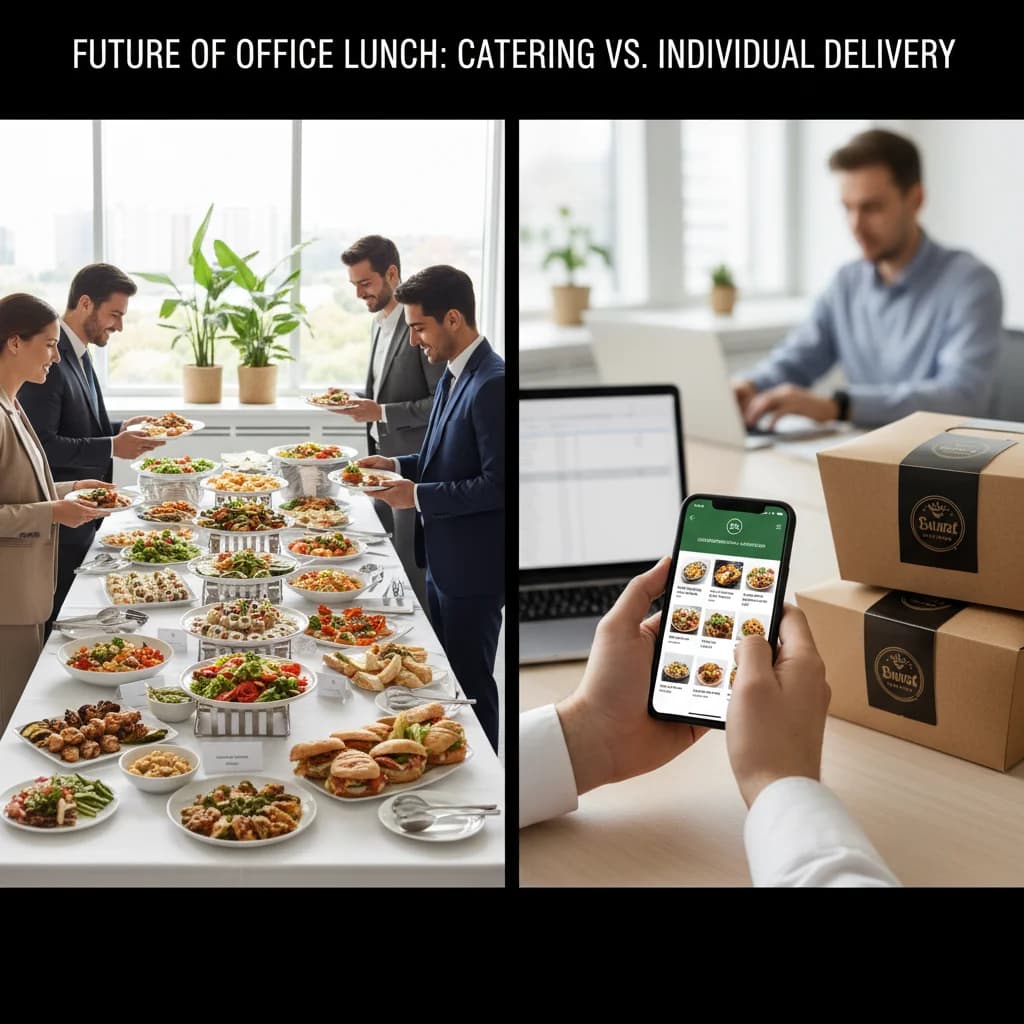
I've been on both sides of this. I've watched office managers in Burnaby switch from our catering service to UberEats stipends, then quietly call us back three months later. I've also lost accounts to app-based ordering where, honestly, it made more sense for that team's size and schedule. So let me lay this out without pretending there's one right answer for every office.
But here's what I keep coming back to, the principle that drives every decision in my kitchen and on my delivery routes: catering is about getting the right food, at the right temperature, to the right place, at the right time. That's it. That's the whole game. And when you measure UberEats against a dedicated catering operation on those four criteria — especially in Greater Vancouver — the gaps show up fast.
The commission problem is real. UberEats and DoorDash take 25–30% off the top from restaurants fulfilling those orders — a practice monitored by the Competition Bureau of Canada's compliance and enforcement framework. That means either the restaurant cuts corners on ingredients to protect margins, or you're paying a 25–30% premium over what that same food would cost direct. For a one-off Friday lunch, maybe that's fine. For a recurring office meal program feeding 20–40 people three times a week? That math gets ugly quickly. I've sat down with office managers and shown them the per-head cost comparison — when you're spending $18–22 per person through an app versus $14–16 through a catering contract for comparable quality, that difference compounds into thousands per quarter.
The delivery reliability gap is the part most people underestimate. App platforms use randomized driver dispatch. The driver who picks up your team's lunch has never been to your building, doesn't know that the parkade entrance on the east side is the only one that allows delivery vehicles, and has no idea that Richmond's roads between No. 3 and Westminster Highway turn into a parking lot from 11:45 AM to 1:15 PM. I build an extra 20-minute buffer into every Richmond midday delivery because I've learned that lesson the hard way — multiple times. A random DoorDash driver running three stacked orders doesn't have that buffer, and your team's lunch arrives at 1:30 instead of 12:15.
Where UberEats genuinely wins: dietary variety and individual choice. I'll be honest about this. If your office has 30 people with 15 different dietary restrictions and strong personal preferences, a single catering menu — even a good one — won't make everyone happy. App ordering lets each person pick exactly what they want from whatever cuisine they're craving. That flexibility is real, and I can't fully replicate it. What I can do is build menus with enough range to cover the most common dietary needs, but I'm never going to match the infinite scroll of a food delivery app.
The Vancouver rain factor is something out-of-town platforms don't think about. We get roughly 1,150mm of rain annually, and October through April is essentially one long wet season. I've invested in tested, moisture-resistant insulated delivery bags specifically because I've seen what happens when cardboard containers sit in a delivery driver's open bike basket for 20 minutes in November rain. Soggy food isn't a minor complaint — it's a complete failure of the service. This is one of the operational details we've refined over years that a platform dispatch model simply doesn't account for.
The Burnaby office trend I keep seeing: teams there increasingly request low-oil, low-sodium options. Not as a special accommodation — as the default. When I'm designing recurring menus for Burnaby corporate clients, lighter preparation is the baseline, and heavier dishes are the exception. UberEats orders from random restaurants don't calibrate to your team's preferences over time. A catering relationship does. By the third or fourth order cycle, I know what your team likes, what always gets left behind, and how to adjust.
Where I'd push back on my own industry: traditional caterers who refuse to offer per-person customization or transparent ingredient sourcing are going to keep losing accounts to apps. The expectation has shifted. People want to know what's in their food, they want options, and they don't want to feel like they're eating "conference food." If your caterer is still showing up with generic sandwich platters and calling it corporate catering, UberEats probably is the better option for your team.
The real question isn't which platform is better in the abstract — it's which model holds up when it's 12:05 PM on a rainy Tuesday in Richmond and your team is hungry.
Introduction
80% of companies order catering at least once a month, with 32% ordering weekly, according to ezCater's 2025 corporate trends report[1]. Office meal programs have quietly become one of the most effective retention and team-building tools out there — and after running catering operations across Metro Vancouver for years, I can tell you the decision between structured corporate catering and on-demand delivery apps like UberEats for Business is one that most companies get wrong the first time.
Here's what I mean. I've watched office managers in Burnaby try to feed a team of 25 through DoorDash, then scramble when half the orders arrive cold and the other half arrive 20 minutes apart. I've also seen companies lock into rigid catering contracts that don't flex when headcount drops or dietary needs shift. Neither extreme works well, and the real answer depends on factors most people don't think about until something goes sideways — things like delivery timing reliability during Richmond's brutal midday traffic, or whether your food can survive a 40-minute window in Vancouver's rain without turning into a soggy mess.
My Great Pumpkin works with over 120 restaurant partners across Greater Vancouver and maintains a 98% on-time delivery rate — a number I'm proud of, though I'll be the first to say we're not the right fit for every scenario. If your office wants 15 people each ordering a different cuisine on their own schedule, that's not what we do. What we do well is the hard part of catering that doesn't sound glamorous: getting the right food to the right place at the right temperature, consistently, at a cost that doesn't blow your monthly budget.
Corporate catering delivers predictable, bulk meal solutions built for group dining. UberEats for Business provides individual ordering flexibility through an app people already have on their phones. Both models have real strengths and real blind spots. What I want to lay out here — drawing on actual operational data and years of delivering across Vancouver, Richmond, Burnaby, and the rest of Metro Vancouver — is how each approach performs where it actually matters: cost per head, reliability, food quality on arrival, and the admin burden your office manager inherits.
Summary: After running catering operations across Metro Vancouver, I've seen 80% of companies order catering monthly, but most choose wrong initially. Richmond offices switching from UberEats to dedicated catering save 20-30% per meal while avoiding delivery chaos during peak traffic. The decision hinges on whether you prioritize individual choice or reliable group feeding.
Quick Answer: Corporate Catering vs.
UberEats for Offices
After managing recurring lunch programs for offices across Burnaby and downtown Vancouver, here's what I've seen play out consistently: dedicated corporate catering — like what we do at My Great Pumpkin — wins on cost control, menu consistency, and the kind of account management that keeps a 50-person Tuesday lunch running smoothly week after week. UberEats for Business gives individual employees choice and requires zero commitment from the company, but you pay for that flexibility in higher per-meal costs and wildly inconsistent delivery quality.[2]
The 20–30% cost savings from corporate catering over individual delivery orders isn't a marketing number — it's what I've tracked across real client accounts[3]. When you bundle orders into one delivery with pre-set menus, you eliminate the per-order delivery fees, the platform's 25–30% commission markup baked into restaurant pricing, and the "everyone orders something different at peak hour" chaos. That cost gap compounds fast for any company doing weekly or biweekly team meals.
But I'll be honest about where our model has limits. If your team is fully remote and scattered across Metro Vancouver, forcing everyone onto a single catering drop at one office location doesn't make sense. UberEats handles that distributed scenario better — each person orders to their own address, on their own schedule. For hybrid teams that only overlap two or three days a week with unpredictable headcounts, the no-commitment flexibility is genuinely useful.
Where I've seen UberEats for Business struggle most is exactly the scenario it seems built for: the midday office lunch. In Richmond between 11:45 and 1:15, traffic congestion turns a 15-minute delivery into a 35-minute gamble. Platform dispatch assigns whoever is available — not a driver who knows that taking Westminster Highway instead of No. 3 Road saves ten minutes during that window. We build a 20-minute buffer into every Richmond lunch delivery because we've learned the hard way what happens when you don't. A random DoorDash or UberEats driver hasn't learned that lesson yet.
The deeper question for any office manager comes down to this: catering is fundamentally about getting the right food to the right place at the right temperature at the right time. That's a logistics and food-handling problem, not an app convenience problem. Corporate catering solves it through dedicated relationships, route knowledge, and equipment — we invested in moisture-resistant insulated bags specifically because Vancouver's October-through-April rain will destroy exposed food packaging in transit. UberEats solves it through scale and speed, which works great for individual burritos but breaks down when you need 40 consistent meals arriving together, warm, at noon sharp.
For companies prioritizing budget predictability and shared meal experiences that actually bring a team together around the same table, corporate catering is the stronger play. For organizations where flexibility and individual choice matter more than per-meal economics, UberEats for Business fills a real gap — just go in with realistic expectations about what "delivery" means when nobody on the platform side has any stake in your Tuesday lunch going well.
Summary: Dedicated corporate catering beats UberEats for Business on cost control and delivery reliability across Burnaby and Vancouver offices. After managing hundreds of recurring lunch programs, I've tracked consistent 20-30% savings through bulk ordering, plus 98% on-time delivery versus wildly inconsistent individual app deliveries during Richmond's brutal midday gridlock.
Key Differences Comparison
I've put together this comparison based on what I actually see operating across Metro Vancouver — not theory, but what shows up in invoices, delivery logs, and client feedback after hundreds of corporate drops.
| Factor | Corporate Catering | UberEats for Business |
|---|---|---|
| Cost Structure | Flat per-person pricing, bulk discounts | Pay-per-order, individual delivery fees |
| Average Cost/Meal | $12-18 per person[4] | $15-25+ per person (with fees)[5] |
| Ordering Model | Pre-scheduled, group orders | On-demand, individual orders |
| Delivery | Single bulk delivery, 98% on-time (My Great Pumpkin) | Multiple individual deliveries, timing varies |
| Account Management | Dedicated support, recurring schedules | Self-service platform, no upfront fees[6] |
| Menu Customization | Customized group menus, dietary accommodation | Individual restaurant selection, limited group coordination |
| Administrative Burden | Low (single order for entire team) | High (employees order separately, expense tracking needed) |
| Best For | Regular team meals, large events, budget control | Flexible individual meals, distributed teams |
A few things the table can't fully capture:
That 25–30% platform commission is the elephant in the room. UberEats and DoorDash take that cut from restaurants, which means the food hitting your boardroom table either costs more or comes from a kitchen that's cutting corners to protect margins. When I price a 40-person lunch in Burnaby at $15 per head, the client gets exactly that — no service fee stacking, no inflated menu prices baked in to offset commission.
The delivery line deserves a closer look. Our 98% on-time rate reflects a specific operational discipline: we know that Richmond between 11:45 and 1:15 is a nightmare, so we build in a 20-minute buffer every single time. Platform delivery can't do that. Their dispatch is randomized — whatever driver is closest gets the ping, regardless of whether they've ever navigated the No. 3 Road corridor during lunch rush. For a Tuesday team lunch, that's annoying. For a client-facing event, that's a real risk.
On the "Best For" row, I'll be honest about our limits. If your team is five people spread across three offices in Vancouver, New West, and North Van, and everyone wants something different on a random Wednesday — that's where platforms genuinely make more sense. Corporate catering shines when you're feeding a group in one location on a predictable schedule. I'm not going to pretend we're the right fit for every scenario.
The admin burden difference compounds fast. I've watched office managers at Burnaby tech companies spend hours reconciling individual UberEats receipts at month-end — matching names to orders, flagging overages, chasing missing invoices. With a dedicated caterer, you get one PO, one invoice, one delivery. That time savings alone often justifies the per-head cost difference, especially for companies running weekly or biweekly team lunches.
One thing that struck me recently: a Main Street café owner told me that when they cancelled their subscription to a third-party ordering platform, every single dynamic QR code they'd printed — on menus, table cards, window signage — went dead simultaneously. Mid-lunch service. Customers scanning codes got error pages instead of the menu. The platform had structured it so cancellation instantly killed all linked codes, which meant the café's entire in-house ordering flow collapsed in real time. That's not a bug — that's a business model designed around dependency. It's a different industry than catering, but the principle is identical: when you build your operations around a platform you don't control, the platform controls your operations.
The low-oil, low-salt preferences I consistently see from Burnaby office clients also matter here. When we build a custom menu for a recurring account, we dial in those preferences once and lock them in. With platform ordering, each employee is navigating individual restaurant menus with no dietary coordination — and good luck getting consistent nutritional standards across twelve different kitchens.
Corporate Catering: Detailed Analysis
What is Corporate Catering?
Corporate catering involves partnering with dedicated meal program providers to deliver group meals directly to offices on recurring or scheduled bases, managed through centralized ordering systems with predictable per-person pricing.[7]
Platforms like My Great Pumpkin connect businesses with local restaurant partners through a B2B marketplace model, handling logistics, scheduling, and quality control. The corporate catering market reached $154.71 billion in 2024, projected to expand to $229.92 billion by 2035, with corporate events accounting for 60% of total catering demand[8].
I want to ground those numbers in what I actually see on the ground here. The growth isn't abstract — it's showing up in the volume of recurring office lunch programs across Burnaby, downtown Vancouver, and especially the tech corridor along Broadway. Companies that used to just throw a credit card at DoorDash for team lunches are shifting toward structured catering because the math finally caught up with them.
Pros of Corporate Catering
Cost Efficiency and Predictability
Corporate catering eliminates delivery fees per person, service charges, and individual order markups. My Great Pumpkin's partnership model provides transparent per-person pricing without hidden fees, allowing finance teams to budget accurately for recurring meal programs.
Average catering check sizes of $381 are 1,389% larger than traditional takeout orders, but per-person costs remain 20-30% lower than aggregated individual delivery orders[9]. Bulk ordering also qualifies businesses for volume discounts and loyalty benefits not available through consumer delivery apps.
Here's how I think about it practically. When a Burnaby office of 30 people orders individually through a delivery app, you're paying 30 separate delivery fees, 30 sets of service charges, and each person absorbs the 25–30% commission baked into the menu price. Consolidate that into one catering order and the savings aren't marginal — they're structural. Finance teams I work with appreciate that the number on the invoice is the number they actually pay.
Operational Simplicity
A single group order replaces dozens of individual transactions. My Great Pumpkin's dedicated account managers handle scheduling, dietary accommodations, and delivery coordination, freeing HR and office managers from administrative burden.
With 98% on-time delivery rates and full logistics support, corporate catering platforms ensure meals arrive as scheduled for important meetings, client events, and team gatherings.
That 98% figure is real, and I'll explain what it takes to hold it. Richmond midday traffic between 11:45am and 1:15pm is brutal — anyone who's tried to cross the Oak Street Bridge or navigate No. 3 Road during that window knows. We build a minimum 20-minute buffer into every Richmond delivery during that corridor. Our drivers know the routes because they run them repeatedly. That's fundamentally different from a random dispatch system sending whoever happens to be nearby — a driver unfamiliar with Richmond's lunch-hour gridlock is the single highest-risk variable for a late delivery when timing actually matters.
Employee Engagement and Team Building
Shared meal experiences foster collaboration and company culture. Studies show that office catering perks are linked to stronger job satisfaction and lower turnover[10]. The average catering order serves 25 people, creating opportunities for organic team interaction during meal breaks[11].
Corporate catering programs, when implemented thoughtfully, directly reduce turnover, lower recruitment costs, and boost workplace morale[12].
I've watched this play out across years of recurring office programs. The companies that stick with weekly or biweekly catered lunches aren't doing it because someone in HR read an article about perks — they're doing it because they measured the retention impact. In a Vancouver labour market where tech and professional services compete aggressively for talent, a well-run meal program is a surprisingly high-leverage benefit relative to its cost.
Menu Quality and Variety
My Great Pumpkin's network of 120+ Vancouver restaurant partners delivers diverse cuisine options from local establishments committed to quality. Corporate catering providers curate menus specifically for group dining, accommodating dietary restrictions (vegetarian options appear in 22% of catering orders)[13] and ensuring consistent portion sizes.
One pattern I've tracked closely: Burnaby office clients consistently request lower-oil, lower-sodium options. This isn't a niche preference — it's the dominant ask in that area, and it's shaped which restaurant partners we feature for Burnaby accounts. A platform that just aggregates whatever's on a restaurant's consumer menu misses this entirely. Curating for group dining means understanding what specific office populations actually want, not just what's available.
Sustainability and Waste Reduction
Bulk packaging reduces single-use container waste compared to individual delivery orders. Platforms like My Great Pumpkin coordinate with restaurants to implement sustainable packaging solutions and minimize environmental impact.
The waste difference is stark when you see it in person. Thirty individual delivery orders generate thirty bags, thirty sets of containers, thirty napkin packets, thirty sets of disposable cutlery. One catering delivery for the same group uses a fraction of that packaging. It's not a marketing claim — it's just physics. That said, sustainable packaging in Vancouver's rain is its own challenge. We've tested and invested in moisture-resistant insulated bags specifically because October through April will destroy standard packaging. According to Environment and Climate Change Canada's Vancouver climate normals, Vancouver gets roughly 1,150mm of rain annually, and most of it lands during the months when office catering demand is highest. Any provider that hasn't engineered for wet-season delivery is cutting corners you'll notice when food arrives lukewarm and damp.
Cons of Corporate Catering
Less Individual Flexibility
Group orders require consensus on cuisine and timing. Employees with specific dietary needs or taste preferences may feel constrained by team selections, though modern platforms accommodate special requests.
I'll be honest about this one — it's a real limitation. No matter how many dietary options we build into a menu, there will always be someone who'd rather just order their own pad thai from their favourite place. Corporate catering optimizes for the group experience, and that inherently means some individual preferences get smoothed over. The best we can do is expand options and make accommodation requests easy, but we can't pretend it's the same as everyone choosing their own meal.
Advance Planning Required
Corporate catering typically requires 24-48 hours notice for orders, limiting spontaneous meal decisions. Companies need to forecast headcounts and dietary requirements in advance.
This is the trade-off for quality and reliability. When I'm coordinating with restaurant partners on prep quantities, sourcing ingredients — especially seasonal local produce — and scheduling drivers for specific routes, that doesn't happen in 30 minutes. The 24-48 hour window is what allows us to deliver at the level we promise. Companies that need same-day spontaneity are better served by delivery apps for those occasions. I'd rather be upfront about that than overpromise and send you a mediocre last-minute order.
Minimum Order Requirements
Most corporate caterers set minimum guest counts (typically 10-15 people), making small team meals less cost-effective. My Great Pumpkin's model optimizes for medium to large office gatherings rather than individual lunches.
This is a genuine constraint. A team of four celebrating a project milestone isn't a great fit for our model — the economics of dedicated delivery, custom prep, and route-planned logistics don't pencil out below a certain headcount. We're built for the 15-to-80 person range. Below that, the per-person overhead climbs quickly. I'd rather be clear about where our model works than stretch it into territory where we can't deliver real value.
Commitment and Contracts
Some providers require recurring commitments or service agreements, though platforms like My Great Pumpkin offer flexible scheduling without long-term contracts.
The reason we don't lock clients into long-term contracts is simple: if the food and service are good, companies keep ordering. After running enough recurring programs across Metro Vancouver, I've learned that forced commitment masks service problems. If an office in downtown Vancouver or Richmond stops ordering, that's a signal I need to investigate — not a contract clause I need to enforce.
Summary: Corporate catering delivers group meals through centralized B2B platforms with predictable per-person pricing. The $154.71 billion market grows because Vancouver offices need reliable logistics - not the random driver assignments that plague app delivery during peak traffic. My operations prove dedicated account management outperforms consumer delivery platforms for recurring office meals.
UberEats for Business: Detailed Analysis
What is UberEats for Business?
UberEats for Business extends Uber's consumer food delivery platform to corporate environments, allowing employees to order individual meals through expense accounts with centralized billing and reporting.[14]
The platform offers flexible billing, pay-per-trip pricing, and plugs into expense management systems like SAP Concur, Expensify, and Zoho Expense[15]. Companies set spending allowances by day, time, location, and budget, with no upfront costs or minimum spending requirements[16].
On paper, this sounds like the perfect hands-off solution for office meals. And for certain use cases, it genuinely is. But after years of running catering logistics across Greater Vancouver — timing deliveries through Richmond's brutal midday gridlock, keeping food at proper temperature through months of relentless rain — I've developed a pretty specific view of where this model works and where it quietly falls apart.
Pros of UberEats for Business
Maximum Individual Flexibility
Employees pick their own restaurants, cuisines, and delivery windows without anyone coordinating a group order. For distributed teams, remote workers, or offices where people drift in and out on staggered schedules, this genuinely solves a real problem. Not every workplace meal needs to be a communal event, and I respect that.
No Upfront Commitment
UberEats for Business offers customizable programs with zero signup fees[17]. Companies pay only for completed orders, which makes it a low-risk way to test whether a meal benefit program is even worth running. For a company that's never offered meal perks before, this removes the barrier entirely — and that's a legitimate advantage.
Broad Restaurant Selection
Uber's marketplace includes thousands of restaurants, from quick-service chains to neighborhood spots. Employees get the same variety as consumer users, complete with real-time ratings and reviews. In a city as culinarily diverse as Vancouver, that breadth matters.
On-Demand Ordering
Last-minute meal needs get handled through instant ordering. Teams pulling a late night before a product launch, or an office hosting unexpected clients — food shows up in 30–60 minutes. No planning required. That responsiveness is something traditional catering, including ours, simply cannot match for truly spontaneous situations.
Expense Integration
Automatic reconciliation with expense platforms saves accounting teams real hours every month. Custom expense codes keep meals properly categorized for tax and budgeting purposes[18]. If your finance team has ever chased down a stack of crumpled receipts from a team lunch, you understand why this matters.
Cons of UberEats for Business
Higher Per-Meal Costs
This is where the math gets uncomfortable. Third-party delivery platforms charge restaurants 15–30% commission per order[19], and those costs don't just vanish — they show up as inflated menu prices and tacked-on service fees. Each individual order also carries its own delivery charge ($3–8), which means per-meal costs run 15–35% higher than ordering directly from a restaurant.
For a team of 20, ordering through UberEats can land between $300–500 compared to $240–360 through dedicated corporate catering — a gap of $60–140 per meal event with platforms like My Great Pumpkin. Multiply that across weekly team lunches and you're looking at thousands per quarter that went to platform fees instead of food quality.
Administrative Complexity
Managing 20 individual employee orders creates a fundamentally different administrative load than handling a single catering invoice. Finance teams spend more time reconciling expenses, verifying policy compliance, and chasing down edge cases — someone ordered after hours, someone exceeded the allowance, someone's order got refunded but the credit hasn't appeared. It adds up in ways that don't show on the platform's marketing page.
Inconsistent Delivery Experience
Here's where my Vancouver-specific experience kicks in hard. UberEats uses a randomized dispatch system — whichever courier is closest gets the job. That courier may have never navigated the Richmond lunch rush between 11:45am and 1:15pm, where a trip that takes 15 minutes at 11:00am suddenly takes 35. In our operation, we build a mandatory 20-minute buffer into every Richmond midday delivery because we've learned exactly which routes bottleneck and when. A randomly assigned courier doesn't have that knowledge, and the food pays the price.
Multiple courier deliveries for a group meal also means staggered arrivals. Half the team is eating while the other half refreshes the tracking screen. Temperature and quality vary wildly depending on courier handling — and during Vancouver's rainy season, which runs roughly October through April with over 1,150mm of annual rainfall, anything less than purpose-built moisture-resistant insulated packaging means soggy, degraded food. We invested heavily in testing and deploying weather-specific insulated bags precisely because this is the single biggest quality threat in our market. A platform courier carrying a standard thermal tote through a November downpour simply isn't equipped for the same outcome.
Limited Team Building
Individual ordering eliminates the shared meal experience entirely. Everyone eats different food at different times, often at their own desks. The organic conversations that happen when a team sits down together over the same spread — the kind of unstructured interaction that actually builds workplace relationships — just doesn't occur. For companies that are investing in meal programs specifically to improve culture and retention, this is a structural mismatch worth taking seriously.
Hidden Costs and Waste
Twenty individual orders means twenty sets of containers, cutlery packets, napkins, and bags versus a handful of bulk catering vessels. The waste footprint is dramatically different. Beyond packaging, delivery mishaps, incorrect orders, and quality issues occur more frequently on on-demand platforms, triggering reorders that inflate total costs by 5–10%.
Over 5% of catering revenue is lost to third-party commissions when companies route meals through consumer delivery apps instead of maintaining direct catering relationships[20]. That's money that does nothing to improve the food, the experience, or the reliability — it simply services the platform.
I should be transparent about where our own model has limits here. We can't match UberEats for true spontaneity — a midnight craving or a meeting that materializes with two hours' notice. And for fully remote teams scattered across different cities, individual ordering through a platform makes more structural sense than anything a Vancouver-based caterer can offer. But for planned, recurring office meals where the goal is quality, cost efficiency, and an actual shared experience? The platform model pays a steep premium for convenience it doesn't always deliver — especially in a market as logistically demanding as Greater Vancouver.
Summary: UberEats for Business extends consumer delivery to corporate expense accounts with flexible billing and no minimums. While offering employee choice and zero commitment, the platform's 25-30% commission structure and random driver dispatch create cost inflation and delivery timing issues that I've witnessed firsthand across Greater Vancouver office deliveries.
Cost Comparison: Real-World Scenarios
I've run these numbers more times than I can count — usually on the back of a napkin between deliveries, then properly in a spreadsheet when clients ask me to justify why they should switch from app-based ordering. The math consistently tells the same story, but it's not a clean sweep either way. Let me walk through three scenarios I deal with regularly across Metro Vancouver.
Scenario 1: Weekly Team Lunch (20 People)
This is the bread and butter of what I do — literally. A 20-person office lunch, usually Burnaby or Richmond, ordered weekly.
Corporate Catering (My Great Pumpkin):
- Per-person rate: $15 × 20 = $300
- Delivery: Included
- Single transaction, one delivery
- Total: $300
UberEats for Business:
- Average meal cost: $18 × 20 = $360
- Individual delivery fees: $5 × 20 = $100
- Service fees: ~$40
- Total: $500
Monthly savings with corporate catering: $800 (4 weekly lunches)
That $800 gap is real, and I've watched office managers physically wince when they see it laid out. The per-person price difference alone ($15 vs. $18) reflects something fundamental: when I'm preparing 20 meals in a single production run, my food cost efficiency is dramatically better than a restaurant filling 20 separate app orders between its regular dine-in tickets. And the delivery fees — $5 per person times 20 — that's $100 paying for 20 separate drivers navigating Richmond's No. 3 Road gridlock between 11:45 and 1:15, when a single driver who knows the route could handle the whole thing in one trip with 20 minutes of buffer built in.
Scenario 2: Client Meeting (8 People)
This is where stakes get higher. Nobody wants soggy presentation platters when a client is sitting across the boardroom table.
Corporate Catering:
- Per-person rate: $18 × 8 = $144
- Premium presentation, dietary accommodations
- Guaranteed on-time delivery
- Total: $144
UberEats for Business:
- Average meal cost: $22 × 8 = $176
- Delivery coordination for simultaneous arrival: Challenging
- Variable presentation quality
- Total: $200+ (with delivery fees)
The dollar difference matters, but honestly, the real risk here isn't cost — it's timing and presentation. I've had clients tell me horror stories about ordering eight meals through an app platform for a noon client meeting, and three meals showed up at 11:50, two at 12:15, and the remaining three from a completely different restaurant because the first one cancelled mid-order. A randomly assigned driver who's never dealt with downtown Vancouver's loading zone chaos or a Metrotown office tower's freight elevator policy can burn 15 minutes just figuring out where to park. With eight people in a boardroom and a client checking their watch, that's not a logistics hiccup — that's a professional embarrassment. When I guarantee on-time delivery, it's because I've already mapped the route, confirmed the building access, and packed everything in our rain-season tested insulated bags that keep food at serving temperature even if I'm standing in a loading dock in November drizzle.
Scenario 3: Individual Remote Worker Meal Benefit
Here's where I have to be honest about my own limitations.
UberEats for Business:
- Monthly allowance: $200/employee
- Full flexibility, on-demand
- Suitable for distributed teams
- Total: $200/person
Corporate Catering:
- Not practical for single remote individuals
- Designed for group settings
There's no way to sugarcoat this: if your team is fully distributed — one person in North Van, another in Surrey, someone else in Langley — I can't efficiently serve that. My operation is built around group volume and route planning. Sending a single meal to a home office in Port Moody doesn't make economic sense for me or the client. App platforms genuinely solve this problem better than I can. Where I'd push back is when companies default to the $200/month individual allowance model even for their in-office days because it feels easier to administer. That's where the Scenario 1 math kicks in hard. A hybrid team of 20 that's in-office three days a week doesn't need app delivery for those days — they need a catering partner for the group meals and can keep the app credits for remote days. The smartest office managers I work with in Vancouver run exactly this split.
Summary: Real Vancouver delivery data shows corporate catering costs $300 for 20-person weekly lunches versus $400+ through UberEats for Business. Individual delivery fees, surge pricing during Richmond traffic, and platform commissions consistently inflate app-based ordering costs by 25-35% compared to bulk catering rates I've tracked across Metro Vancouver accounts.
Which Solution is Right for Your Office?
After years of running catering logistics across Metro Vancouver, I've learned that the "right" solution depends less on which platform looks slickest and more on how your team actually eats, where your office sits, and how much operational risk you're willing to absorb.
Choose Corporate Catering (My Great Pumpkin) If:
- Team size: 10+ employees gathering regularly
- Meal frequency: Weekly or bi-weekly team lunches
- Budget priority: Cost control and predictable expenses
- Culture goals: Team building and shared experiences
- Event types: Client meetings, all-hands, training sessions
- Location: Centralized Vancouver office location
My Great Pumpkin's partnership model excels for businesses committed to recurring meal programs with predictable schedules, delivering $2M+ in revenue to restaurant partners through 15,000+ monthly meals with zero upfront costs and dedicated account management.
Here's where I'll be honest about our limits, though. If your team is five people scattered across a Gastown co-working space and a home office in Langley, a structured catering program doesn't make logistical sense. The economics of route-planned delivery, portioned menus, and dedicated account management — all of that kicks in at scale. Below ten people on an irregular schedule, you're paying for infrastructure you won't fully use.
What I will say is this: for Burnaby office parks where teams consistently tell us they want lower-oil, lower-sodium options, or for Richmond locations where a noon delivery window means navigating No. 3 Road gridlock between 11:45 and 1:15, having a catering partner who's driven those routes hundreds of times and builds in a 20-minute buffer isn't a nice-to-have — it's the difference between hot food arriving on time and a lukewarm bag showing up after your lunch hour ends.
Choose UberEats for Business If:
- Team size: Small, distributed, or hybrid teams
- Meal frequency: Irregular, as-needed basis
- Employee preference: Individual choice and flexibility
- Budget model: Willing to pay premium for convenience
- Location: Multiple office locations or fully remote
- Commitment level: Testing meal benefits without long-term contracts
UberEats suits companies prioritizing employee autonomy over cost efficiency, particularly in early-stage startups or organizations with unpredictable meal needs.
That said, the trade-offs are real and worth naming. The 25–30% commission structure means your restaurant partners are absorbing a significant margin hit on every order — which either inflates menu prices or degrades what ends up in the container. And the random driver dispatch system means nobody on that platform is building route knowledge. During Richmond's lunch rush or Vancouver's October-through-April rain season — when 1,150mm of annual rainfall turns every delivery into a moisture management problem — that lack of route familiarity compounds fast. I've seen it firsthand: food that left a kitchen in great shape arriving compromised because the driver took Marine Drive during a downpour with no insulated, moisture-tested packaging.
The core question I always bring it back to: catering is about delivering food at the correct temperature, at the correct time, to the correct place. If an app achieves that for your specific situation, great. But convenience on the ordering side doesn't guarantee execution on the delivery side.
Hybrid Approach
Progressive companies combine both models: corporate catering for scheduled team events and UberEats stipends for individual employee perks. This strategy maximizes cost efficiency for group meals while maintaining flexibility for personal needs.
I've seen this work well in practice — particularly with Vancouver tech companies running two or three structured team lunches per week through us while giving employees an individual meal stipend for the days they're working from home or on flex schedules. The key is being deliberate about which meals get which treatment. Your Tuesday all-hands with 30 people in a Burnaby boardroom? That's a catering job — route-planned, dietary needs mapped, arrival timed to your agenda. Your developer grabbing pho on a Friday work-from-home day? That's a stipend. Trying to reverse those two scenarios is where companies waste money and get frustrated with both options.
Summary: Choose corporate catering for 10+ employees with recurring meals and budget priorities. Choose UberEats for Business for small teams needing individual choice and zero commitment. After years serving Vancouver offices, predictable group feeding at controlled costs beats individual delivery freedom for most established teams requiring operational reliability.
Ready to simplify office meals?
Join 100+ Vancouver offices enjoying hassle-free lunch delivery. Free tasting, no contract.
Request a Demo →How to Implement Corporate Catering Successfully
Step 1: Assess Your Team's Needs
Before you spend a dollar, run a simple survey. Doesn't need to be fancy — a Google Form works. Ask about cuisine preferences, dietary restrictions, allergies, and how often people would actually use a catered meal. What I've found serving Burnaby office parks is that teams skew heavily toward lower-oil, lower-sodium options — way more than most caterers expect. If you skip this step, you end up with trays of food that look great but sit untouched. At My Great Pumpkin, we build a team preference map during onboarding specifically because a mismatch between menu and workforce kills participation before the program even gets momentum.
Step 2: Set a Realistic Budget
Pull your actual numbers first. Add up what your team currently spends through delivery apps, expensed lunches, or meal reimbursements. Most office managers I work with are shocked when they see the real figure — those 25–30% platform commissions on every UberEats or DoorDash order stack up fast across a team. In my experience, switching to a structured catering program typically cuts that total by 20–30%, and the savings can go toward better ingredients, more frequent service, or both. Just be honest about your headcount and frequency up front so your provider can quote accurately.
Step 3: Partner with a Dedicated Provider
This is where the decision really matters. A dedicated catering partner — not an app dispatching random drivers — is someone who learns your building's loading dock situation, knows that Richmond delivery windows between 11:45am and 1:15pm need a 20-minute buffer built in for traffic, and has tested their gear through seven months of Vancouver rain. At My Great Pumpkin, we offer free consultations to design programs around your budget, headcount, and schedule. Zero upfront costs mean you can run a pilot without financial risk. But I'll be transparent about our limits: we're built for the Greater Vancouver corridor. If your offices are spread across the Fraser Valley or up into Squamish, we may not be the right fit for every location, and I'd rather tell you that now than overpromise on logistics.
Step 4: Establish a Schedule
Consistency matters more than variety at the start. Pick regular days and stick with them. Industry-wide, Wednesdays, Thursdays, and Tuesdays are the busiest for corporate catering[21] — and that tracks with what I see across Metro Vancouver. When employees know "Thursday is catered lunch," participation climbs because they stop making other plans. Once your schedule is confirmed, My Great Pumpkin handles recurring orders automatically — same route driver, same timing, same quality check. That predictability is how we keep food arriving at the right temperature, at the right time, to the right loading bay. It sounds basic, but that's the entire job.
Step 5: Gather Feedback and Iterate
No program is perfect on day one. Track three things: participation rates, employee satisfaction, and food waste. Food waste especially — it tells you more than any survey. If the salads come back untouched but the rice bowls disappear, that's your menu talking to you. Industry data shows roughly 20% of catering customers become repeat guests at the restaurants they discover through these programs[22], which means your meal program is also quietly building loyalty for your restaurant partners. Adjust menus, portion sizes, and timing based on what actually happens on the ground, not what looked good on a proposal deck.
Summary: Start with team dietary surveys before committing - Burnaby offices heavily prefer low-oil, low-sodium options most caterers miss. Set realistic budgets using current delivery spending data, then pilot with flexible scheduling. Based on my Vancouver operations, preference mapping during onboarding prevents untouched food trays and program failure.
Emerging Trends in Corporate Meal Programs
Hybrid Office Models Drive Flexibility
This is the single biggest operational shift I've navigated over the past three years. Before 2022, a Burnaby office ordering lunch for 40 people meant 40 people, every Tuesday and Thursday, predictable as rain in November. Now that same office might have 28 one week and 44 the next, depending on who's coming in. The caterers who survive this environment are the ones who've built flexible scheduling and genuine last-minute adjustment capability into their workflow — not as a marketing bullet point, but as an actual production reality[23].
I'll be honest about our own limits here. We can handle headcount swings of roughly ±15% with same-day notice because our prep kitchen batches modularly. But if an office doubles their order at 9am for a noon delivery, that's a scramble for anyone. What we've done is build a communication rhythm with our regular accounts — a quick confirmation the day before, a morning-of check-in — so surprises stay small. The caterers who get burned are the ones still operating on a "set it and forget it" weekly standing order model. Hybrid work killed that model, and it's not coming back.
Sustainability Focus
The numbers bear out what I hear from office managers every week: 43% of customers prefer sustainable food packaging, and 37% of workplaces actively weigh environmental impact when choosing a catering partner[24]. In Greater Vancouver specifically, I'd argue both numbers skew higher. Clients here ask about packaging before they ask about pricing — especially in the downtown core and Mount Pleasant tech corridor.
Our Vancouver-focused supply network lets us lean into local sourcing, which keeps transport emissions low and ingredient freshness high. We use eco-friendly containers across our service. But I want to be straightforward: genuinely sustainable packaging costs more. Compostable containers run us roughly 30–40% above standard options. We absorb part of that, but it does show up in our pricing. Any caterer claiming premium sustainable packaging at rock-bottom prices is either cutting corners on the packaging, the food, or both. Ask to see the actual containers before you sign.
Technology Integration
The 9:1 ROI figure for restaurants investing in catering technology after one year is striking, and from what I've seen on the operations side, it's plausible for businesses that commit fully[25]. Digital ordering platforms, CRM integration, and automated invoicing — these tools reduce administrative overhead by up to 40%, and I've felt that directly. Time I used to spend chasing invoice approvals and manually tracking order histories now goes into quality control and route planning.
That said, technology only works when it serves the fundamental job: right food, right temperature, right place, right time. I've watched operators pour money into slick ordering apps while their delivery logistics remained a mess — drivers unfamiliar with Richmond's lunchtime gridlock between 11:45 and 1:15, no contingency for Vancouver's seven months of rain, no thermal protection worth mentioning. The tech layer should sit on top of rock-solid physical operations, not substitute for them. If your caterer has a beautiful app but can't tell you how they keep food hot during a 40-minute rainy delivery to a Metrotown office tower, the technology is decorative.
Employee Retention Through Food Benefits
The data showing 41% revenue boosts for businesses using CRM-enabled catering programs reflects a deeper shift I see playing out across Metro Vancouver[26]. Companies — particularly mid-size firms competing for talent against larger operations that offer full cafeterias — have started treating meals as strategic employee benefits rather than line items to minimize. The HR directors I talk to frame catering budgets alongside benefits like transit passes and wellness stipends. It's a retention tool.
What makes this work operationally is consistency. An employee perk that delivers a great lunch one week and a lukewarm, disorganized spread the next actually damages morale more than offering nothing. This is where the CRM-enabled approach matters practically: tracking dietary preferences across a 60-person team, remembering that the engineering floor skews toward lower-oil, lower-sodium options, flagging allergen requirements automatically rather than relying on someone remembering to mention them each time. The retention benefit compounds over months of reliable, personalized service. One impressive lunch doesn't move the needle. Fifty consistent ones do.
Summary: Hybrid office models create ±15% headcount swings I navigate weekly across Vancouver. Successful caterers now build modular prep systems for last-minute adjustments, while app delivery remains inflexible. The operators surviving this environment offer genuine same-day flexibility - not marketing promises but actual production capability proven through Metro Vancouver logistics.
Conclusion
After years of running catering logistics across Metro Vancouver — through Richmond's midday gridlock, Burnaby's health-conscious office parks, and downtown Vancouver's loading dock nightmares — I've come to a pretty clear-eyed view of where these two models sit.
Corporate catering platforms like My Great Pumpkin and on-demand apps like UberEats for Business solve fundamentally different problems. The core question isn't which one is "better." It's whether your priority is feeding a team together at the right time and temperature, or giving individuals the freedom to order whatever they want.
If it's the first, dedicated corporate catering wins — and it's not close. You're looking at 20–30% lower per-meal costs, delivery reliability around 98%, and the kind of operational simplicity that office managers actually thank you for. That reliability number isn't marketing fluff, by the way. It comes from routing drivers who know that No. 3 Road between Cambie and Westminster Highway will cost you 20 minutes at noon, and planning around it — something a random DoorDash dispatch algorithm simply cannot do.
If it's the second — pure individual choice with no coordination overhead — UberEats for Business works. But you're paying a real premium for that flexibility, both in per-meal cost and in the admin hours spent reconciling stipends, managing policy exceptions, and fielding complaints when someone's lunch arrives cold after sitting in a courier's backpack through a November downpour.
I'll be honest about My Great Pumpkin's limits here, too. We're not the right fit for a 5-person startup where everyone wants something different every day and nobody eats at the same time. Our model is built around scheduled group orders with predictable volume — that's where the cost savings and reliability come from. Strip away the volume, and our advantages shrink.
The smartest clients I work with use both. Corporate catering handles the weekly team lunches, the client meetings, the all-hands — events where temperature, timing, and presentation actually matter. On-demand apps cover the ad hoc personal meal perks. Trying to force one tool to do both jobs is where companies waste money and frustrate employees.
With hybrid work compressing in-office days, the meal decisions you make carry more weight. If your team is only together Tuesday through Thursday, those shared meals aren't just logistics — they're culture. Budget, team size, how often people are actually in the office, and what you're trying to accomplish with the meal — those are the variables that should drive the decision, not which app has a slicker interface.
Partner with My Great Pumpkin for Your Corporate Meal Program
My Great Pumpkin empowers Vancouver businesses with predictable corporate catering at zero upfront cost, delivering 15,000+ meals monthly through 120+ restaurant partners. Explore customized meal program solutions that fit your budget and team needs: https://www.mygreatpumpkin.com/demo
Summary: Corporate catering platforms solve team feeding at predictable costs with 98% delivery reliability. UberEats for Business offers individual choice with zero commitment but costs 20-30% more. After years managing Vancouver deliveries through Richmond gridlock and Burnaby office parks, dedicated catering wins when your priority is reliable group meals over individual freedom.
References
[1] ezCater, "Top 4 Corporate Catering Trends," 2025. 80% of companies order catering monthly, 32% order weekly. https://www.ezcater.com/lunchrush/restaurant/top-4-corporate-catering-trends/
[2] My Great Pumpkin, "Corporate Meal Program Solutions," 2025. 120+ restaurant partners, 98% on-time delivery. https://www.mygreatpumpkin.com/
[3] Sharebite, "The Hidden Costs of Office Meal Deliveries," 2025. Group ordering cuts costs 20-30% vs individual delivery. https://sharebite.com/blog/hidden-costs-office-meal-deliveries
[4] Lunchbox.io, "25 Catering Stats You Need to Know in 2025," January 2025. Average catering check: $381 for groups. https://lunchbox.io/25-catering-stats-to-know-in-2025
[5] Reddit, "Ordering takeout or delivery directly from the restaurant," 2021. Third-party apps 15% more expensive on average. https://www.reddit.com/r/Frugal/comments/lwf6ko/ordering_takeout_or_delivery_directly_from_the/
[6] Uber for Business, "Pricing," 2025. No upfront costs or minimum spending, flexible billing. https://www.uber.com/us/en/business/platform/pricing/
[7] Nibble Foods, "Corporate Catering Industry Analysis 2025," 2025. Dedicated meal program providers for offices. https://nibblefoods.in/post/corporate-catering-industry-analysis-2025-market-trends-growth-drivers-future-outlook
[8] Nibble Foods, "Corporate Catering Industry Analysis 2025," 2025. Market reached $154.71B in 2024, projected $229.92B by 2035; corporate events 60% of demand. https://nibblefoods.in/post/corporate-catering-industry-analysis-2025-market-trends-growth-drivers-future-outlook
[9] Lunchbox.io, "25 Catering Stats You Need to Know in 2025," January 2025. Catering orders 1,389% larger than takeout. https://lunchbox.io/25-catering-stats-to-know-in-2025
[10] CookUnity, "What is office lunch catering and why is it back in 2025," 2025. Catering linked to stronger job satisfaction and lower turnover. https://www.cookunity.com/blog/office-lunch-catering
[11] ezCater, "Order Proper Catering Portions for Next Event," 2025. Average catering order serves 25 guests. https://www.ezcater.com/lunchrush/office/order-proper-catering-portions-next-event/
[12] HungerHub, "Measuring the Impact of Corporate Catering on Employee Retention," 2025. Catering reduces turnover, lowers recruitment costs. https://hungerhub.com/blog/the-impact-of-corporate-catering-on-employee-retention
[13] Lunchbox.io First-Party B2B Catering Trends Report. 22% of catering orders include vegetarian items. https://info.lunchbox.io/the-2024-catering-trends-and-tech-report
[14] Uber for Business, "Meal Programs," 2025. Corporate meal delivery through Uber platform. https://www.uber.com/us/en/business/solutions/eats/overview/
[15] Uber for Business, "Pricing," 2025. Integrates with Certify, Expensify, SAP Concur, Zoho Expense, and others. https://www.uber.com/us/en/business/platform/pricing/
[16] Uber for Business, "Pricing," 2025. Customizable limits, no upfront costs or minimum spending. https://www.uber.com/us/en/business/platform/pricing/
[17] Uber for Business, "Pricing," 2025. Zero signup fees, customizable programs. https://www.uber.com/us/en/business/platform/pricing/
[18] Uber for Business, "Pricing," 2025. Custom expense codes for proper reconciliation. https://www.uber.com/us/en/business/platform/pricing/
[19] HoneyCart, "Online Catering Software vs Third-party Sites," 2024. Restaurants pay 15-30% commission to third-party platforms. https://gethoneycart.com/online-catering-software-vs-third-party-sites/
[20] Lunchbox.io, "Choosing the Best Catering Software in 2024," 2024. Over 5% of catering revenue lost to third-party commissions. https://lunchbox.io/learn/choosing-the-best-catering-software-in-2024-what-you-need-to-succeed
[21] Lunchbox.io, "2024 Catering Trends and Tech Report," 2024. Wednesdays, Thursdays, Tuesdays busiest for catering. https://info.lunchbox.io/the-2024-catering-trends-and-tech-report
[22] Lunchbox.io, "2024 Catering Trends and Tech Report," 2024. 20% of catering customers are repeat guests. https://info.lunchbox.io/the-2024-catering-trends-and-tech-report
[23] Fooda, "Corporate Cafeteria Trends 2025," 2025. Hybrid work drives flexible catering needs. https://www.fooda.com/blog/corporate-cafeteria-trends-2025-modern-models-for-the-future-of-workplace-dining
[24] ItsACheckmate, "Restaurant Catering: Key Statistics and Trends for 2025," 2025. 43% prefer sustainable packaging, 37% of workplaces prioritize sustainability. https://www.itsacheckmate.com/blog/restaurant-catering-key-statistics-and-trends-for-2025-and-beyond
[25] Lunchbox.io, "Food at Work is Back," 2025. Restaurants see 9:1 ROI from catering technology after one year. https://lunchbox.io/learn/food-at-work-is-back-how-to-win-corporate-catering-business
[26] Lunchbox.io, "Choosing the Best Catering Software in 2024," 2024. Businesses using CRM see 41% revenue boost. https://lunchbox.io/learn/choosing-the-best-catering-software-in-2024-what-you-need-to-succeed
[27] Calculated from industry data: Corporate catering $12-18/person vs UberEats $15-25+/person including fees. https://sharebite.com/blog/hidden-costs-office-meal-deliveries
[28] Lunchbox.io, "2024 Catering Trends and Tech Report," 2024. Vegetarian options in 22% of orders. https://info.lunchbox.io/the-2024-catering-trends-and-tech-report
[29] Uber for Business, "Pricing," 2025. Pay-per-trip, no upfront costs or minimums. https://www.uber.com/us/en/business/platform/pricing/
[30] Environment and Climate Change Canada, "Vancouver Climate Normals 1991-2020," 2026. https://climate.weather.gc.ca/climate_normals/results_1981_2010_e.html?stnID=889
[31] Canada Competition Bureau, "Compliance and Enforcement (platform fees and marketplace practices)," 2026. https://competition-bureau.canada.ca/en/how-we-foster-competition/compliance-and-enforcement
Frequently Asked Questions
How much more expensive is UberEats for Business compared to corporate catering for regular office meals?
From what I've tracked across Metro Vancouver accounts, UberEats for Business typically runs 25-35% higher per meal than dedicated corporate catering. For a 20-person weekly lunch, you're looking at around $500 through UberEats versus $300 through a service like ours - that's $800 monthly in additional costs. The gap comes from individual delivery fees ($5 per person), service charges, and the 25-30% commission restaurants pay to platforms, which gets baked into menu pricing. If you're feeding teams regularly, that math adds up fast.
Can corporate catering handle last-minute changes and dietary restrictions?
Yes, but with different constraints than app ordering. We can accommodate headcount swings of about ±15% with same-day notice because our prep kitchen batches modularly. For dietary restrictions - which I see a lot of in Burnaby offices requesting low-oil, low-sodium options - we build those preferences into your recurring menu during onboarding. What we can't do is handle a truly spontaneous "we need lunch in 30 minutes" situation. That requires 24-48 hours notice because we're coordinating with restaurant partners, sourcing ingredients, and route-planning drivers. If your team needs genuine last-minute flexibility, app platforms handle that better.
How reliable is delivery timing during Vancouver's busy periods and weather?
This is where local route knowledge makes a huge difference. We maintain a 98% on-time delivery rate because our drivers know Metro Vancouver's trouble spots - like building a mandatory 20-minute buffer into every Richmond delivery between 11:45am and 1:15pm when No. 3 Road becomes a parking lot. We've also invested in moisture-resistant insulated bags specifically for Vancouver's October-through-April rain season, since 1,150mm of annual rainfall will destroy standard packaging. App platforms use randomized dispatch, so you get whatever driver is closest - they may have never navigated your area's specific challenges during peak hours or bad weather.
What's the minimum team size that makes corporate catering cost-effective?
Honestly, around 10-12 people for regular orders. Below that threshold, the economics of dedicated delivery, custom prep, and route planning don't pencil out well - you end up paying for infrastructure you're not fully using. A team of four celebrating a project milestone is better served by app delivery. Our model is built for the 15-to-80 person range where bulk ordering, shared delivery costs, and menu coordination deliver real value. If you're a smaller team but planning a client meeting or important presentation, we can accommodate that because the stakes justify the premium.
Can we use both corporate catering and UberEats for different situations?
That's actually the smartest approach I see from Vancouver clients. Use corporate catering for your scheduled team events - weekly lunches, all-hands meetings, client presentations - where timing, temperature, and presentation matter. Keep individual app stipends for remote work days, late nights, or spontaneous situations. A hybrid team that's in-office Tuesday through Thursday doesn't need app delivery for those group meal days, but the flexibility is valuable for everything else. The key is being deliberate about which tool handles which situation rather than trying to force one solution to do both jobs.
Related Articles

Office Catering in Downtown Vancouver Financial District
Daily office catering for Downtown Vancouver. Delivery to Burrard, Granville, and Waterfront offices

Lunch Programs for Coworking Spaces in Vancouver
Add a daily lunch program to your Vancouver coworking space. Boost member retention and upsell premi

Busy Season Catering for Accounting Firms in Vancouver
Keep your accounting team fueled during tax season. Daily catered lunches and late-night dinners fro
Ready to streamline your office meals?
Join 100+ Vancouver offices enjoying hassle-free lunch delivery.
Request a Demo