How to Handle 10 Dietary Restrictions in One Office
Managing 10+ dietary restrictions in office meal programs doesn't have to be overwhelming.
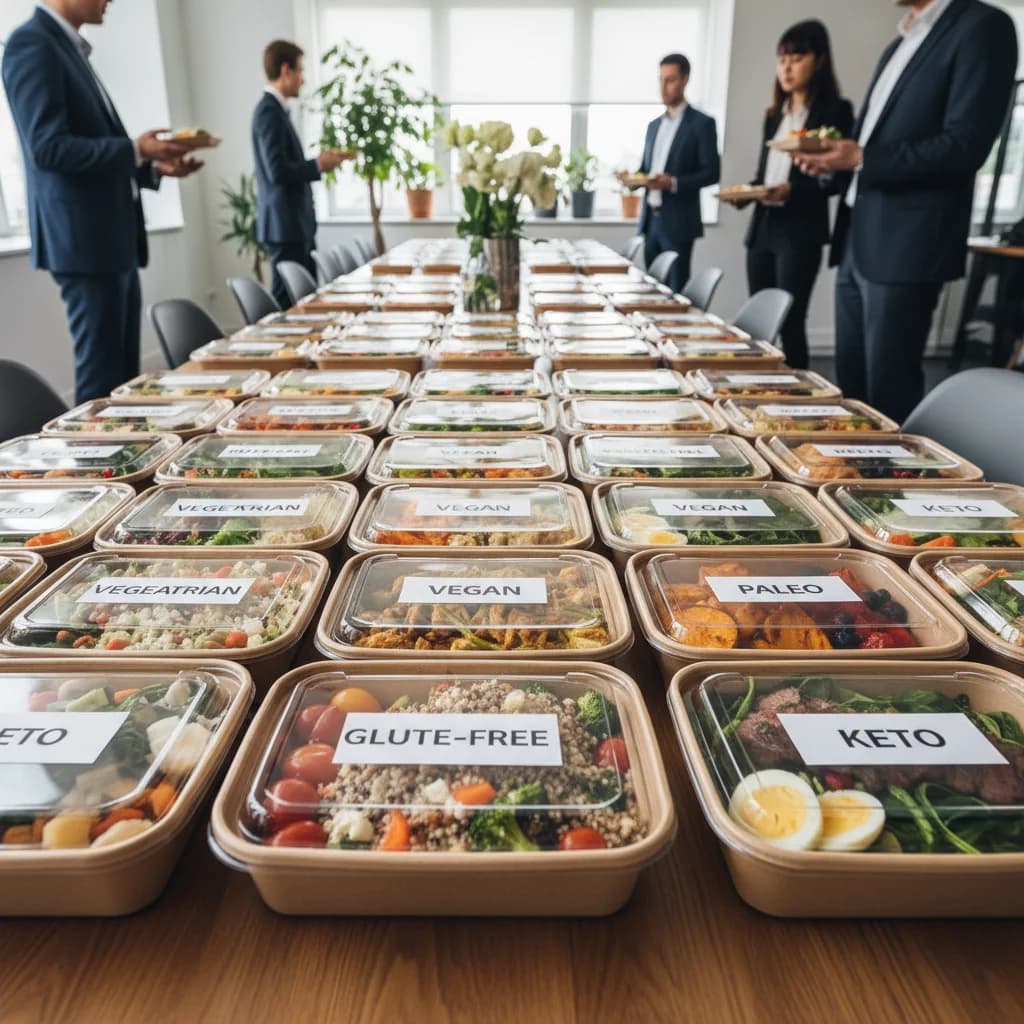
After catering hundreds of office lunches across Burnaby, Richmond, and Downtown Vancouver, I can tell you this: the number of dietary restrictions per order has roughly doubled in the last five years. A single 30-person office order might include gluten-free, vegan, halal, keto, low-sodium, nut-free, dairy-free, pescatarian, low-FODMAP, and shellfish allergy — all on the same ticket. If you don't have a system for this, you will make mistakes, and in catering, a mistake means someone either can't eat or gets sick.
Here's the exact workflow I use to handle it cleanly every time.
Step 1: Collect Restrictions Before You
Touch a Single Ingredient
- Send a structured intake form — not a free-text email — at least 48 hours before the event for groups of 50+, or 24 hours for smaller orders. Free-text replies like "I'm sort of vegetarian but I eat fish sometimes" create chaos at scale.
- Categorize every response into one of three tiers:
| Tier | Type | Examples | Handling Protocol |
|---|---|---|---|
| Tier 1 — Allergy / Medical | Life-threatening or medically required | Nut allergy, celiac disease, shellfish anaphylaxis | Separate prep surface, dedicated utensils, individually sealed and labeled containers |
| Tier 2 — Religious / Ethical | Non-negotiable personal commitments | Halal, kosher, vegan, Hindu vegetarian | Dedicated prep area, no cross-contact with restricted proteins |
| Tier 3 — Preference / Lifestyle | Flexible but important to the client | Keto, low-carb, low-sodium, pescatarian | Accommodate through menu design; minor cross-contact is acceptable |
- Flag Tier 1 restrictions immediately and confirm directly with that individual — not through an office admin playing telephone. One miscommunication on a peanut allergy can shut down your business.
Step 2: Design the Menu Around Overlaps, Not Exceptions
This is where most caterers waste money and time — building 10 separate meals for 10 restrictions. Don't do that.
- Map restriction overlaps on paper. A dish that is vegan, gluten-free, and nut-free satisfies at least three restrictions simultaneously. A grilled salmon rice bowl with no soy sauce covers pescatarian, dairy-free, halal, and low-FODMAP in one container.
- Build a "safe base" that clears the most restrictions. In my kitchen, that's usually a rice or quinoa grain bowl with roasted seasonal vegetables. From October through April here in Vancouver, that means hearty root vegetables — squash, yam, beets — that hold temperature well during our long rainy delivery runs.
- Add modular proteins and sauces on the side. This gives you flexibility without multiplying your prep by 10x.
- Target 3–4 well-designed menu items that collectively cover all 10 restrictions, rather than 10 individual custom meals.
Step 3: Prevent Cross-Contamination in
Prep and Packing
- Prep Tier 1 allergy meals first, before any allergens enter the workspace. This is non-negotiable food safety.
- Use color-coded cutting boards and utensils — one set for allergen-free prep, one for everything else. My team uses red boards for nut-free/gluten-free and green for general prep.
- Label every single container with the diner's name, the dish contents, and a bold allergen-free callout (e.g., "NUT-FREE — CELIAC SAFE"). A handwritten sticky note is not sufficient for Tier 1 meals. Use printed labels.
- Individually seal Tier 1 meals in tamper-evident packaging. This protects against accidental lid-swapping during transport — which I've seen happen more than once on bumpy drives through Richmond during the noon rush.
Step 4: Nail the Delivery and Handoff
- Separate Tier 1 meals into their own insulated bag. Do not stack them with general meals. One leaking teriyaki container ruins everything.
- Time your delivery to avoid peak congestion. Burnaby office clients consistently prefer a 2:00–3:00 PM window — it dodges the lunch rush on Willingdon and keeps food out of the 11:45 AM–1:15 PM Richmond traffic nightmare. If you're routing from Richmond to Downtown during peak, budget 50 minutes minimum, not the 30 minutes Google Maps shows you at 10 PM.
- Hand Tier 1 meals directly to the designated contact — not left on a lobby table. Get a name, get a confirmation. This is your liability firewall.
- Use moisture-resistant insulated bags rated to hold food above 65°C for at least 90 minutes. I've tested four different brands specifically for Vancouver's wet season, and this is honestly one of the biggest operational edges you can build. Soggy, lukewarm food arriving at a client's office in November rain is a reputation killer.
Step 5: Build a Restriction Database for Repeat Clients
Most office catering is recurring — weekly or biweekly. Don't ask the same 30 people about their restrictions every single time.
- Create a client profile for every office you serve regularly. Store each person's name, tier, and specific restrictions.
- Update the profile quarterly or whenever the office admin flags a change. People join, leave, and develop new allergies.
- Pre-load the profile into your next order so the admin only has to confirm, not rebuild from scratch. This saves them time, which is why they keep ordering from you instead of your competitor.
What Burnaby and Richmond Offices Actually Want
A pattern I've noticed after years delivering in these areas: Burnaby office clients skew heavily toward low-oil, low-sodium requests. It's not always framed as a medical restriction — it's a cultural and health-conscious preference that shows up order after order. Build your "safe base" recipes with this in mind and you'll get fewer revision requests and more reorders.
Richmond offices, on the other hand, tend to have more diverse religious dietary requirements — halal and vegetarian Hindu requests come up frequently. Having a reliable halal protein supplier locked in[1] saves you from scrambling on short notice.
[1]: Verify halal certification directly with your supplier and keep documentation on file. Clients will ask, and "I think so" is not an answer.
Summary: Collect all dietary restrictions upfront through employee self-identification, design menus around common overlaps rather than individual exceptions, implement strict cross-contamination protocols during prep and packaging, execute clear handoff procedures with detailed labeling, and maintain a restriction database for repeat clients. Richmond lunch deliveries require 20-minute traffic buffers during peak hours.
Last reviewed: March 2026. Data current as of this date.
Introduction
One in 10 US adults has a food allergy, while approximately 6% of Canadians live with allergies ranging from mild discomfort to life-threatening anaphylaxis, according to Food Allergy Research & Education and Canadian health data.[1][2] When you add vegetarian, vegan, gluten-free, kosher, halal, and other lifestyle-based dietary needs to the mix, office managers coordinating workplace meals face the challenge of accommodating 10 or more distinct restrictions within a single team.
After catering hundreds of events across Vancouver, Richmond, and Burnaby, I can tell you the dietary landscape here is more complex than almost anywhere else in North America. Metro Vancouver's workforce is extraordinarily diverse — a single Burnaby office lunch order might include halal, vegetarian, gluten-free, and shellfish-allergy requirements all at once. And those Burnaby teams consistently tell us they also want low-oil, low-sodium options, which adds another layer office managers rarely see coming.
Here's what makes this operationally hard:
- Volume of restrictions per order — We regularly see 10+ distinct dietary needs in a single team of 30. That's not an edge case here; that's a Tuesday.
- Severity range — Some restrictions are preference-based (low-carb, dairy-free by choice). Others are anaphylaxis-level, where a single cross-contact mistake means an EpiPen and a 911 call. You have to treat the entire workflow as if every restriction is life-threatening, because you can't always tell which is which.
- The coordination burden falls on one person — Usually an office manager or EA who has zero food safety training and is juggling this alongside 40 other responsibilities.
My Great Pumpkin, Vancouver's B2B corporate meal platform connecting 120+ restaurants with office clients, simplifies dietary accommodation through comprehensive filtering systems and individual meal selection. The platform ensures every employee finds suitable options without requiring office managers to become allergen experts or manually track complex restriction matrices.
What follows are the actionable strategies I've pressure-tested across real Greater Vancouver corporate deliveries — from early information gathering to cross-contamination prevention — showing exactly how to turn dietary complexity into a reliable, repeatable system instead of a guessing game.
Quick Answer: How Do You Accommodate 10+ Dietary Restrictions?
The most effective approach combines individual meal selection with dietary filtering technology, allowing employees to self-identify restrictions and choose from pre-filtered safe options, eliminating the burden of manual accommodation tracking.[3]
After managing corporate catering across Burnaby and Downtown Vancouver for years, I can tell you that manually tracking dietary needs falls apart the moment your headcount passes 20. The method that actually works in practice breaks down like this:
- Have each employee self-identify their dietary restrictions through an ordering platform before the event — not through a shared spreadsheet, not through an office manager collecting emails. Direct input from the person eating the food is the only reliable source.
- Use a platform that tags every menu item with comprehensive allergen and dietary labels — vegetarian, vegan, gluten-free, dairy-free, nut-free, kosher, halal. Platforms like My Great Pumpkin do this automatically, so each person sees only the options that are safe for them.
- Keep the office manager in an oversight role, not a data-entry role. They should be reviewing orders and confirming headcounts, not cross-referencing Karen's nut allergy against Tuesday's lunch menu.
This matters especially here in Greater Vancouver, where the cultural diversity of any given office means you're routinely juggling halal, vegetarian, and gluten-free requests in the same order — particularly in Burnaby offices, where I've noticed teams also tend to prefer lower-oil, lower-sodium preparations on top of everything else. Stacking those preferences manually is a recipe for mistakes.
This employee-driven model scales infinitely — whether accommodating 5 or 50 different restrictions — without increasing administrative complexity. I've seen it work cleanly for 80-person Burnaby tech company lunches where we counted 14 distinct dietary profiles in a single order. The system filtered everything; the office admin just hit confirm.
The Scale of Workplace Dietary Diversity
Common Dietary Restrictions in Modern Offices
According to workplace catering research, corporate food orderers most frequently accommodate these restrictions:[4]
| Dietary Restriction | Prevalence in Workplaces | Type |
|---|---|---|
| Vegetarian | 31% | Lifestyle choice |
| Gluten-free | 30% | Medical (celiac) + preference |
| Peanut allergies | 28% | Medical (allergy) |
| Vegan | 27% | Lifestyle/ethical |
| Dairy-free | 23% | Medical (lactose intolerance/allergy) |
| Nut allergies (tree nuts) | 24% | Medical (allergy) |
| Kosher | Variable | Religious |
| Halal | Variable | Religious |
| Shellfish allergies | Variable | Medical (allergy) |
| Egg allergies | Variable | Medical (allergy) |
Here's the reality I deal with every week: in a typical 50-person Vancouver office order, expect 15–20 distinct dietary needs scattered across these categories. And they don't come one at a time — people stack restrictions. A single attendee might be vegan, gluten-free, and allergic to tree nuts, all at once. Burnaby tech offices are where I see this most, especially since those teams already lean toward low-oil, low-salt menus as a baseline preference.
How to handle this without losing your mind:
- Collect dietary data at least 48 hours before the event. For groups of 50+, this is non-negotiable. Send a simple form — name, restriction, severity (allergy vs. preference). Chase responses at the 24-hour mark.
- Sort restrictions into two tiers. Medical allergies (peanut, tree nut, shellfish, egg, celiac) get treated as hard constraints — zero cross-contamination. Lifestyle and preference restrictions (vegetarian, vegan, low-salt) are important but carry different operational stakes.
- Design your menu around overlap. A dish that's simultaneously vegan, gluten-free, and nut-free covers the widest net in a single tray. Build outward from there, not inward from a standard menu. After catering hundreds of events in Vancouver, I can tell you: one smart shared dish eliminates three separate special orders.
- Label every single item. Full ingredient callouts, printed, on the serving line. No guessing. No "I think it's dairy-free." This protects your clients and protects you.
Why Prevalence Is Increasing
Food allergies among adults have increased by 50% over the past decade, with 11% of US adults now affected.[5] Contributing factors include:
- Generational shift: The "food allergy generation" entering the workforce—children with allergies doubled between 2000-2020[6]
- Better diagnosis: Increased awareness leads to more identified sensitivities
- Lifestyle trends: Plant-based diets grew 20% year-over-year from 2024-2025[3]
- Cultural diversity: More varied religious and cultural dietary requirements in workplaces
This isn't a temporary trend — it's the permanent baseline. Every year I see the dietary spreadsheets for recurring corporate clients in downtown Vancouver and Burnaby get longer, not shorter. The offices filling up with mid-career professionals now are the same cohort that grew up with EpiPens in their backpacks. Meanwhile, Metro Vancouver's cultural diversity means halal, kosher, and Jain dietary needs show up regularly alongside the medical ones.
What this means for your operation, practically:
- Treat dietary accommodation as a core capability, not an add-on. If your standard workflow can't handle five simultaneous restrictions for a 50-person order, your workflow is already outdated.
- Build supplier relationships that give you flexibility. My Great Pumpkin's restaurant network adapts to this diversity by partnering with 120+ Vancouver establishments offering cuisine types that naturally accommodate various restrictions, from Mediterranean (naturally nut-free options) to South Asian vegetarian (dairy-free curries). The key word is naturally — you want cuisines where the restriction is built into the tradition, not hacked onto a Western menu as an afterthought.
- Update your restriction knowledge every quarter. New allergen guidelines, new labeling laws, new dietary movements — what I've learned delivering to Burnaby offices is that the clients themselves are often more current on this than the caterers. Stay ahead or get replaced.
Summary: Metro Vancouver offices typically see 8-12 different dietary restrictions per 30-person order, with vegetarian (31%), gluten-free (30%), and peanut allergies (28%) leading prevalence rates. Burnaby tech offices show higher rates of lifestyle-based restrictions, while Richmond corporate clients frequently request halal accommodations. Prevalence increases annually due to improved medical diagnosis and cultural diversity.
Strategy 1: Gather Information
Early and Systematically
Create a Dietary Restriction Database
The foundation of successful accommodation is comprehensive information collection before ordering begins.
After catering hundreds of events across Metro Vancouver — from Burnaby tech offices to downtown conference rooms — I can tell you the single biggest source of day-of chaos is missing dietary information. You find out someone has a severe nut allergy at 12:05pm when the food is already on the table. That's a nightmare you prevent with a system, not good intentions.
Step-by-step process:
- Initial survey during onboarding: Include dietary restriction questions in new employee paperwork. Don't wait for the first catered lunch to discover someone on your team has celiac disease. Capture it on day one.
- Annual updates: Survey your entire team once a year. People's needs shift — new diagnoses, new religious observances, pregnancies, lifestyle changes. A database that's 18 months stale will fail you.
- RSVP integration: Add a mandatory dietary field to every meeting and event invitation. Make it required, not optional. In my experience with Burnaby office clients especially, people skip optional fields and then you're scrambling.
- Centralized tracking: Maintain a single spreadsheet or database — one source of truth — categorizing every restriction by:
- Allergen type (medical necessity)
- Lifestyle preference (vegetarian, vegan)
- Religious requirement (kosher, halal)
- Severity level (life-threatening vs. preference)
Keep this file accessible to whoever places catering orders. If it lives only in one person's inbox, it's useless when that person is on vacation.
Effective survey questions:[3]
- "Please list any food allergies or intolerances we should be aware of"
- "Do you follow any dietary restrictions for religious or ethical reasons? (e.g., vegetarian, vegan, kosher, halal)"
- "Are there any foods you avoid for health reasons?"
- "How severe is your restriction? (life-threatening allergy / severe intolerance / preference)"
This database becomes your master reference, eliminating the need to re-collect information for each meal order. For large events — 50 people or more — I strongly recommend confirming the final headcount and dietary breakdown at least 48 hours before the event. That gives your caterer enough lead time to source proper ingredients and prep separate allergy-safe items without cutting corners.
Categorize by Severity and Type
Not all restrictions are equal—prioritize based on health risk.
This matters enormously for how your caterer handles the food. A life-threatening peanut allergy requires dedicated prep surfaces, separate packaging, and clear labelling. A low-carb preference just means including a salad option. Treating them the same wastes money and attention; failing to distinguish them puts people at risk.
Critical (medical/safety):
- Life-threatening allergies (peanuts, tree nuts, shellfish, sesame)
- Celiac disease (gluten contamination)
- Severe lactose intolerance
These get flagged first, communicated clearly to your caterer in writing, and double-checked on delivery. No exceptions.
Important (health/religious):
- Non-anaphylactic food allergies
- Religious requirements (kosher, halal)
- Medically prescribed diets
These require genuine accommodation — not just a token side dish. Working with Vancouver's diverse workforce, I see kosher and halal requests regularly, and getting them right matters for trust and inclusion.
Preferences (lifestyle):
- Vegetarian choices
- Vegan preferences
- Low-carb diets
Worth accommodating and honestly easy to handle well. Burnaby office clients in particular tend to lean toward lighter, lower-oil, lower-sodium options across the board — so building menus around clean, plant-forward dishes often satisfies preference-based requests and general crowd appeal at the same time.
My Great Pumpkin's platform accommodates all levels while allowing office managers to flag critical restrictions that require extra attention during ordering, following BC Centre for Disease Control food safety guidelines for temperature control and allergen management.
Summary: Create a comprehensive dietary database during employee onboarding, not during first meal orders. Survey annually for restriction changes, categorize by severity (medical vs. preference), and maintain centralized records accessible to meal coordinators. Include emergency contact information for severe allergies and update profiles immediately when employees report new restrictions or medical diagnoses.
Strategy 2: Shift to Individual Meal Selection
Why Group Orders Fail with Multiple Restrictions
Traditional group ordering creates accommodation bottlenecks:
- The office manager becomes the single point of failure — they must memorize and track every restriction across the entire team
- Restaurants prepare food in bulk, which leaves almost zero room for meaningful customization
- Shared serving stations and communal platters raise cross-contamination risk significantly
- One forgotten restriction means someone gets excluded from the meal entirely
- Any late change or addition forces a re-order of the entire meal, not just one portion
71% of employees prefer choosing their own meals to accommodate personal dietary needs.[4] After years of handling Burnaby office catering — where teams consistently request low-oil, low-sodium options — I can confirm this tracks with what I see on the ground. The more restrictions in a group, the faster centralized ordering falls apart. Individual selection removes those failure points completely.
How Individual Selection Works
Modern platforms enable employee-driven ordering. Here's the step-by-step flow:
- Menu publication — The office manager selects approved restaurants and sets the per-person meal budget. That's it. Their job is essentially done.
- Dietary filtering — Each employee enters their own restrictions (allergies, halal, vegan, low-sodium, etc.) once into their profile. Filters stay saved for future orders.
- Individual selection — Employees browse only the options that have already passed through their personal restriction filters. They never see unsafe items.
- Automatic compilation — The platform aggregates every individual choice by restaurant, so each kitchen receives one clean, consolidated order — not 50 separate calls.
- Coordinated delivery — All meals from all restaurants arrive together at the scheduled delivery time, packaged and labeled individually.
Example scenario (50-person office with 15 dietary restrictions):
- Old method: Office manager spends 90 minutes building a spreadsheet matching employees to dishes, calls 3 restaurants to place custom orders, then manually tracks payments and confirmations. One mistake anywhere in this chain and someone doesn't eat.
- My Great Pumpkin method: Office manager spends 15 minutes selecting restaurants and a budget cap. Each employee spends 2 minutes choosing their own meal from pre-filtered safe options. The platform handles aggregation, ordering, and delivery coordination automatically.
Here's what this looks like in practice from my side of the operation: when individual orders come through aggregated and clearly labeled, my kitchen team can prep with precision. Every container is tagged with the employee's name and dietary flags. There's no guessing, no "which one was the gluten-free?" moment during packing. For Burnaby office deliveries, I schedule these for the 2–3 PM window — it avoids the brutal midday traffic crunch and gives teams a clean afternoon meal without disrupting their lunch-hour workflow. For any group over 50 people, I need the final order locked in at least 48 hours ahead so sourcing and prep go smoothly.
The time savings and error reduction are real and measurable — but the bigger win is that every single person at the table gets a meal they can actually eat, without anyone having to advocate for themselves or feel like an inconvenience.
Summary: Replace group ordering with individual employee meal selection to eliminate accommodation bottlenecks. Group orders fail because office managers become single points of failure, restaurants can't customize bulk preparations, and shared serving creates cross-contamination risks. Individual selection allows employees to self-filter safe options while scaling accommodation without increasing coordinator workload.
Strategy 3: Leverage Dietary Filtering Technology
Comprehensive Allergen and Diet Tagging
Platforms like My Great Pumpkin tag menu items with detailed dietary information:
After catering hundreds of events across Vancouver and Burnaby, I can tell you the single biggest source of day-of chaos is dietary miscommunication. A proper tagging system eliminates that. Here's exactly what to look for and how to use it.
Allergen tags:
- Contains: Dairy, Eggs, Fish, Shellfish, Tree Nuts, Peanuts, Wheat/Gluten, Soy, Sesame
- May contain traces (for cross-contamination awareness)
Dietary category tags:
- Vegetarian (no meat/fish)
- Vegan (no animal products)
- Gluten-free
- Dairy-free
- Nut-free (both peanuts and tree nuts)
- Kosher
- Halal
- Paleo
- Keto-friendly
One thing I've noticed working with Burnaby office clients specifically — there's a strong preference for lower-oil, lower-sodium dishes. That preference doesn't always show up in a standard allergen tag, so when you're building filtered menus for those offices, layer in nutritional-style filters on top of the allergen ones. Tag for "lighter prep" or equivalent if your platform supports it. Your Burnaby clients will notice.
My Great Pumpkin's 120+ restaurant partners provide ingredient disclosure, enabling accurate tagging that employees trust when filtering menus.
Employee Self-Service Filtering
Employees access the platform and apply personal filters:
- Log in and select all applicable dietary restrictions — multiple selections allowed, so someone who is both dairy-free and nut-free checks both boxes in a single step.
- Browse the filtered menu, which now shows only items compatible with every restriction selected. Nothing slips through.
- Open any menu item to view the full ingredient list. Read it. This is the transparency layer that builds trust — employees stop guessing and start verifying.
- Check for "may contain traces" warnings. For anyone with a severe allergy, this is non-negotiable. A dish can be "nut-free" by recipe but still flagged for trace exposure due to shared kitchen equipment.
This approach eliminates three major pain points:
- Office manager knowledge gap: Employees know their restrictions better than coordinators
- Communication errors: No telephone game between employee → office manager → restaurant
- Menu frustration: Employees aren't presented with options they can't eat
The filtering happens upstream, preventing disappointment rather than managing it after ordering mistakes.
Here's the real-world scenario I've lived through dozens of times: an office coordinator in Richmond places a group order for 40 people, relays dietary needs over the phone, and by the time the information reaches our kitchen, "no shellfish" has turned into "no fish" and someone's lunch is wrong. That problem vanishes when each employee filters and selects for themselves. For large orders — 50 people or more — I always recommend confirming the final menu at least 48 hours out, but even that confirmation is cleaner when the individual selections are already accurate at the source.
Summary: Use platforms with comprehensive allergen tagging (dairy, eggs, fish, shellfish, nuts, gluten, soy, sesame) and dietary category filters (vegetarian, vegan, kosher, halal, paleo, keto). Enable employee self-service filtering where individuals select meals pre-filtered for their restrictions. Burnaby offices particularly value low-oil, low-salt tagging for health-conscious teams.
Strategy 4: Prevent Cross-Contamination
Understanding Cross-Contamination Risk
For severe allergy sufferers, trace amounts of allergens can trigger reactions.[7] After catering hundreds of events across Metro Vancouver — from Burnaby office parks to downtown towers — I can tell you that cross-contamination is the single fastest way to turn a routine lunch delivery into a medical emergency. It happens through four main channels:
- Shared cooking surfaces — grills, fryers, and flat-tops that contact multiple proteins and allergens back to back
- Shared utensils — tongs, knives, cutting boards, and serving spoons used across dishes without sanitizing between
- Airborne particles — flour dust from a nearby prep station, steam from shellfish stock, even the fine mist from a high-speed blender
- Ingredient proximity during preparation — allergen-containing items stored or prepped inches away from allergen-free dishes, especially in tight Vancouver commercial kitchens where counter space is a luxury
80% of food-allergic consumers say allergen safety drives their restaurant loyalty choices,[8] and from what I've seen with corporate clients — particularly those health-conscious Burnaby offices that already lean toward low-oil, low-sodium menus — this number tracks. If employees don't trust the food, participation in your meal program drops fast. Cross-contamination prevention isn't a nice-to-have. It's what keeps people eating.
Restaurant Vetting for Allergen Safety
When selecting restaurant partners, My Great Pumpkin evaluates:
Not every restaurant that says they handle allergies actually has the systems to back it up. Here's what rigorous vetting looks like, step by step:
- Confirm separate prep areas — Look for a dedicated allergen-free zone in the kitchen. In many Vancouver restaurants, space is tight, so even a designated cutting board and a cleared section of counter counts — but it must be consistent and enforced, not improvised per order.
- Verify staff training — Ask specifically: has the kitchen team been educated on contamination risks? Not just the head chef — the line cooks, the prep staff, the person packing delivery containers. One untrained hand undoes every protocol.
- Request process documentation — Written protocols for allergy orders should exist before you partner, not get created after an incident. Ask to see them. If a restaurant can't produce a documented workflow for handling allergen-specific orders, move on.
- Demand ingredient transparency — Full disclosure of every component in every dish, plus honest answers about shared equipment. Does the fryer also handle shrimp? Does the grill get a full scrub between proteins? These details matter more than the menu description.
Vancouver restaurants partnering with My Great Pumpkin understand corporate meal safety requirements exceed typical consumer expectations. What I've learned working with local kitchens is that the best partners welcome this scrutiny — it's the ones who get defensive about process questions that worry me.
Individually Packaged Meals
Individual packaging offers superior contamination control:
For offices managing multiple dietary restrictions and severe allergies, this is the format I push hardest. Here's why it works:
- Each meal is sealed separately at the source kitchen — contamination risk during transport drops to near zero, which matters when you're running deliveries through Vancouver rain for 40+ minutes
- No shared serving utensils at the office — eliminates the buffet problem where one pair of tongs touches every dish on the table
- Clear labeling is visible before opening — employees verify their meal matches their needs without unwrapping anything, without guessing
- Employee confidence in meal safety goes up measurably — and participation follows
For offices with multiple severe allergies, My Great Pumpkin recommends individually packaged meals rather than family-style or buffet formats, eliminating cross-contamination risk during serving. I've seen too many well-intentioned buffet setups go sideways when someone uses the wrong spoon or a lid gets swapped. Individual packaging removes human error from the serving step entirely.
Labeling Requirements
Every delivered meal should include:
These five elements need to be on every single container, every single delivery — no exceptions:
- Employee name — so the right meal reaches the right person without anyone rummaging through bags
- Dish name — clear and specific (not just "chicken bowl" — specify "Grilled Chicken Rice Bowl with Sesame Dressing")
- Full ingredient list — every component, including oils, sauces, garnishes, and sub-ingredients within sauces
- Allergen warnings — formatted for instant recognition (e.g., "Contains: dairy, wheat") and placed prominently, not buried in small print
- Restaurant name and contact — so if an employee has a last-second question before eating, they can call the kitchen directly
This information empowers employees to make final safety verification before eating. In practice, that 10-second label check is the last line of defense — and from my experience delivering to offices across Burnaby, Richmond, and downtown Vancouver, it's the step that gives people the confidence to actually sit down and enjoy their meal instead of skipping it out of anxiety.
Summary: Vet restaurant partners for allergen safety protocols including dedicated prep surfaces, separate utensils, and airborne particle control. Require individually packaged meals for severe allergies, never communal serving. Implement detailed labeling with ingredient lists and "may contain" warnings. During Vancouver's rainy season, use waterproof labels that remain legible through 90-minute deliveries.
Ready to simplify office meals?
Join 100+ Vancouver offices enjoying hassle-free lunch delivery. Free tasting, no contract.
Request a Demo →Strategy 5: Choose Build-Your-Own and Naturally Inclusive Cuisines
Build-Your-Own Meal Formats
Self-assembly meals accommodate diverse restrictions effortlessly:[3]
After catering hundreds of events across Metro Vancouver, I can tell you that build-your-own stations are the single most reliable way to feed a group with mixed dietary needs. Every person controls their own plate, which means fewer mistakes on your end and fewer complaints on theirs. Here's how to set up each format so nothing falls through the cracks.
Taco/burrito bars:
- Set out clearly separated base options: Corn tortillas (GF), flour tortillas, and lettuce wraps — always in that order so guests with gluten restrictions hit the safe option first and avoid cross-contact from shared tongs.
- Offer at least one protein per major dietary category: Grilled chicken, beef, black beans (vegan/vegetarian), and tofu. Keep beans and tofu in their own serving vessels with dedicated utensils.
- Separate every topping into its own container: Sour cream, cheese, guacamole, salsa, cilantro, lime wedges. Label each one with allergen flags (dairy, etc.).
- Confirm dietary coverage before the event:
- Vegetarian ✅
- Vegan ✅
- Gluten-free ✅
- Dairy-free ✅
This format works especially well for Burnaby office groups. What I've learned delivering to those clients is they lean toward lower-oil, lower-salt options — so a taco bar with fresh salsas and grilled proteins lands better than heavy, sauce-drenched trays every time.
Grain bowl bars:
- Provide at least two base options from different food groups: Rice, quinoa, and mixed greens cover gluten-free, grain-free, and low-carb needs simultaneously.
- Include plant-based protein alongside animal protein: Grilled chicken or salmon next to marinated tofu or seasoned chickpeas ensures every guest has a filling option.
- Separate every topping — especially allergens: Place nuts, sesame seeds, and soy-based sauces in their own clearly labeled containers, physically distanced from other toppings to prevent accidental cross-contact.
- Confirm dietary coverage before the event:
- Highly customizable for allergies and preferences ✅
- Guests self-select only what's safe for them ✅
Salad bars:
- Offer multiple green bases: Romaine, spinach, and mixed greens give variety and avoid single-ingredient monotony that makes people feel like dietary restrictions stuck them with a sad plate.
- Provide diverse protein choices: Grilled chicken, hard-boiled eggs, chickpeas, and tofu cover the major dietary categories.
- Keep every topping and dressing in its own vessel with its own utensil: Croutons (gluten), cheese (dairy), nuts (tree nut allergen), and dressings (often contain dairy, soy, or eggs) must be isolated and labeled.
- Confirm dietary coverage before the event:
- Accommodates nearly all restrictions ✅
- Lowest risk format for large groups with unknown dietary needs ✅
One operational note that matters here in Vancouver: during rainy season — roughly October through April — build-your-own stations delivered to outdoor or semi-covered venues need serious moisture protection. We tested four different insulated bag systems specifically to keep food above 65°C for at least 90 minutes in damp conditions. That's not a nice-to-have; it's a food safety requirement when you're holding proteins and grains at a self-serve station. Make sure your caterer has a real answer for temperature maintenance, not just a promise.
My Great Pumpkin's restaurant network includes partners specializing in these flexible formats, providing ready-made dietary accommodation.
Naturally Inclusive Cuisines
Some cuisine types inherently accommodate multiple restrictions:[3]
Not every event needs a build-your-own setup. Sometimes a well-chosen cuisine does the heavy lifting for you. These four cuisine types naturally cover the most common dietary restrictions I see requested across Vancouver corporate and social events. Rotate through them across recurring orders to keep variety high without creating logistical headaches.
Mediterranean:
- Naturally dairy-light — olive oil is the base fat, not butter or cream
- Rich in vegetarian options like hummus, falafel, and stuffed grape leaves
- Built around fresh vegetables and grains
- Typically nut-free in main dishes (confirm with your specific caterer, since some Mediterranean desserts use pistachios or almonds)
Thai/Vietnamese:
- Rice noodles serve as the default starch — naturally gluten-free
- Coconut milk curries replace dairy-based sauces — naturally dairy-free
- Abundant vegetable dishes that feel like main courses, not afterthoughts
- Soy-based proteins (tofu, tempeh) are standard, not special-order
⚠️ Watch for hidden allergens: Fish sauce is in almost everything. Peanuts appear in pad Thai and many garnishes. If you have guests with fish or peanut allergies, confirm every dish ingredient with the restaurant — don't assume "Thai vegetable curry" is automatically safe.
Mexican:
- Corn-based staples (tortillas, tostadas) are naturally gluten-free
- Bean proteins make vegan and vegetarian options filling and satisfying
- Dairy is typically optional — cheese and sour cream go on top, not cooked in
- Built around fresh ingredients: lime, cilantro, tomato, avocado
Indian vegetarian:
- One of the world's deepest vegetarian and vegan culinary traditions — these aren't improvised substitutions, they're dishes perfected over centuries
- Lentil and legume proteins (dal, chana) provide substance without meat
- Rice-based dishes are naturally gluten-free (confirm that naan and roti are served separately for those avoiding wheat)
- Dairy is clearly identifiable — ghee and paneer are used deliberately, making them easy to flag and avoid
Rotating through these cuisine types provides menu variety while inherently accommodating common restrictions.
One practical scheduling tip for orders going to Richmond: midday traffic between 11:45 AM and 1:15 PM is genuinely brutal. I always build in an extra 20-minute buffer for any Richmond lunch delivery, and if you're routing from Richmond to Downtown during peak hours, plan for a solid 50 minutes — not the 30 minutes Google Maps shows you at 10 PM. For Burnaby office clients, I've found that scheduling delivery between 2:00 and 3:00 PM avoids the lunch rush entirely and aligns with when those teams actually want to eat. For any large event over 50 people, lock in the menu at least 48 hours in advance — that lead time is what lets your caterer source properly and prep without cutting corners on allergen separation.
Summary: Deploy taco bars, grain bowls, and Mediterranean platters where employees control ingredients and portion sizes. Position gluten-free bases first to prevent cross-contact from shared utensils. Mediterranean and Asian cuisines naturally accommodate multiple restrictions. Build-your-own formats reduce preparation complexity while increasing employee satisfaction across diverse dietary needs.
Strategy 6: Maintain Backup Options and Emergency Meals
The "Forgotten Restriction" Problem
Despite best efforts, situations arise requiring backup meals:
- A new employee attends their first catered meal with no dietary info on file
- A visiting client has an undisclosed allergy
- An employee develops a new intolerance between the time you ordered and the day of the event
- A delivery error results in the wrong meal arriving
Order 10–15% extra meals that cover the most common restrictions. This single step prevents someone from being left out entirely.[3]
Follow these steps to build your backup meal buffer:
- Count your headcount, then add 10–15% rounded up to the nearest whole meal.
- Select backup dishes from this list — each one covers multiple restrictions without any customization needed:
| Backup Dish | Vegan | Gluten-Free | Nut-Free | Dairy-Free |
|---|---|---|---|---|
| Green salad with olive oil dressing | ✅ | ✅ | ✅ | ✅ |
| Plain grilled chicken and vegetables | ❌ | ✅ | ✅ | ✅ |
| Fruit platter | ✅ | ✅ | ✅ | ✅ |
| Vegetable spring rolls | ✅ (confirm no egg) | ❌ (wrapper) | ✅ | ✅ |
| Plain rice and beans | ✅ | ✅ | ✅ | ✅ |
- Choose at least two dishes from the list above for every order. Prioritize the ones marked ✅ across all four columns — green salad, fruit platter, and rice and beans cover roughly 90% of dietary restrictions on their own.
- Label every backup container clearly with its contents and the restrictions it satisfies. After delivering across Burnaby offices for years, I can tell you — people won't touch unlabeled backup food. They assume it's someone else's special order.
- Store backup meals in insulated bags separate from the main order. During Vancouver's rainy season (October through April), we use moisture-resistant insulated bags tested to hold food above 65°C for 90 minutes. Cold, wet backups help nobody.
Emergency Meal Service
For employees with severe or life-threatening allergies, My Great Pumpkin can set up a dedicated safety net. Here's exactly how it works:
- Request a pre-approved safe restaurant list specific to the individual's restriction. We maintain relationships with local suppliers and kitchens across Metro Vancouver who can verify allergen-free preparation.
- Set up a standing emergency meal order. For example: always include 1 completely nut-free meal, prepared and packaged in a separate facility, with every delivery.
- Arrange separate delivery for that meal. It arrives in its own sealed, labeled container — never transported alongside dishes that contain the allergen. Cross-contamination during transit is a real risk, especially when you're stacking catering bags in a vehicle for a 50-minute drive from Richmond to Downtown during peak hours.
- Establish direct communication with the employee. We confirm exact meal contents with the allergy sufferer before every delivery — not through an office admin, not through a group email. Directly.
This safety net ensures employees with life-threatening allergies never face the choice between skipping a meal or risking their health.
Summary: Order 10-15% extra meals covering common restrictions for forgotten needs, new employees, or visiting clients. Stock simple options like grilled protein with steamed vegetables that accommodate vegetarian, gluten-free, and dairy-free simultaneously. Keep emergency supplier contacts for same-day dietary accommodation requests, especially critical for Downtown Vancouver lunch meetings with external clients.
Comparison: Manual Tracking vs. Automated Platform
After managing dietary restrictions across hundreds of corporate catering orders — especially for Burnaby office clients who already lean toward specific preferences like low-oil, low-salt meals — I can tell you the gap between manual and platform-based tracking is massive. Here's what it actually looks like in practice.
| Aspect | Manual Coordination | My Great Pumpkin Platform |
|---|---|---|
| Time investment | 2-3 hours per order | 15-20 minutes per order |
| Error rate | High (human memory limits) | Minimal (automated filtering) |
| Scalability | Linear increase with restrictions | Constant regardless of restrictions |
| Employee satisfaction | Moderate (frequent mistakes) | High (guaranteed safe options) |
| Cross-contamination risk | Elevated (bulk serving) | Reduced (individual packaging) |
| Menu variety | Limited (few restaurants handle complex needs) | Extensive (120+ restaurant access) |
| Cost | Hidden (labor hours) | Transparent (meal cost only) |
What This Table Means When You're Actually Running Orders
Understand where manual tracking breaks down. When you're juggling 30+ dietary profiles by spreadsheet — vegan, halal, gluten-free, nut allergy — and simultaneously routing a delivery from Richmond to Downtown during lunch rush (that's 50 minutes minimum in peak traffic, not the 30 you'd hope for), something gets missed. I've seen it happen: a single wrong label on a bulk tray means someone with a severe allergy is at risk. The 2–3 hours per order in that table isn't exaggeration — it's the reality of cross-referencing restrictions, calling restaurants to confirm prep methods, and triple-checking packaging.
Recognize what individual packaging actually solves. Bulk serving trays are a cross-contamination problem I've dealt with constantly. One shared serving spoon between a regular pasta tray and a gluten-free option, and you've got a liability issue. Individual packaging eliminates that vector entirely — and it also makes delivery during Vancouver's rainy season (October through April) far more manageable, since sealed individual containers hold up better inside moisture-resistant insulated bags.
Factor in the hidden labor cost of manual coordination. That "Hidden (labor hours)" line in the cost column deserves attention. If you're paying someone $25/hour to spend 2–3 hours per order reconciling dietary needs, that's $50–$75 buried in every single order that never shows up on an invoice. A platform with transparent per-meal pricing lets you see exactly what you're spending — no guessing.
Use the platform's restaurant access to match your client base. With 120+ restaurants available through the platform, you can actually accommodate the specific preferences that dominate Greater Vancouver office catering — lighter, lower-sodium options for Burnaby tech campuses, diverse Asian cuisine selections for Richmond offices, and so on. Manually, I'd be limited to the 5–8 restaurants I'd personally vetted for complex dietary handling. That's just not enough variety to keep a recurring corporate client happy past the first month.
Treat the switch as an operational upgrade, not just a convenience. The real shift is moving dietary accommodation from something you manage on behalf of every employee to something employees handle themselves through self-service filtering. Your role changes from error-prone gatekeeper to logistics operator focused on what you're actually good at — making sure food arrives hot, on time, and intact.
The platform approach transforms dietary accommodation from a complex coordination challenge into streamlined employee self-service — and frees you to focus on delivery execution, which in a city with Vancouver's weather and traffic realities, is already a full-time job.
Summary: Manual coordination requires 2-3 hours per order with high error rates, while automated platforms reduce management to 15-20 minutes with minimal mistakes. Manual tracking fails at scale due to human memory limitations, whereas platforms maintain consistent performance regardless of restriction count. Employee satisfaction increases significantly with guaranteed safe meal options through automated filtering.
Communication: Setting Expectations
Transparent Dietary Policy
Document your office meal program's dietary approach:
Every office meal program needs a written dietary policy that employees can reference before they ever place an order. I've seen too many Burnaby office accounts fall apart in the first two weeks because nobody spelled out what the program does and doesn't cover. Write it once, circulate it company-wide, and pin it somewhere visible — Slack channel, breakroom bulletin board, onboarding doc.
Sample policy statement:
"Our office meal program aims to accommodate all dietary restrictions and preferences. We use My Great Pumpkin's platform, which allows you to filter menus by your specific needs. Please update your dietary profile in the system whenever your restrictions change. For life-threatening allergies, please contact [Office Manager] to discuss additional safety protocols."
Put this in front of people before the first delivery arrives. After managing corporate accounts across Metro Vancouver, I can tell you that the single biggest source of complaints isn't the food — it's employees assuming the program handles something it was never set up to handle. A clear policy statement kills that problem on day one.
Educate Team on Self-Service Process
Brief training ensures employee adoption:
Run one short session before your program goes live. Fifteen minutes saves you weeks of confused support emails. Here's the sequence that works:
- Platform walkthrough: Spend 10 minutes showing the live interface — specifically how dietary filters work. Click through them in real time. Screenshots don't stick; a live demo does.
- Dietary profile setup: Walk every employee through entering their own restrictions right there in the session. If they leave the room without a completed profile, most will never go back and do it.
- Ordering practice: Have everyone select a meal from an actual upcoming menu. This surfaces confusion immediately — someone will ask about a filter combination you didn't anticipate, and you want that question now, not on delivery day.
- Q&A session: Open the floor for concerns about safety, variety, and how changes get made. The most common question I hear from Burnaby and Richmond offices: "What if my restrictions change?" Make sure people know they can update their profile anytime.
My Great Pumpkin provides onboarding support for new corporate clients, ensuring smooth team transition to individual selection model. Use that support — have their team co-run the session if possible so employees see a direct line to help.
Address Cross-Contamination Concerns
For severe allergy sufferers, provide additional safety information:
This is where trust gets built or broken. Employees with serious allergies need more than a filter — they need to understand the layers of protection behind their meal. Cover these four points explicitly, either in your policy document or in a direct conversation with affected team members:
- Restaurant vetting process explanation — How restaurants on the platform are screened, what food safety standards they meet, and how allergen information is verified
- Individually packaged meal benefits — Each meal arrives sealed and labeled for one person, which drastically reduces the cross-contact risk that comes with buffet-style or family-style catering setups
- How to contact restaurants with specific questions — Give employees a clear path to reach the restaurant directly when they need details beyond what the menu label shows
- Emergency protocol if reaction occurs — Spell out exactly what to do and who to call, including your office's internal first-response steps and the location of any on-site epinephrine
Transparency builds trust that dietary accommodation is taken seriously. I've worked with offices where one well-handled allergy conversation turned a skeptical employee into the program's biggest advocate. Don't gloss over this step.
Summary: Document a written dietary policy covering accommodation scope, employee responsibilities, and emergency protocols. Train teams on self-service meal selection platforms and profile updating procedures. Clearly communicate cross-contamination limitations for severe allergies and establish escalation procedures for medical emergencies. Circulate policies through onboarding documentation and accessible reference channels like Slack.
Conclusion
Handling 10+ dietary restrictions in a single office meal program comes down to three things: systematic information gathering, individual meal selection technology, and cross-contamination prevention protocols.
Why This Works
- Shift from group ordering to employee-driven filtering. When each person selects their own meal through a platform that tags allergens and dietary needs, you remove the coordination bottleneck entirely. No more spreadsheets, no more guessing, no more relying on one office manager's memory.
- Scale without adding workload. Whether you're managing 5 dietary needs or 50, the office manager's effort stays the same after initial program setup. The system does the heavy lifting.
- Build for the future now. Workplace diversity across Metro Vancouver keeps growing. Food allergies are on the rise. What used to be a nice-to-have — dietary accommodation — is now a baseline expectation for any serious meal program. Setting up the right system today means you won't scramble when a new hire brings restriction #11 or #15 to the table.
The Practical Reality
After running catering across Vancouver, Richmond, and Burnaby for years, I can tell you the biggest source of meal program failures isn't the food — it's the coordination. Manual tracking breaks down the moment complexity increases. A platform with comprehensive allergen tagging, dietary filtering, and access to a 120+ restaurant network spanning cuisines that naturally accommodate various restrictions eliminates that failure point.
The technology already exists. The only barrier between chaotic manual coordination and effortless inclusive dining is the decision to implement it.
Simplify Dietary Accommodation for Your Vancouver Office
Discover how My Great Pumpkin's dietary filtering and individual meal selection transform complex restriction management into employee self-service: https://www.mygreatpumpkin.com/demo
Looking for Vancouver's Asian-fusion meal partner?
The Storm Cafe delivers fresh bento boxes, rice bowls, and catering platters across Metro Vancouver — from Richmond to North Van. Retail orders, family meals, and corporate lunches all in one place.
References
[1] Food Allergy Research & Education (FARE), "Creating Food Allergy-Aware Workplaces," 2024. Key finding: 1 in 10 US adults have food allergies, making workplace accommodation essential rather than exceptional. https://www.foodallergy.org/living-food-allergy/information-you/adults-allergies/workplaces
[2] Canadian National Center for Biotechnology Information, "Food Allergy and Foodservice: A Comparative Study," 2024. Prevalence of food allergy in Canada based on history and/or physician diagnosis estimated at approximately 6%, with symptoms ranging from mild discomfort to severe anaphylaxis. https://pmc.ncbi.nlm.nih.gov/articles/PMC12477836/
[3] ezCater, "Navigating Dietary Restrictions: A Workplace Catering Playbook," December 2025. Comprehensive guide covering: 71% of employees prefer choosing own meals; 5% vegetarian/vegan; 1% celiac; 33% avoid gluten; plant-based sales grew 20% YOY; recommendations for build-your-own formats, naturally inclusive cuisines, backup meals, and individual packaging. https://www.ezcater.com/lunchrush/office/dietary-restrictions-in-the-workplace/
[4] ezCater, "The Food for Work Report 2024," November 2024. Workplace dietary restriction statistics: Vegetarian 31%, Gluten-free 30%, Peanut allergies 28%, Vegan 27%, Dairy-free 23%, Nut allergies 24%; 71% employees prefer individual meal choice. https://1703639.fs1.hubspotusercontent-na1.net/hubfs/1703639/ezCater_Food_For_Work_Report_2024.pdf
[5] National Center for Biotechnology Information, "Food Allergy Issues Among Consumers: A Comprehensive Review," 2024. Food allergy impacts about 8% of children and 11% of adults in United States, representing significant public health concern and workplace accommodation need. https://pmc.ncbi.nlm.nih.gov/articles/PMC11002200/
[6] Boston College Law Review, "The Food Allergy Generation Goes to Work," 2024. Number of children with food allergies doubled over past two decades, affecting estimated 5.6 million children now entering workforce with lifelong dietary restrictions. https://bclawreview.bc.edu/articles/3188/files/67e6bbf69b1cb.pdf
[7] Food Allergy Research & Education (FARE), "Avoiding Cross-Contact," 2024. Documentation of cross-contamination dangers: trace amounts of allergens can trigger reactions; shared equipment and surfaces present serious risks requiring prevention protocols. https://www.foodallergy.org/resources/avoiding-cross-contact
[8] Food Safety Magazine, "Building Loyalty Through Safety: Enhancing Allergen Management Programs," 2024. Research finding: 80% of food-allergic consumers in Canadian foodservice sector cite allergen safety as primary driver of restaurant loyalty and repeat business. https://www.food-safety.com/articles/10139-building-loyalty-through-safety-enhancing-allergen-management-programs-as-a-strategic-business-opportunity
[9] BC Centre for Disease Control, "Food Premises Guidelines for Food Service Operations," 2026. https://www.bccdc.ca/health-professionals/professional-resources/food-premises-guidelines
[10] TransLink, "Metro Vancouver Transit and Traffic Data," 2026. https://www.translink.ca/
Frequently Asked Questions
How do I handle an employee with multiple severe allergies (like nuts, dairy, and gluten) without making them feel excluded?
Individual meal selection platforms solve this perfectly. Instead of the office manager trying to navigate multiple restrictions, the employee filters the menu themselves and sees only options that are safe for all their allergies combined. I've worked with Burnaby tech offices where someone had five different restrictions, and they were actually excited about their meal choices because they could browse freely instead of feeling like they were getting whatever was "left over" after accommodating everyone else.
What happens if someone forgets to mention their dietary restriction until the day of the event?
Always order 10-15% extra meals that cover the most common restrictions - things like plain grilled chicken with vegetables, green salads with olive oil dressing, or rice and beans. These backup options naturally accommodate multiple dietary needs without customization. After hundreds of Vancouver deliveries, I can tell you this buffer has saved more events than any other single strategy. Keep them in separate insulated bags and label them clearly so people know what they're getting.
How do I prevent cross-contamination when serving 50+ people with mixed dietary needs?
Switch to individually packaged meals instead of buffet-style serving. Each container is sealed at the restaurant, labeled with the person's name and dietary flags, and eliminates the shared-serving-spoon problem entirely. This is especially critical during Vancouver's rainy season when you're dealing with longer delivery times - sealed individual containers hold temperature better and prevent any mixing during transport from Richmond to downtown offices.
Which restaurants in Metro Vancouver can actually handle complex dietary accommodations reliably?
Look for cuisines that naturally accommodate restrictions rather than trying to retrofit Western menus. Mediterranean restaurants typically use olive oil instead of dairy, Thai places build around rice noodles (gluten-free), and Indian vegetarian spots have centuries of plant-based protein expertise. your meal subscription service's 120+ restaurant network includes vetted partners across Vancouver, Burnaby, and Richmond who meet strict allergen safety protocols and provide full ingredient transparency.
How far in advance do I need to confirm dietary needs for large office events?
For groups over 50 people, lock in dietary requirements and menu selections at least 48 hours before delivery. This gives restaurants time to source proper ingredients and prep allergen-free items using separate equipment. For Burnaby office deliveries especially, I schedule these between 2-3 PM to avoid the brutal midday traffic rush - that timing also gives kitchens more prep flexibility than trying to hit exact noon delivery windows during peak congestion periods.
Related Articles

Office Catering in Downtown Vancouver Financial District
Daily office catering for Downtown Vancouver. Delivery to Burrard, Granville, and Waterfront offices

Set Catering for Film Productions in Vancouver
Film set catering in Vancouver. Union-compliant meals, 6 AM call times, on-location delivery for cre

Lunch Programs for Coworking Spaces in Vancouver
Add a daily lunch program to your Vancouver coworking space. Boost member retention and upsell premi
Ready to streamline your office meals?
Join 100+ Vancouver offices enjoying hassle-free lunch delivery.
Request a Demo