Healthcare Office Meal Solutions for Shift Workers
Vancouver healthcare clinics and hospitals need meal solutions that fit 20-minute lunch windows, sealed packaging for infection control, and multiple daily delivery times. Here's what works.
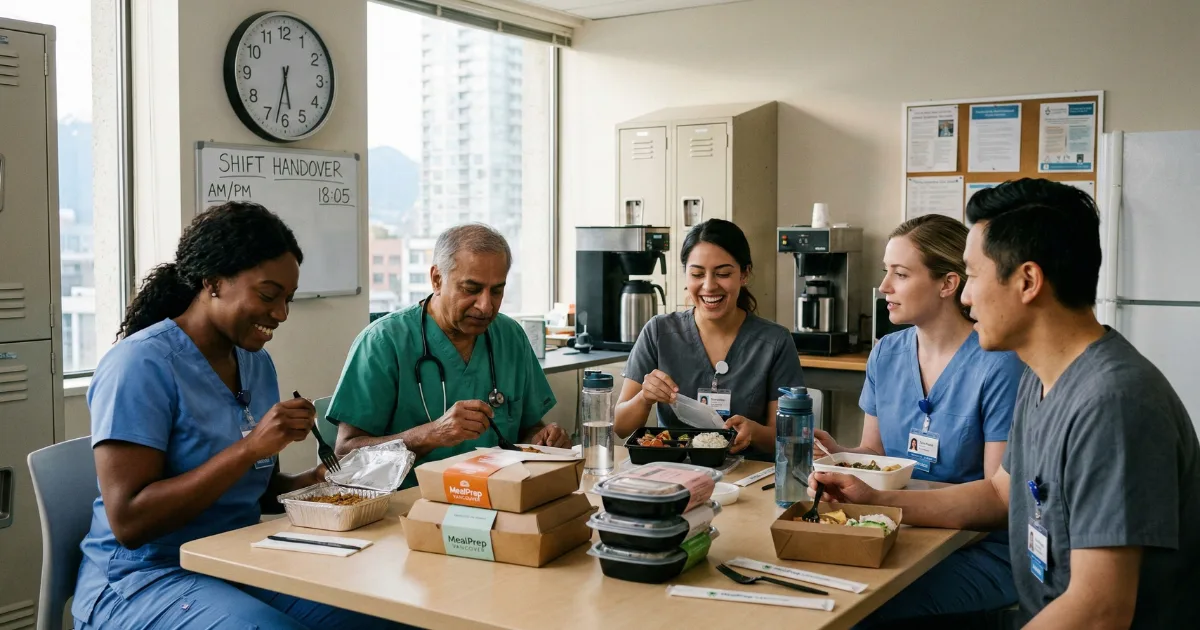
I've been delivering meals to healthcare offices across Metro Vancouver for long enough to know that this industry has the hardest lunch logistics of any segment we serve. Harder than construction sites, harder than law firms, harder than IT companies with their hybrid schedules. And the reason is simple: healthcare workers don't get to choose when they eat. Their patients choose for them.
A dental hygienist at a Broadway corridor clinic doesn't take lunch at noon because she wants to. She takes lunch at 12:15 because that's the 20-minute gap between a root canal follow-up and a crown prep. A nurse at VGH doesn't eat at a scheduled break time — she eats when the ward is momentarily stable enough for her to step away, and that window might be 15 minutes or it might not happen at all. A physiotherapist at a Richmond medical office eats between patients, which means lunch is whatever can be opened, consumed, and cleaned up in the time it takes the next patient to check in at reception.
These aren't people who can scroll through a delivery app at 11:45 and wait 35 minutes for a driver. They need food that's already there when their window opens, in packaging they can handle without contaminating anything, with enough nutritional density to power them through an afternoon of physical and cognitive work.
This is the problem My Great Pumpkin solves for healthcare offices across Vancouver. And after serving clinics from the Broadway corridor to Richmond's medical district, hospital satellite offices near VGH and St. Paul's, and dental practices scattered across Burnaby and the North Shore, I've built a specific operational model for healthcare that doesn't exist in standard corporate catering.
Why Healthcare Is the Most Demanding Meal Delivery Segment
Three factors make healthcare offices fundamentally different from every other B2B client we serve:
1. The lunch window is brutally short.
In a standard office, lunch is 30-60 minutes. People wander to the kitchen, heat something up, sit down, eat, chat, and return to their desks. In healthcare, the window is 15-30 minutes, and it's not negotiable. A clinic running 15-minute patient appointments has exactly the gap between one patient leaving and the next arriving for the practitioner to eat. If they're running behind schedule — which is every day — that gap shrinks to 10 minutes or disappears entirely.
This means the food has to be immediately ready to eat. No heating required. No assembly. No shared platters that require serving. Individual sealed containers that a nurse can grab from the break room, open at their station, eat in 12 minutes, and dispose of without leaving anything that needs cleaning.
2. Infection control isn't optional — it's regulatory.
Healthcare facilities operate under strict infection prevention and control protocols. Food entering a clinical environment has to arrive in sealed, tamper-evident packaging. Shared buffet-style catering — the default for most corporate lunch programs — is a non-starter in any facility that sees patients. Cross-contamination risk, surface contact, multiple people handling serving utensils — all of it violates the hygiene standards that healthcare facilities are required to maintain.
Our individual sealed packaging isn't just a convenience for healthcare clients — it's a compliance requirement. Each meal arrives in a sealed container that hasn't been opened since it left the restaurant kitchen. No shared contact surfaces. No communal serving. The clinic manager can verify that every meal arrived sealed, and that verification matters for facility audits.
3. Irregular schedules mean multiple delivery windows.
A standard office gets one lunch delivery around noon. A healthcare facility might need food at three different times in a single day:
- Day shift lunch: 11:30 AM - 12:30 PM
- Evening shift meal: 5:30 PM - 6:30 PM
- Night shift meal: 11:30 PM - 12:30 AM
Even clinics that only run day shifts have staggered lunch patterns because practitioners can't all leave patients simultaneously. A 12-person clinic might have three groups of four eating at 11:30, 12:00, and 12:30 — which means the food needs to hold quality across a 60-minute window minimum.
The Healthcare Shift Schedule Problem — Visualized
The diagram below maps the typical shift overlap windows we've encountered across hospitals and 24-hour clinics in Vancouver. These overlap periods are where meal delivery has the highest impact — and where the logistics are most constrained.
For 24-hour facilities like hospital departments and urgent care clinics, the three delivery windows create a rhythm that shift workers can rely on. But most of our healthcare clients are daytime clinics — medical offices, dental practices, physiotherapy and chiropractic clinics — that only need the noon window. The key difference from standard office delivery is that even within that single window, the timing precision matters more. An office can have lunch sitting in the kitchen for an hour. A clinic needs food ready at 11:45 because the practitioners' break windows are staggered and unpredictable.
Different Healthcare Settings, Different Meal Logistics
Not all healthcare offices are the same. Here's what I've learned about each type across Metro Vancouver:
Hospitals (VGH, St. Paul's, Royal Columbian) — Cafeteria Supplement
Hospitals have cafeterias, but anyone who's worked at VGH knows the cafeteria situation: long lines, limited selection, and a break window too short to stand in that line. Our hospital clients aren't replacing the cafeteria — they're supplementing it. A department of 15-25 nurses or allied health staff orders through us as a unit, and the food is staged in their department break room before the shift change.
The logistics wrinkle at hospitals is building access. Getting a delivery driver from the parking area to a specific department inside a large hospital is a 10-15 minute exercise in badge access, elevator waits, and hallway navigation. We've solved this with pre-arranged drop points — usually a loading dock or a ground-floor service entrance — where a designated staff member picks up the order. The driver never enters the clinical area. This satisfies infection control requirements and eliminates the access complexity.
Hospital delivery pricing is at the $12-15 range because the coordination overhead is higher than a standalone clinic, and delivery often requires navigating institutional parking and access.
Medical Clinics (5-20 staff) — The Core Healthcare Client
This is our sweet spot in healthcare. A walk-in clinic on Kingsway, a family practice near Commercial-Broadway, a specialist office on the Broadway corridor between Cambie and Oak — these clinics have 5-20 staff, no cafeteria, limited nearby food options, and practitioners who get exactly one break per shift that's never at a predictable time.
The clinic office manager is our primary contact, and they're usually the person who was spending 30-45 minutes every day managing individual lunch orders before switching to us. Now they confirm headcount by 9 AM, and food arrives at 11:30-11:45 in sealed individual containers that go straight to the break room fridge or counter.
At $10-13 per person for clinics of 8-20 staff, the monthly program runs $1,600-$5,200. That replaces scattered individual ordering at $15-20 per person through delivery apps — a savings that clinic managers notice immediately on the expense report.
Dental Offices — The Tightest Schedules in Healthcare
Dental offices are unique because every minute of chair time is revenue. A dentist who takes a 30-minute lunch is a dentist who isn't billing for that 30 minutes. In practice, most dental professionals I've served take 15-20 minute breaks between patients, and they eat at their desk or in a small back-office area.
What works for dental offices: meals that can be consumed in under 15 minutes with zero prep time. Our rice boxes hit this exactly — open lid, eat, close lid, dispose. No microwaving, no plating, no cleanup that goes beyond throwing away a container.
The other dental-specific factor is odor control. A dental clinic full of patients doesn't want the break room smelling like garlic shrimp at 12:30. We specifically curate lower-aromatic menu selections for dental clients — rice bowls with mild proteins, steamed dishes, congee — and avoid strongly spiced or fried items that permeate small clinic spaces. This is a detail that general caterers never think about, and it's the #1 complaint I hear from dental offices that tried other meal services.
Dental office programs typically run 4-8 staff at $12-14 per person — smaller orders, but these clinics value the time savings disproportionately because every minute of practitioner time has a direct revenue equivalent.
Physiotherapy, Chiropractic, and Allied Health Clinics
These clinics fall between medical clinics and dental offices in terms of scheduling pressure. A physiotherapist sees patients for 30-60 minute appointments, which creates slightly more predictable break windows than a dental office. But the physical demands of their work — manually treating patients for 6-7 hours per day — mean their nutritional needs are closer to construction workers than to office workers.
What works: Higher-calorie, protein-rich meals at the $12-13 per person tier. Physiotherapists and chiropractors need food that sustains physical energy through an afternoon of manual therapy. Light salads don't cut it. Our restaurant partners' braised pork rice, curry chicken bowls, and protein-heavy stir-fry options are the consistent picks from these clinics.
What Healthcare Workers Actually Need Nutritionally
I'm not a dietitian, and I won't pretend to be one. But after serving hundreds of healthcare professionals, I've learned what they tell me they need — and what the reorder patterns confirm.
High sustained energy, not sugar spikes. Healthcare workers can't afford a 2 PM energy crash. They're making clinical decisions, handling patients, interpreting test results. A lunch that causes a blood sugar spike followed by a crash is worse than no lunch at all. Our rice-and-protein format provides steady energy: complex carbohydrates from rice, protein from braised or steamed meats, and vegetables that add fiber and micronutrients without excessive sugar.
Enough calories to sustain physical work. Nurses walk 8-12 km per shift. Physiotherapists are physically manipulating patients for hours. Dental hygienists hold awkward postures that demand core stability. These are physically demanding jobs, and the caloric needs are real. Our healthcare portions are calibrated to the $12-14 tier, which provides 600-800 calories per meal — enough to sustain a working professional through a demanding afternoon without being so heavy it causes sluggishness.
Foods that are easy on the stomach under stress. Healthcare environments are stressful. Eating under stress with a short window means heavy, greasy food can cause real discomfort. We've found that steamed and braised preparations perform better than fried options for healthcare clients. Our partners' congee, steamed fish, braised chicken, and gentle curries are the most reordered items across our healthcare accounts. Deep-fried items and heavily spiced dishes see lower repeat orders from this segment specifically.
Infection Control and Packaging Standards
This isn't a nice-to-have for healthcare. It's a dealbreaker.
Every meal we deliver to a healthcare facility arrives in a sealed, single-serve container with tamper-evident closure. This means:
- No shared serving containers or platters
- No communal utensils or tongs
- Each meal is a self-contained unit: entree, utensils, napkin, all sealed
- The container seal is visibly intact when the recipient opens it
- No return packaging — everything is single-use and disposable
We also provide contact-free delivery staging. The driver places sealed bags at the designated drop point (usually a non-clinical area like a reception counter or loading dock), and clinic staff distribute from there. No delivery personnel enter clinical areas. No interaction between drivers and patients.
For clinics that require documentation, we provide delivery manifests showing: items delivered, time of delivery, temperature at staging (for clinics that require it), and driver identification. This isn't standard for most of our corporate clients, but healthcare facility managers have told me this documentation matters for their accreditation records.
Pricing for Healthcare Offices
Let me be straightforward about what healthcare meal programs cost, because clinic managers are working within tight operational budgets:
| Healthcare Setting | Typical Staff | Per-Person Range | Monthly Estimate (5 days/week) |
|---|---|---|---|
| Small clinic (5-8 staff) | 5-8 | $12-$14 | $1,200-$2,240 |
| Medium clinic (10-15 staff) | 10-15 | $11-$13 | $2,200-$3,900 |
| Large clinic / medical group (16-25) | 16-25 | $10-$13 | $3,200-$6,500 |
| Hospital department (15-30) | 15-30 | $12-$15 | $3,600-$9,000 |
| Dental office (4-8 staff) | 4-8 | $12-$14 | $960-$2,240 |
Why smaller clinics pay slightly more per meal: Our delivery cost is essentially fixed regardless of whether we're dropping off 5 meals or 25. A 5-person clinic has the same driver route, the same packaging, and the same coordination overhead as a 20-person clinic, but the cost is spread across fewer meals. At the 15+ staff level, the per-meal economics improve significantly.
What's included at these prices:
- Individually sealed meals with utensils and napkins
- Delivery to your designated drop point
- Menu rotation from our restaurant network
- Headcount flexibility with same-morning adjustment
- Monthly consolidated billing
What costs extra:
- Multiple daily delivery windows (evening/night shift meals require separate delivery runs, priced per run)
- Premium menu selections beyond the standard rotation
- Delivery documentation for accreditation purposes (minimal surcharge)
The honest comparison: a healthcare worker ordering individually through DoorDash or UberEats spends $16-22 per lunch after delivery fees and tips. Our $10-15 per meal, delivered in sealed packaging to the clinic, saves $5-10 per person per day. For a 12-person clinic ordering 5 days a week, that's $1,200-$2,400 per month in savings versus individual app ordering — and the clinic manager gets 30-45 minutes of their day back.
Multi-Shift Delivery: How We Handle 24-Hour Facilities
For hospitals and 24-hour clinics, the single noon delivery doesn't work. Here's our multi-window delivery model:
Window 1: Day Shift Lunch (11:30 AM - 12:00 PM delivery)
- Standard delivery from our regular lunch routes
- Full menu selection from our restaurant network
- This is our strongest window — full kitchen capacity, peak driver availability
Window 2: Evening Shift Meal (5:30 PM - 6:00 PM delivery)
- Available for facilities that confirm by 2 PM
- Menu selection is slightly reduced (not all partners operate dinner service)
- Pricing includes a $1-2 per meal surcharge for the separate delivery run
Window 3: Night Shift Meal (11:30 PM - 12:00 AM delivery)
- Available for hospital accounts with minimum 10 meals per night delivery
- Limited menu from partners with late-night kitchen operations
- Pricing includes a $2-3 per meal surcharge
- I'll be honest: our night delivery network is more limited than daytime, and reliability is slightly lower (95% on-time vs. 98% for lunch). We're transparent about this because healthcare night shifts can't afford a no-show delivery.
Most of our healthcare clients operate daytime clinics and only need Window 1. But for hospital departments, urgent care clinics, and extended-hours medical offices, the multi-window option solves a problem that no other corporate caterer in Vancouver is set up to handle.
Real Vancouver Healthcare Geography
I want to map our healthcare delivery capabilities across specific Vancouver healthcare corridors, because geography matters for this segment:
Broadway Corridor (VGH to UBC) — The densest concentration of healthcare offices in Metro Vancouver. VGH, BC Women's and Children's, BC Cancer Agency, Eye Care Centre, plus dozens of specialist clinics on Broadway between Cambie and Granville. Our drivers run this corridor daily and know the parking realities — the underground loading access at VGH, the side-street drop points near the specialist clinics, the fact that Oak Street between Broadway and 12th is perpetually congested and you route via Laurel instead.
St. Paul's and Downtown — St. Paul's on Burrard plus the walk-in clinics and medical offices scattered through the West End and Coal Harbour. Downtown delivery logistics are tight but familiar — we serve dozens of corporate clients downtown already, and adding healthcare offices to those routes is operationally efficient.
Richmond Medical District — The concentration of medical offices along Westminster Highway and No. 3 Road, plus Richmond Hospital. Our Richmond routes account for the noon gridlock on No. 3 Road with a 20-minute delivery buffer. The Chinese-cuisine focus of our restaurant network is particularly well-received by Richmond healthcare staff, which aligns with the area's demographics.
Burnaby / Metrotown Area — Medical offices near Burnaby Hospital and along Kingsway. Similar to our existing Burnaby IT and corporate routes, with the added note that Burnaby healthcare staff consistently prefer lighter, lower-oil preparations — a preference pattern we've seen across segments in Burnaby.
North Vancouver / West Vancouver — Lions Gate Hospital area and the medical offices along Lonsdale. These are our furthest delivery routes for healthcare, and we run them 3 days per week rather than daily. For daily service, we need a minimum of 15 meals per delivery to justify the bridge crossing and route extension.
Getting Started with a Healthcare Meal Program
Setting up a healthcare office is slightly more involved than a standard corporate account because of the infection control and timing requirements. Here's the process:
Day 1: Discovery Call
- Clinic hours and shift structure
- Staff count by shift
- Break window patterns (when do people actually eat?)
- Facility access and drop point logistics
- Any packaging or documentation requirements for accreditation
- Budget range and funding model (clinic-funded, practitioner-paid, hybrid)
Day 2-3: Configuration
- Menu selection with healthcare-appropriate options (lower aromatic for dental, higher calorie for physio/nursing)
- Delivery window confirmation
- Packaging and labeling protocol
- Headcount confirmation workflow (9 AM daily)
Day 4-5: Pilot Delivery
- First delivery with facility manager present for feedback
- Verify: timing accuracy, drop point access, packaging integrity, food quality, portion adequacy
- Adjust any element that doesn't fit the clinical workflow
Week 2: Full Launch
- Program runs automatically
- Clinic coordinator confirms headcount by 9 AM (2-minute task)
- Monthly consolidated invoice
The setup is faster than most clinic managers expect — they're used to procurement processes that take weeks. We can go from first call to first delivery in under a week because the operational complexity is on our side, not theirs.
Summary: Healthcare offices present the toughest meal delivery logistics: 15-30 minute break windows, sealed packaging for infection control, staggered eating times, and multi-shift delivery needs. At $10-15/person with individually sealed containers, the program replaces $16-22 individual app orders while giving clinic managers 30-45 minutes of daily time back. Specific solutions vary by setting — hospitals need cafeteria supplements at controlled drop points, clinics need precision-timed sealed deliveries, dental offices need low-aroma meals consumable in under 15 minutes.
Last reviewed: March 2026. Data current as of this date.
Introduction
Vancouver's healthcare sector employs tens of thousands of professionals across hospitals, clinics, dental offices, and allied health practices — yet most healthcare workers rely on vending machines, skipped meals, or rushed individual orders because their work schedules make normal lunch breaks impossible, consistent with BC health workforce conditions reported by the Health Employers Association of BC.[1] For facilities where patient care cannot pause for staff meals, the logistics of feeding healthcare workers require a fundamentally different approach than standard corporate catering.
After delivering to healthcare offices from VGH satellite departments to Richmond medical clinics to dental practices across Burnaby, I've learned that this segment has been underserved by corporate caterers for one simple reason: it's operationally demanding without being high-margin. A dental office with 6 staff isn't a lucrative account for a caterer built around 50-person corporate lunches. But those 6 people are working under more time pressure than any boardroom full of executives, and they need a meal solution that respects that reality.
My Great Pumpkin serves healthcare offices as part of our B2B platform connecting 120+ Vancouver restaurants with corporate clients. Our individually sealed packaging, flexible delivery windows, and healthcare-specific menu curation address the three barriers that make standard catering fail in clinical environments: break windows too short for communal meals, infection control requirements that prohibit shared serving, and shift schedules that demand food at times when most caterers have gone home.
What follows is a detailed breakdown of how we've built meal programs specifically for Vancouver's healthcare offices — the settings, the logistics, the food, and the pricing that makes it work.
Quick Answer
What Meal Solution Works Best for Healthcare Offices?
The optimal healthcare meal program delivers individually sealed meals timed to practitioner break windows, with contact-free staging at a non-clinical drop point, at $10-15 per person, featuring low-aromatic menu selections that can be consumed in 15 minutes or less — aligned with infection prevention and control practices outlined by the BC Centre for Disease Control.[1] At My Great Pumpkin, we serve healthcare offices across Metro Vancouver's Broadway corridor, Richmond medical district, downtown core, and Burnaby.
The honest answer is that healthcare meal programs must be designed around three constraints that don't exist in other industries: infection control (sealed individual packaging, no shared serving), schedule rigidity (food must be ready when the break happens, not when the delivery is convenient), and clinical environment sensitivity (no strong food odors in patient-facing areas). Any caterer who doesn't build around those three constraints will fail in healthcare, regardless of how good the food is.
Our approach at $10-15 per person: sealed individual meals from our Chinese-cuisine-focused restaurant network, delivered to a designated non-clinical drop point 15-30 minutes before the first break window. Each meal is a complete self-contained unit — entree, utensils, napkin — that a nurse, dental hygienist, or physician can grab, open, eat in 12-15 minutes, and dispose of without leaving anything that needs cleaning. For clinics of 5-20 staff, this replaces the 30-45 minutes someone was spending coordinating individual orders, and saves $5-10 per person per day versus delivery app pricing.
Ready to simplify office meals?
Join 100+ Vancouver offices enjoying hassle-free lunch delivery. Free tasting, no contract.
Request a Demo →Building Healthcare Meal Programs That Work
The Break Window Problem
Healthcare workers don't have lunch hours — they have lunch minutes. This single fact drives every design decision in our healthcare meal program:
| Healthcare Role | Typical Break Window | Eating Time Available | Meal Requirements |
|---|---|---|---|
| Nurse (hospital ward) | 20-30 min | 15-20 min | High calorie, grab-and-go, no prep |
| Dental hygienist | 15-20 min | 10-15 min | Fast consumption, low odor, sealed |
| Family physician (clinic) | 20-30 min | 15-20 min | Desk-friendly, no cleanup needed |
| Physiotherapist | 25-35 min | 20-25 min | High protein, sustained energy |
| Walk-in clinic doctor | 10-20 min | 5-15 min | Ultra-fast, one-container, no heating |
| Medical receptionist | 30 min | 25 min | Standard portion, flexible timing |
A meal that requires 5 minutes of prep, 5 minutes of heating, and 5 minutes of cleanup has consumed the entire break window of a dental hygienist before she's taken a single bite. That's why zero prep time isn't a luxury for healthcare — it's a functional requirement. Our sealed containers go from fridge or counter to eating in under 30 seconds: pull tab, open, eat.
The Nutrition-Performance Connection in Healthcare
I mentioned earlier that I'm not a dietitian, and that's still true. But I do listen to what healthcare professionals tell me, and there's a consistent pattern across clinics:
Morning-shift healthcare workers need food by noon or clinical performance degrades. A nurse who started at 7 AM and hasn't eaten by 12:30 PM is 5.5 hours into physically and cognitively demanding work. Decision quality drops. Patience with difficult patients thins. Physical stamina for patient handling decreases. These aren't abstract productivity concerns like an office worker being slightly less focused — in healthcare, fatigue affects patient outcomes.
Our menu selections for healthcare accounts emphasize:
- Complex carbohydrates (rice-based meals) for sustained blood sugar rather than spikes
- Lean proteins (steamed chicken, braised pork, tofu) for muscle recovery and satiety
- Moderate portions (600-800 cal) — enough to fuel an afternoon shift without post-lunch heaviness
- Low-GI options where possible to avoid the energy crash that sugar-heavy meals produce
The most reordered items across our healthcare accounts: steamed chicken rice, braised pork with vegetables, vegetable curry with rice, congee with protein toppings (morning deliveries), and tofu stir-fry. The least reordered: deep-fried items, heavily spiced dishes, and anything with strong garlic or onion aromatics.
Monthly Cost Comparison: Healthcare Meal Programs
For a 12-person medical clinic running a daily lunch program:
| Approach | Per-Person Cost | Monthly Total | Coordinator Time |
|---|---|---|---|
| Individual DoorDash/UberEats orders | $16-22 | $3,840-$5,280 | 30-45 min/day |
| My Great Pumpkin meal program | $11-13 | $2,640-$3,120 | 2 min/day |
| Staff bring own food | $0 (to clinic) | $0 | 0 min |
| Net savings vs. delivery apps | $5-9/person | $1,200-$2,160 | 28-43 min/day |
The "staff bring own food" option looks free, but clinic managers consistently tell me it results in 2-3 staff per day either skipping lunch entirely or extending their breaks to run out for food. In a clinic billing $200-400 per practitioner hour, two practitioners adding 10 minutes each to their lunch break costs $67-133 per day in unbilled patient time. Over a month, that's $1,340-$2,660 in lost revenue — more than the meal program costs.
Conclusion
Healthcare offices are the most operationally demanding meal delivery segment in our entire B2B client base — and the most underserved. The combination of ultra-short break windows, infection control packaging requirements, clinical environment sensitivity, and multi-shift scheduling creates a set of constraints that standard corporate caterers can't or won't accommodate.
At $10-15 per person with individually sealed meals from our 120+ restaurant network, we've built healthcare-specific programs serving clinics along the Broadway corridor, medical offices in Richmond, dental practices across Burnaby, and hospital departments at VGH and St. Paul's. The food is calibrated for healthcare workers: sustained-energy meals that can be consumed in 15 minutes, low-aromatic selections for dental environments, higher-calorie options for physically demanding roles, and sealed packaging that satisfies infection control requirements.
I'll be transparent about limitations: our night shift delivery window (11:30 PM) has slightly lower reliability than daytime (95% vs. 98% on-time), our smallest viable clinic size is 4-5 staff due to delivery economics, and we don't handle specialized therapeutic diets (renal, cardiac). What we handle well is the daily operational meal problem for healthcare offices of 5-30 staff — getting sealed, nutritious, ready-to-eat food to the right place at the right time so practitioners can eat during their actual break windows instead of skipping meals or scrambling with delivery apps.
The healthcare professionals I serve don't need a food experience. They need fuel that arrives reliably in packaging they can trust, during the only 15-20 minutes they'll get to eat all shift. That's a different problem than any other corporate lunch program, and it requires a different solution.
Start Your Healthcare Meal Program
Explore meal plans for Vancouver healthcare offices: https://www.mygreatpumpkin.com/demo
Summary: Healthcare meal programs must solve three industry-specific constraints: ultra-short break windows (15-30 min), sealed individual packaging for infection control, and clinical environment sensitivity (low-aromatic menus). At $10-15/person, our programs save healthcare offices $1,200-$2,400/month versus delivery apps while recovering 30-45 minutes of daily coordinator time and reducing lost practitioner revenue from extended or skipped breaks.
Looking for Vancouver's Asian-fusion meal partner?
The Storm Cafe delivers fresh bento boxes, rice bowls, and catering platters across Metro Vancouver — from Richmond to North Van. Retail orders, family meals, and corporate lunches all in one place.
References
[1] Health Employers Association of BC (HEABC), "BC Health Workforce Conditions Report," 2026. Data on healthcare worker scheduling, shift patterns, and workplace wellness provisions in British Columbia. https://heabc.bc.ca/
[2] BC Centre for Disease Control (BCCDC), "Infection Prevention and Control Guidelines for Healthcare Settings," 2026. Standards for food handling, sealed packaging requirements, and clinical environment hygiene in BC healthcare facilities. http://www.bccdc.ca/
Frequently Asked Questions
How do you handle the fact that healthcare workers eat at unpredictable times during their shifts?
We deliver 15-30 minutes before the earliest expected break window, and our sealed packaging is designed to hold at room temperature or in a break room fridge for up to 2 hours without quality loss. For a clinic where practitioners eat between 11:30 and 1:00 depending on patient flow, we deliver at 11:15. Each sealed meal waits in the break room until the practitioner's window opens. The individually sealed format means there's no degradation from sitting — unlike buffet-style catering where food quality drops every minute it's out. This stagger-friendly approach is the core design principle for our healthcare accounts.
Our dental office has 6 staff — is that enough to justify a meal program?
Yes. Six staff is our minimum viable size for dental offices in Metro Vancouver. At $12-14 per person, your monthly cost is approximately $1,200-$1,680 for a 5-day weekly program. The per-meal economics are slightly higher than a 20-person clinic because delivery cost is fixed regardless of order size. But the value proposition for dental offices is outsized: every minute your dentist or hygienist spends dealing with lunch logistics is a minute they're not in the chair generating revenue. At $200-400 per practitioner hour, even saving 10 minutes daily across your team recovers the cost of the program.
What about infection control — can you provide sealed individual packaging that meets clinical facility standards?
Every meal we deliver to healthcare facilities arrives in a sealed, tamper-evident individual container. Each container is a self-contained unit — entree, utensils, napkin — sealed at the restaurant kitchen and not opened until the recipient eats. No shared serving containers, no communal utensils, no contact surfaces between meals. Our delivery staging is contact-free: the driver places sealed bags at your designated non-clinical drop point, and your staff distributes from there. We can also provide delivery manifests documenting items, delivery time, and temperature for facilities that need documentation for accreditation or audit purposes.
Do you deliver to hospital departments, or just standalone clinics?
We deliver to both, but the logistics differ. For standalone clinics, we deliver directly to the front reception or a designated back-office drop point. For hospital departments, we use pre-arranged institutional drop points — usually a loading dock or ground-floor service entrance — where a designated staff member from your department picks up the order. Our drivers don't enter clinical areas of hospitals, which satisfies infection control protocols and avoids the badge-access complexity of navigating large hospital buildings. We currently serve departments at facilities near VGH, St. Paul's, and in the Richmond Hospital area, with delivery at the $12-15 per person range reflecting the additional coordination required for institutional settings.
Can you accommodate evening and night shift deliveries for 24-hour healthcare facilities?
We offer three delivery windows for healthcare: Day shift lunch (11:30 AM), evening shift meal (5:30 PM), and night shift meal (11:30 PM). Day shift is our strongest window with full menu selection and 98% on-time reliability. Evening shift is available with 2 PM same-day confirmation at a $1-2 per meal surcharge. Night shift requires a minimum of 10 meals per delivery and carries a $2-3 surcharge, with slightly reduced menu options and 95% on-time reliability. I'm transparent about the night window limitations because healthcare night shifts genuinely cannot afford a missed delivery — if our capacity for your facility's overnight needs isn't sufficient, I'd rather say so upfront than have a failed delivery at midnight when your team is counting on it.
Related Articles

Office Catering in Downtown Vancouver Financial District
Daily office catering for Downtown Vancouver. Delivery to Burrard, Granville, and Waterfront offices

Set Catering for Film Productions in Vancouver
Film set catering in Vancouver. Union-compliant meals, 6 AM call times, on-location delivery for cre

Lunch Programs for Coworking Spaces in Vancouver
Add a daily lunch program to your Vancouver coworking space. Boost member retention and upsell premi
Ready to streamline your office meals?
Join 100+ Vancouver offices enjoying hassle-free lunch delivery.
Request a Demo