In-House Kitchen vs. Outsourced Corporate Catering
Compare building an in-house corporate kitchen ($150K-$500K) vs. outsourcing catering in Vancouver. Real cost analysis over 5 years covering buildout, staffing, compliance, and menu variety.
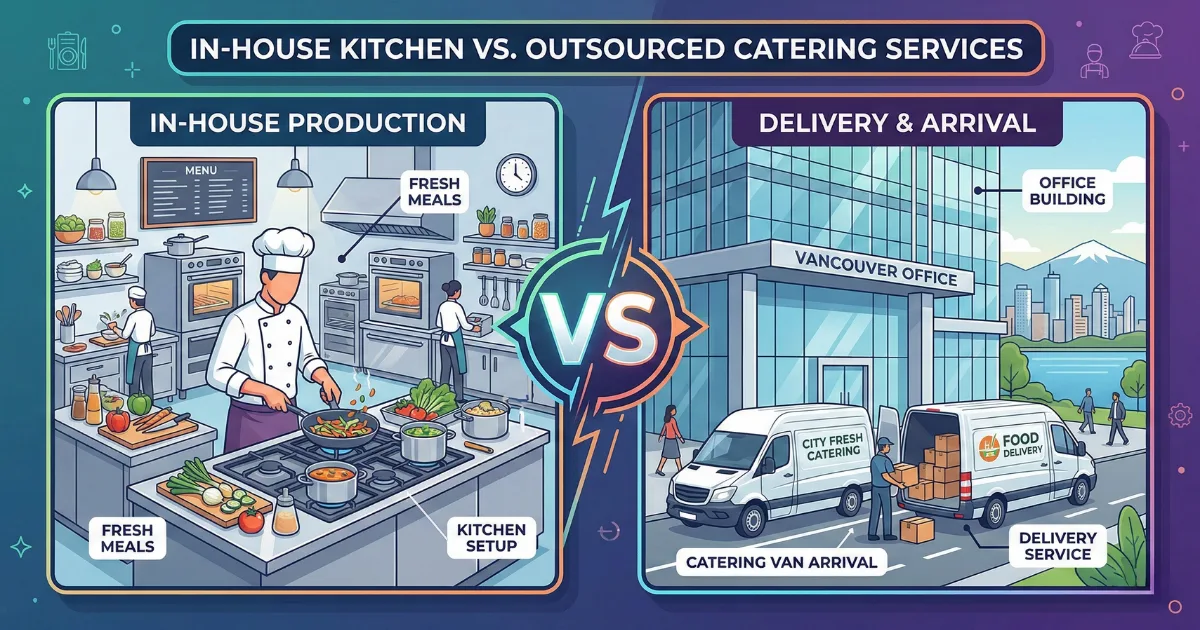
Every few months, a facilities manager or CFO sits across from me and asks some version of the same question: "We're growing fast. Should we just build our own kitchen?" It's a question that sounds like it has an obvious answer once you're past a certain headcount. Big tech campuses do it. Googleplex has kitchens. Surely at some point it makes financial sense to bring everything in-house.
After years of running My Great Pumpkin's corporate catering operations across Metro Vancouver — delivering to offices in Downtown, Burnaby, Richmond, and New Westminster through a network of 120+ restaurant partners — I've had this conversation dozens of times. I've watched three companies build kitchens. I've watched two of those companies quietly shut them down within 18 months. And I've worked with plenty of offices in that 80-to-200 employee range where the question keeps coming up because the per-head math seems tempting on a napkin.
The short answer: for most Vancouver offices under 200 employees, building an in-house kitchen costs more over 5 years than outsourcing, and the gap is wider than the buildout number alone suggests. The long answer requires walking through capital costs, staffing, regulatory compliance, menu fatigue, and the opportunity cost of commercial square footage in one of North America's most expensive real estate markets.
Let me lay it all out.
Last reviewed: March 2026. Data current as of this date.
The Capital Cost: $150K-$500K Before Anyone
Cooks a Single Meal
Building a commercial kitchen inside a Vancouver office isn't a renovation — it's a construction project with specialized engineering requirements. Here's what I've seen companies actually spend:
Ventilation and exhaust systems: $40,000-$120,000. A commercial kitchen requires a Type 1 hood system with fire suppression, dedicated HVAC makeup air, and rooftop exhaust ducting. In a downtown Vancouver high-rise, running ductwork from a mid-floor office to the rooftop isn't just expensive — some buildings won't permit it at all. The strata or landlord approval process alone can take 3-6 months.
Plumbing and grease interceptors: $25,000-$60,000. Vancouver's sewer bylaws require grease interceptors for any commercial cooking operation. Retrofitting these into an existing office floor means tearing into concrete, rerouting drain lines, and passing a City of Vancouver plumbing inspection. If you're in a newer building along the Broadway corridor or in Metrotown, the plumbing infrastructure might accommodate this. In an older Gastown or Yaletown building, you could be looking at structural engineering assessments on top of the plumbing work.
Commercial cooking equipment: $30,000-$80,000. Ranges, ovens, fryers, refrigeration units, prep stations, dishwashing systems. This isn't residential-grade equipment — it needs to meet CSA standards and pass Vancouver Coastal Health inspection. A basic setup for 50-person daily service starts around $30K. A full kitchen capable of serving 150+ with menu variety pushes well past $60K.
Electrical upgrades: $15,000-$40,000. Commercial cooking equipment draws significant amperage. Most Vancouver office floors aren't wired for it. You'll need dedicated circuits, possibly a panel upgrade, and an electrical permit.
Construction, permits, and design: $40,000-$200,000. General contracting, architectural drawings (required for permit), building permits from the City of Vancouver, fire department approval, accessibility compliance. Timeline: 4-8 months from design to operational kitchen.
Total buildout range: $150,000-$500,000, depending on building age, floor location, kitchen size, and menu ambition. The $150K figure assumes a basic prep-and-reheat setup in a ground-floor unit with existing commercial plumbing. The $500K figure reflects a full-production kitchen in a multi-story office building downtown.
And here's what catches people off guard: that money is spent before a single meal is served. If your lease expires in 3 years, you've just poured $150K-$500K into an asset you can't take with you. Most commercial kitchen buildouts are not transferable — they're fixtures that stay with the building when you leave.
Ongoing Staffing: $180,000+ Per Year, Minimum
A kitchen without a cook is an expensive storage room. Here's the realistic staffing cost for a corporate kitchen serving 50-150 employees daily in Vancouver:
Head chef / kitchen manager: $65,000-$85,000/year. This is someone who can plan menus, manage food costs, maintain health code compliance, and actually cook at volume. In Vancouver's current labor market, experienced institutional cooks command $28-$38/hour. You need someone full-time, 5 days a week, starting prep at 8:00 AM for a noon service.
Kitchen assistant / prep cook: $42,000-$52,000/year. Your head chef cannot do everything alone once you're past about 40 daily covers. Prep, dishwashing, cleaning, receiving deliveries — that's a second full-time position.
Relief / part-time coverage: $15,000-$25,000/year. Vacations, sick days, statutory holidays. When your chef is out, someone still needs to feed the office. Relief cooks in Vancouver are scarce and command premium day rates.
Payroll burden (CPP, EI, WorkSafeBC, benefits): ~20% of base salaries. For two full-time kitchen staff plus relief coverage, that's $24,000-$32,000/year in employer-side costs alone.
Total annual staffing: $146,000-$194,000/year, with a realistic midpoint around $180,000 for a competent two-person kitchen operation.
This number doesn't include the cost of turnover. Hospitality turnover in BC runs high — the BC Restaurant and Foodservices Association has documented this extensively. If your chef leaves, you're looking at 4-8 weeks to recruit, during which you're either scrambling with temp cooks or — more often — ordering catering anyway.
Ready to simplify office meals?
Join 100+ Vancouver offices enjoying hassle-free lunch delivery. Free tasting, no contract.
Request a Demo →Vancouver Coastal Health Compliance: The Invisible Overhead
Operating a commercial kitchen in British Columbia means submitting to Vancouver Coastal Health (VCH) inspections. This isn't optional, and it's not a one-time checkbox.
Pre-opening requirements:
- Submit a food service facility plan for review
- Obtain a food service establishment permit
- Pass an initial inspection before serving any food
- Ensure at least one person on-site holds a valid FOODSAFE Level 1 certificate (Level 2 for the person in charge)
Ongoing obligations:
- Routine inspections (typically 1-3 per year, unannounced)
- Temperature logging for all refrigerated and hot-held items
- Documented cleaning and sanitation schedules
- Pest control program
- Allergen management procedures
- Proper food labeling and handling protocols
What non-compliance looks like: VCH inspection results are public. If your corporate kitchen gets a low rating or a closure order, that's visible to anyone who searches — including your own employees. I've seen one Vancouver office kitchen receive a conditional pass that required immediate corrective action, and the internal fallout was significant. Employees who had been eating there daily suddenly didn't trust the food. The company ended up outsourcing catering within two months anyway, having spent $280K on a buildout they used for less than a year.
The compliance overhead isn't dramatic in isolation — maybe 5-8 hours per week of documentation, monitoring, and cleaning protocol adherence. But it's perpetual, and it falls on your kitchen staff, which means it's eating into their cooking and prep time. For a two-person kitchen serving 100+ people, that squeeze is real.
Menu Fatigue: The Problem Nobody Budgets For
Here's something I've watched destroy in-house kitchen programs that were otherwise well-run: a single kitchen with one or two cooks produces a limited flavor profile, and employees notice within 8-12 weeks.
Your head chef has a repertoire. Maybe it's 40-50 dishes they can rotate through competently. That sounds like a lot until you realize you're serving the same audience every single day, 5 days a week. By week 10, the rotation starts feeling repetitive. By week 16, employees are skipping the kitchen and ordering delivery on their phones. By week 24, participation rates have dropped 20-30% from their launch-day peak, and your CFO is looking at a kitchen that cost $300K to build and $180K/year to staff, feeding 60% of the office instead of 90%.
This isn't a failure of the chef. It's a structural limitation of a single-source kitchen. One person, one set of skills, one set of equipment, one supply chain.
Compare that with an outsourced model drawing from 120+ restaurant partners. A team eating three days a week might get Japanese bento boxes on Monday, Mediterranean grain bowls on Wednesday, and Vietnamese banh mi on Friday — all from different kitchens with different chefs, different techniques, and different supply chains. The variety is structural, not dependent on one person's creativity under daily pressure.
Space Opportunity Cost: Vancouver's $40-$65/sqft Reality
This is the cost that facilities managers understand instinctively but CFOs sometimes overlook in the kitchen ROI calculation.
A functional commercial kitchen for 50-150 daily covers requires 400-800 square feet of dedicated space — kitchen proper, storage, dishwashing area, and a buffer zone for fire code compliance. In Vancouver's commercial real estate market, that square footage has a very real alternative value.
Downtown Vancouver (Class A office): $45-$65/sqft/year. An 600 sqft kitchen is giving up $27,000-$39,000/year in leasable or usable space.
Burnaby (Metrotown / Brentwood corridor): $35-$50/sqft/year. Same kitchen footprint: $21,000-$30,000/year.
Richmond (City Centre / No. 3 Road): $30-$45/sqft/year. Same footprint: $18,000-$27,000/year.
That 600 square feet could be a meeting room, a quiet work area, additional desks for 6-8 employees, or a wellness room. In a market where companies are paying $40+/sqft for every square foot of their lease, dedicating space to kitchen infrastructure is a real capital allocation decision — not just a facilities question.
The 5-Year Total Cost Comparison
Let me bring this together with a concrete scenario: a 75-person Vancouver office, feeding employees 5 days a week, comparing in-house kitchen buildout versus outsourced catering over 5 years.
In-house assumptions:
- Buildout: $300,000 (mid-range for a downtown office)
- Annual staffing: $180,000
- Annual food & supplies: $146,250 ($7.50/meal x 75 people x 260 days)
- Annual compliance/maintenance: $15,000
- Annual space opportunity cost: $30,000 (600 sqft @ $50/sqft)
- Total Year 1: $571,250
- Total Years 2-5: $371,250/year
Outsourced assumptions:
- No buildout cost
- Per-meal cost: $13/person (My Great Pumpkin mid-tier)
- Annual cost: $253,500 ($13 x 75 people x 260 days)
- No staffing, no compliance overhead, no space loss
- Total Year 1: $253,500
- Total Years 2-5: $253,500/year
Over 5 years, the in-house kitchen costs approximately $2,056,250. Outsourced catering costs approximately $1,267,500. That's a $788,750 difference — nearly $158,000 per year in savings by outsourcing.
And that gap only widens when you factor in scenarios the chart doesn't capture: equipment replacement (commercial kitchen gear has a 5-7 year lifecycle, so you're staring down major capital expenditure again right as the initial investment depreciates), chef turnover requiring temporary catering anyway, or the buildout becoming a sunk cost if you relocate offices.
The Break-Even Question: When Does In-House Actually Make Sense?
I'd be dishonest if I said outsourcing always wins. There's a crossover point, and I'll tell you where I've seen it.
In-house kitchens start making financial sense at roughly 200+ employees eating daily, in a building you own or have a 10+ year lease on, with sufficient space that the kitchen doesn't displace revenue-generating square footage.
At 200 daily covers, the food cost per meal in an in-house kitchen drops to roughly $5.50-$6.50 because of bulk purchasing power and reduced per-unit prep labor. The staffing cost per meal also improves — you might add one more cook, but you're spreading $220K in labor across 52,000 annual meals instead of 19,500. The math starts working.
There are also non-financial reasons that justify in-house kitchens for certain companies:
Brand and culture signaling. Tech campuses use kitchens as recruiting tools. "Free chef-prepared lunch daily" is a perk that shows up in job postings and Glassdoor reviews. For companies competing for talent in Vancouver's tech market — along the Broadway corridor, in Mount Pleasant, around the future Broadway subway stations — the kitchen itself becomes part of the employer brand.
Dietary control for specialized populations. Companies with strict halal, kosher, or allergen-free requirements sometimes find it easier to control a kitchen than to audit external caterers. A biotech firm I spoke with in South Vancouver built a kitchen specifically because three employees had severe cross-contamination allergies, and the liability risk of external food was too high for their risk management team.
Event and client entertainment. If your office regularly hosts clients, investors, or partners, an in-house kitchen allows you to offer a hospitality experience that outsourced catering cannot replicate. Law firms in downtown Vancouver and financial services offices near Waterfront Station sometimes build kitchens for this reason — the kitchen serves a dual purpose as both employee benefit and business development tool.
But these are exceptions, not the rule. For the majority of Vancouver offices in the 25-150 employee range, the numbers don't support a buildout.
What Outsourcing Actually Looks Like in Practice
I want to address a misconception I hear regularly: that "outsourced catering" means sad sandwich platters on a boardroom table.
What we do at My Great Pumpkin is fundamentally different from that image. We rotate through 120+ local restaurant partners across Metro Vancouver. A 75-person office eating with us three days a week might get Korean bibimbap bowls on Monday from a partner kitchen in Burnaby, West Coast salmon grain bowls on Wednesday from a Kitsilano supplier, and Indian butter chicken with fresh naan on Friday from a Richmond restaurant. Every delivery accommodates dietary restrictions — halal, vegetarian, vegan, gluten-free, allergy-specific — because our partners are vetted for their ability to handle these requirements at volume.
The per-meal cost of $10-$15 covers food, delivery, logistics coordination, and menu rotation. There's no buildout, no staffing liability, no equipment maintenance, no VCH inspection anxiety. Your office manager confirms headcount weekly and approves a menu. We handle everything else.
For offices in Richmond's business parks — near No. 3 Road or along Westminster Highway — we build a 20-minute delivery buffer into every lunch slot because we know what that corridor looks like between 11:45 AM and 1:15 PM. For downtown high-rise offices where loading dock access requires coordination, our drivers know the buildings. During Vancouver's rainy season from October through April, our insulated moisture-resistant delivery bags keep food at temperature even when conditions are harsh.
This operational depth is what you're actually comparing against when you evaluate "build vs. buy." The kitchen buildout cost is the visible number. The invisible comparison is against a delivery operation that has already solved the logistics problems your in-house team would spend months learning.
The Decision Framework
Here's how I'd structure this decision if I were advising a facilities manager or CFO in Metro Vancouver:
Build an in-house kitchen if:
- You have 200+ employees eating daily, consistently
- You own your building or have a 10+ year lease
- You have 600+ sqft that isn't displacing revenue-generating space
- Kitchen-as-perk is central to your recruiting strategy
- You have specialized dietary/liability requirements that require full control
- You're prepared for $300K+ upfront and $370K+/year ongoing
Outsource catering if:
- You have 25-200 employees
- Your lease is under 10 years
- Space is at a premium (especially downtown or Metrotown)
- You want menu variety without single-source fatigue
- You prefer variable cost over fixed overhead
- You'd rather not manage kitchen staff, health inspections, and equipment
Consider a hybrid if:
- You have a large office (150+) with a pantry/warming kitchen but not full production
- You want to supplement outsourced catering with on-site snacks, coffee, and breakfast items
- Your culture values a kitchen "feel" without the full buildout cost
What My Great Pumpkin Offers
I'll keep this brief and factual, since I've been upfront about my perspective throughout.
We run corporate meal programs across Greater Vancouver — Downtown, Burnaby, Richmond, New Westminster, Surrey, and surrounding municipalities. Our network of 120+ local restaurant partners provides rotating menus with full dietary accommodation. The per-meal cost runs $10-$15 per person depending on menu tier and team size, with no setup fees, no capital requirements, and no long-term contract lock-in. We handle logistics, menu rotation, dietary tracking, and delivery.
For companies currently evaluating a kitchen buildout, we offer a 4-week pilot at standard rates. Run the outsourced model for a month, track total cost and employee satisfaction, and compare it against your buildout projections with real data from your own team. I've done this comparison exercise with enough Vancouver offices to know how it usually turns out — but I'd rather your CFO see the numbers firsthand.
If you're a facilities manager or CFO in Metro Vancouver working through this decision, reach out through mygreatpumpkin.com/demo and we'll walk through the analysis specific to your team size, building situation, and current spending.
The Bottom Line
Building an in-house kitchen feels like a bold investment in your team. And at the right scale — 200+ employees, owned building, long-term commitment — it can be. But for the vast majority of Vancouver offices, the math tells a different story. A $300K buildout plus $370K/year in operating costs, stretched over a lease that might end before the kitchen pays for itself, competing for square footage that costs $40-$65/sqft in Vancouver's commercial market — that's a significant bet.
Outsourced catering through a service like ours costs $253K/year for the same 75-person office, with no capital outlay, no staffing liability, no health inspection overhead, and menu variety that a single kitchen structurally cannot match. Over 5 years, the difference is nearly $790,000.
The kitchen question isn't really about food. It's about capital allocation, space utilization, and risk management. For most Vancouver offices, the answer is clear — but I respect that every company's situation is different. Run the numbers for your specific case, and let the math decide.
Calculate your meal budget
Not sure which meal delivery option fits your budget? Our free calculator compares meal kits, prepared meals, restaurants, and home cooking side-by-side in CAD.
Frequently Asked Questions
How much does it cost to build a commercial kitchen in a Vancouver office?
A commercial kitchen buildout in a Vancouver office typically costs $150,000-$500,000 depending on building age, floor location, and kitchen scope. Major cost components include ventilation and exhaust systems ($40K-$120K), plumbing and grease interceptors ($25K-$60K), commercial cooking equipment ($30K-$80K), electrical upgrades ($15K-$40K), and construction with permits ($40K-$200K). Downtown high-rises tend toward the higher end due to ductwork routing challenges and strata approval requirements, while ground-floor units with existing commercial plumbing may come in closer to the $150K baseline. This investment is made before any meals are served and typically cannot be recouped if you relocate.
What are the ongoing costs of running an in-house corporate kitchen in Vancouver?
Annual operating costs for an in-house corporate kitchen serving 50-150 employees in Vancouver run approximately $370,000 or more. This breaks down into staffing at $180,000+ per year (head chef, prep cook, and relief coverage including employer payroll burden), food and supplies at roughly $146,000 per year for a 75-person office, Vancouver Coastal Health compliance and equipment maintenance at $15,000 per year, and space opportunity cost of $18,000-$39,000 per year depending on your location in Metro Vancouver. The staffing figure alone assumes only two full-time kitchen positions and does not account for turnover costs, which are significant in BC's hospitality labor market.
At what company size does an in-house kitchen make financial sense over outsourced catering?
In-house kitchens generally start making financial sense at approximately 200 or more employees eating daily, in a building you own or have a lease of 10+ years, with sufficient space that the kitchen does not displace revenue-generating square footage. At 200 daily covers, bulk purchasing drives food costs down to $5.50-$6.50 per meal, and staffing costs spread more efficiently across higher meal volume. Below that threshold, the combination of capital buildout costs, fixed staffing overhead, regulatory compliance, and Vancouver commercial real estate opportunity costs typically makes outsourced catering the more cost-effective option by a significant margin.
What Vancouver Coastal Health requirements apply to a corporate office kitchen?
Operating a commercial kitchen in a Vancouver office requires a food service establishment permit from Vancouver Coastal Health (VCH), with mandatory pre-opening facility plan review and initial inspection. At least one person on-site must hold a valid FOODSAFE Level 1 certificate, and the person in charge needs FOODSAFE Level 2. Ongoing obligations include unannounced routine inspections one to three times per year, temperature logging for all refrigerated and hot-held items, documented cleaning and sanitation schedules, pest control programs, allergen management procedures, and proper food labeling. Inspection results are publicly accessible, so a low rating or closure order can damage employee trust and company reputation.
How much can a Vancouver office save by outsourcing catering instead of building a kitchen?
For a 75-person Vancouver office providing daily meals, outsourcing catering saves approximately $789,000 over five years compared to building and operating an in-house kitchen. The in-house path costs roughly $2.06 million over five years when you total the buildout ($300K), staffing ($180K/year), food and supplies ($146K/year), compliance and maintenance ($15K/year), and space opportunity cost ($30K/year). Outsourced catering at $13 per meal costs approximately $1.27 million over the same period with no capital outlay, no staffing liability, and no regulatory overhead. That works out to average savings of roughly $158,000 per year, and the gap widens further when you factor in equipment replacement cycles and potential office relocations.
Related Articles
Skip The Dishes for Business vs. Dedicated Meal Programs
Compare Skip The Dishes for Business against dedicated corporate meal programs for Vancouver offices

Office Catering in Downtown Vancouver Financial District
Daily office catering for Downtown Vancouver. Delivery to Burrard, Granville, and Waterfront offices

Shift Meal Solutions for Call Centers in Vancouver
Call center meal programs in Vancouver. Feed rotating shifts without disrupting phone queues. Plans
Ready to streamline your office meals?
Join 100+ Vancouver offices enjoying hassle-free lunch delivery.
Request a Demo