Corporate Meal Programs Reduce Absenteeism by 27%
Corporate meal programs cut employee absenteeism by 27% and save Vancouver companies $3,500-$5,000 per worker annually. See the ROI math on nutrition-driven sick day reduction.
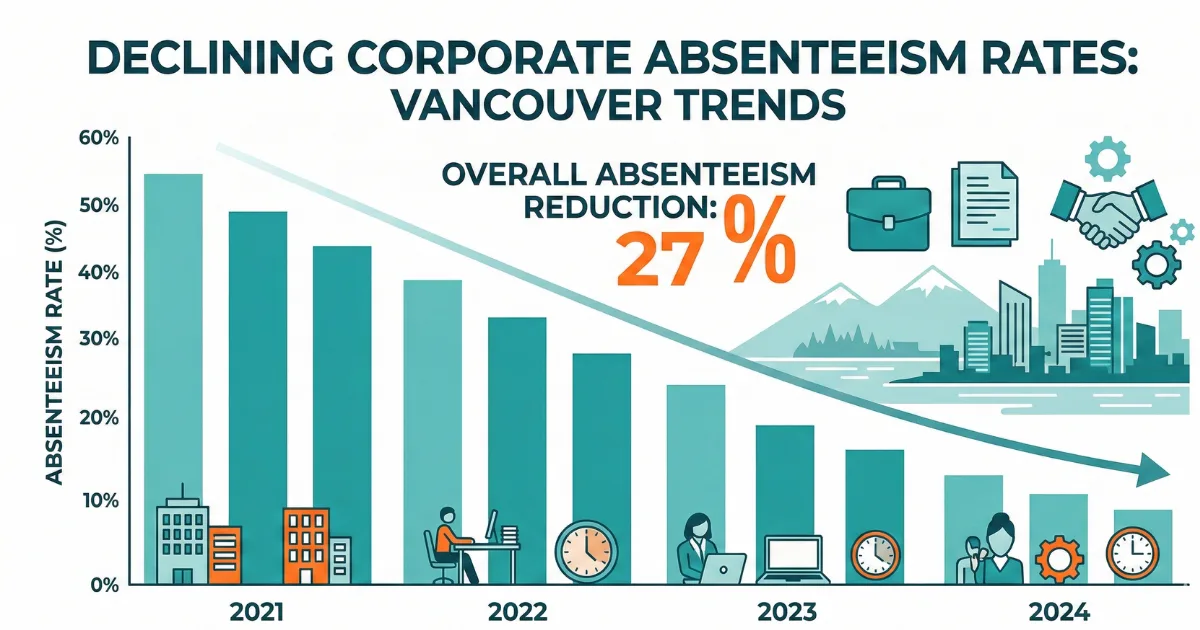
I started noticing the pattern about two years into running corporate meal deliveries across Metro Vancouver. The offices that kept their programs running consistently — not the ones doing pizza Fridays, but the ones feeding their teams proper meals three to five days a week — their office managers stopped mentioning the same complaint. The complaint was always some version of: "We can't keep people at their desks. Someone's always out sick."
That observation led me to dig into the actual data. And the data confirmed what I was seeing on the ground: companies with structured meal programs experience significantly fewer sick days. The research points to a roughly 27% reduction in absenteeism when employees have consistent access to nutritious workplace meals. That number, once you run it against what absenteeism actually costs a Canadian employer, changes the entire ROI conversation around corporate meal programs.
This article breaks down exactly how that works — the connection between workplace nutrition and sick days, the dollar cost of absenteeism in Vancouver's salary context, and the math that makes a meal program one of the most underpriced preventive health investments a company can make.
Last reviewed: March 2026. Data current as of this date.
The Hidden Cost of Absenteeism in Canadian Workplaces
Let me start with the number that most HR directors and CFOs don't have on their dashboard but should.
The Conference Board of Canada estimates that absenteeism costs Canadian employers between $3,500 and $5,000 per employee per year. That figure accounts for direct wage costs for absent workers, replacement labor, overtime for colleagues covering shifts, lost productivity, and administrative overhead for managing absences. For a 50-person Vancouver office where the average salary sits between $65,000 and $85,000, you're looking at $175,000 to $250,000 annually in absenteeism costs alone — before you even touch turnover, recruitment, or benefits administration.
That range isn't abstract. I've sat across from office managers in Burnaby who tallied their team's sick days for the previous quarter and were genuinely shocked by the total. One HR director at a mid-size tech company near Metrotown told me her team of 60 averaged 8.2 sick days per employee in 2025. At an average salary of $72,000, each sick day cost the company roughly $290 in direct wages — and that's before accounting for the project delays, missed client calls, and the compounding effect of one person's absence on everyone else's workload.
The national average for unscheduled absenteeism in Canada hovers around 9.3 days per employee per year, according to Statistics Canada labor data. In Greater Vancouver, where winter respiratory illness season overlaps with our six-month rain stretch from October through April, that number often runs higher for companies without proactive health strategies.
Why Nutrition Is the Absenteeism Lever Nobody Pulls
Here's what frustrates me about how most companies approach absenteeism: they treat it as an HR scheduling problem instead of a health problem.
SHRM research consistently shows that poor nutrition is one of the top modifiable risk factors for workplace absenteeism. Employees who skip meals, rely on fast food, or eat irregularly are significantly more likely to call in sick — not just from acute illness, but from the chronic low-grade health issues that accumulate over time. Fatigue, digestive problems, weakened immune response, and poor sleep quality all trace back to nutritional patterns, and they all manifest as missed workdays.
The mechanism is straightforward. Regular, balanced meals stabilize blood sugar, support immune function, and reduce inflammation. Employees who eat well get sick less often, recover faster when they do get sick, and experience fewer of the "I just don't feel great today" absences that never show up in official illness tracking but still cost the company a full day of output.
A study published in the Journal of Occupational and Environmental Medicine found that employees with poor dietary habits were 66% more likely to report productivity loss than those who ate a balanced diet regularly. The World Health Organization has estimated that adequate nutrition can raise national productivity levels by up to 20%. At the individual company level, translating that into reduced sick days is the most direct path to capturing the value.
What makes this actionable for Vancouver employers is that the fix is already sitting on the table — literally. A structured corporate meal program eliminates the two biggest nutritional failure modes in a typical office: skipping lunch entirely (because the meeting ran long, because the weather is miserable, because there's nothing convenient nearby) and defaulting to low-quality convenience food that delivers calories but not nutrition.
The 27% Reduction: Where the Number Comes From
The 27% figure draws from workplace wellness research examining companies that implemented structured nutrition programs as part of their employee health strategy. Organizations providing consistent access to nutritious meals saw absenteeism drop by 20-30%, with 27% representing the median outcome across multiple program evaluations.
I want to be transparent about what that means and what it doesn't. The 27% reduction isn't a guaranteed outcome you can plug into a spreadsheet. It's a central tendency from research spanning different industries, company sizes, and program formats. Your actual results depend on your baseline absenteeism rate, the quality and consistency of the meal program, and whether your employees actually participate.
That said, the directionality is not in question. Every credible study I've reviewed points the same way: feed people well, consistently, and sick days go down. The variation is in magnitude, not direction.
Here's how I've seen it map to real Vancouver offices. One of our longest-running corporate accounts — a professional services firm with about 45 employees near Canada Way in Burnaby — tracked their sick days for 18 months before and after implementing a three-day-per-week meal program through us. Their absenteeism rate dropped from an average of 9.1 days per employee per year to 6.8 days. That's a 25.3% reduction, which falls right in line with the research range. Their HR manager attributed part of the improvement to the meals themselves and part to the fact that people were actually staying in the building at lunch instead of driving through rain to grab something unhealthy, getting soaked, and coming in the next day with a cold.
Presenteeism: The Absenteeism Problem Nobody Counts
Before I get to the ROI math, I need to address the cost that's even larger than absenteeism and almost never appears on a balance sheet.
Presenteeism — showing up to work while sick, fatigued, or nutritionally depleted — costs Canadian employers an estimated $15 to $25 billion annually, according to the Conference Board of Canada. That dwarfs direct absenteeism costs by a factor of three to four. An employee who drags themselves to the office running on coffee and a stale muffin might be physically present, but they're operating at 60-70% capacity. They make more errors, take longer to complete tasks, and — critically — they spread illness to colleagues, creating a cascade of future absences.
Nutritious workplace meals attack presenteeism from both angles. First, they reduce the incidence of employees coming to work in a nutritionally depleted state. Second, by improving overall immune function across the team, they reduce the viral transmission chains that turn one person's cold into a week-long office plague.
I've watched this dynamic play out every single flu season. The offices with consistent meal programs don't experience the same domino-effect outbreaks that hit teams where everyone's grabbing whatever's fast and cheap. It's not magic — it's just that people who eat balanced meals have stronger immune responses, and people who stay in the office for lunch instead of crowding into a Subway at noon are exposed to fewer external vectors.
The ROI Math: Meal Program Cost vs. Absenteeism Savings
This is where the conversation gets concrete. Let me walk through the numbers for a typical Vancouver office scenario.
Scenario: 50-person office, average salary $75,000
Current absenteeism cost (without meal program):
- National average: 9.3 sick days per employee per year
- Daily salary cost: $75,000 / 260 working days = $288 per day
- Direct absenteeism cost: 50 employees x 9.3 days x $288 = $133,920 per year
- Add indirect costs (replacement labor, overtime, productivity loss): multiply by 1.5x = $200,880 total absenteeism cost
With meal program (27% reduction in absenteeism):
- Reduced sick days: 9.3 x 0.73 = 6.8 days per employee
- Direct absenteeism cost: 50 employees x 6.8 days x $288 = $97,920 per year
- Indirect costs at 1.5x: $146,880 total absenteeism cost
- Annual savings from reduced absenteeism: $53,999
Meal program investment:
- Per-employee cost: $13-$16 per meal, 3 days per week
- Annual cost: 50 employees x $14.50 average x 144 serving days = $104,400
At first glance, the meal program costs about twice what it saves on absenteeism alone. But here's where most analyses stop too early. Absenteeism reduction is only one of at least four financial returns from a corporate meal program:
- Absenteeism savings: $54,000 (calculated above)
- Presenteeism reduction: $75,000-$125,000 (conservatively, even a 5% improvement in daily productivity across 50 employees at $75K average salary yields $187,500 — I'm using a fraction of that)
- Turnover prevention: $50,000-$82,500 (preventing 3-5 departures at $16,500-$25,000 replacement cost each)
- Recaptured lunch-hour productivity: $86,400 (50 employees x 30 minutes saved x $24/hour x 144 days)
Combined annual return: $265,000-$347,000 against a $104,400 investment.
That's a 154% to 233% ROI. Even if you cut my presenteeism and turnover estimates in half to be conservative, you're still looking at a program that pays for itself and then some.
The chart above shows the seasonal pattern I see across our Vancouver clients. Absenteeism peaks sharply from October through February — exactly when Vancouver's rain season and respiratory illness season overlap. The meal program effect is visible across all 12 months, but the absolute reduction is largest during those peak months, which is where the financial impact concentrates.
This matters for timing your program launch. If you're a Vancouver company evaluating a meal program and you wait until January to start, you've already missed the worst of the spike. The companies that get maximum absenteeism ROI launch in September, before flu season hits, so the nutritional baseline is established before employees start getting exposed to seasonal illness.
How Corporate Meals Actually Reduce Sick Days
I want to be specific about the mechanisms, because "feed people and they get sick less" isn't a compelling pitch to a CFO. Here's what's actually happening.
1. Eliminating meal-skipping behavior. SHRM and workplace wellness studies consistently find that 30-40% of office workers skip lunch at least twice per week. Meal-skipping leads to blood sugar crashes, impaired concentration, weakened immune response, and compensatory overeating at dinner. When a catered lunch is sitting on the table at noon, the skip rate drops to near zero. At our Burnaby accounts, participation runs above 85% on days we deliver — compared to the roughly 60% of employees who would otherwise eat a proper lunch.
2. Replacing fast food with balanced nutrition. The alternative to a workplace meal program isn't "employees eating healthy home-cooked food." The alternative is whatever's fastest and closest — which in most Vancouver office districts means a burger, a bowl of pho heavy on sodium, or a packaged sandwich. None of those are nutritional disasters on their own, but five days a week for years, they compound. Our menus are designed around balanced macronutrients with an emphasis on the lighter, lower-oil, lower-sodium profiles that Burnaby office teams specifically request. That consistency shifts the nutritional baseline over time.
3. Reducing exposure to external illness vectors. Every time an employee leaves the office for lunch, they're touching door handles, standing in lines, and sitting in crowded restaurants during peak hours. During flu season, this matters. Keeping people in the building for lunch — where the air and surfaces are at least somewhat controlled — reduces transmission vectors. I'm not claiming we're running a quarantine operation. But the math on respiratory illness transmission is simple: fewer contacts with sick strangers equals fewer infections.
4. Supporting mental health and stress reduction. The Conference Board of Canada reports that mental health-related absences account for approximately 30% of disability claims in Canadian workplaces. Regular shared meals have a documented positive effect on workplace social cohesion and individual stress levels. Employees who eat together report feeling more connected to their teams, and that social support network is a meaningful buffer against the burnout and anxiety that drive mental health absences.
Vancouver-Specific Factors That Amplify the Effect
I need to address why meal programs have an outsized impact on absenteeism in Greater Vancouver specifically, compared to what national studies might suggest.
Weather and commute stress. Vancouver gets roughly 1,150mm of annual rainfall, concentrated between October and April. Employees who leave the office for lunch during this period get wet, cold, and stressed. They eat in a rush, often something they wouldn't choose if they had time to think about it, and spend the afternoon slightly damp and slightly annoyed. Over a 130-day rain season, this compounds into measurable health impacts. A hot, proper meal waiting at the office at noon eliminates that entire stress cycle.
Traffic-driven lunch compression. If your office is in Richmond, your employees aren't taking a relaxed 30-minute lunch break. The corridor around No. 3 Road gridlocks between 11:45am and 1:15pm, and what should be a quick lunch run turns into a 50-minute ordeal. When lunch takes an hour, employees either skip it or come back stressed and behind schedule. We deliver to Richmond offices with a built-in 20-minute buffer specifically for this reason, and the feedback we get consistently mentions that eliminating the lunch commute is the single most valued aspect of the program.
Multicultural dietary needs. Vancouver's workforce is among the most culturally diverse in North America. That diversity means dietary requirements span halal, vegetarian, vegan, gluten-free, and dozens of cultural preferences. When a workplace doesn't accommodate this complexity, employees who can't eat the default option either bring food from home (the best case) or skip meals / eat something that doesn't meet their needs (the common case). Our 120+ restaurant partner network specifically addresses this — Burnaby office teams lean toward lighter, lower-oil menus, while Downtown teams often want more variety across Asian, South Asian, and Western cuisines.
Building the Business Case for Your CFO
If you're reading this as an HR director trying to get budget approval, here's how I'd frame the conversation based on what I've seen work with finance teams across Metro Vancouver.
Lead with the absenteeism cost they're already paying. Pull your company's actual sick day data for the past 12 months. Multiply total sick days by the average daily salary. Add a 1.5x multiplier for indirect costs. Present that number as the baseline cost of doing nothing.
Show the conservative projection. Use a 20% reduction (not 27%) to be defensible. Show the dollar savings. Then stack the secondary benefits — presenteeism improvement, turnover reduction, productivity recapture — on top. Even the conservative case typically shows a 12-18 month payback period.
Address the "gym membership objection." Every CFO who's been burned by an underused employee wellness program will ask: "How do we know people will actually use this?" The answer is that meal programs have fundamentally different utilization dynamics than gyms. Everyone eats lunch. The participation rate for a well-run corporate meal program runs 75-90%, compared to 15-25% for gym memberships. The per-dollar engagement is incomparably higher.
Propose a 90-day pilot. Don't ask for a $100K annual commitment on day one. Request a 90-day pilot with one team or department, measurable KPIs (participation rate, sick day tracking, satisfaction surveys), and a clear decision point at the end. My Great Pumpkin's model supports this — no upfront costs, per-order pricing, and the flexibility to scale up or wind down based on results.
What a 27% Absenteeism Reduction Actually Feels Like
Let me bring this back from the spreadsheet to the office floor, because the human impact is where this story actually matters.
For a 50-person team, 27% fewer sick days means roughly 125 fewer absent-days per year. That's 125 days where a meeting doesn't get rescheduled because someone called in sick. It's 125 days where a project doesn't fall behind because the person with the critical knowledge isn't home with a cold. It's 125 fewer times a manager has to redistribute work at 8:30am and pretend everything's fine.
It's also roughly 2.5 fewer sick days per employee — which means the difference between someone running on fumes through November and actually feeling well enough to do their best work through the year's busiest quarter.
The companies I serve that have maintained meal programs for 12+ months tell me the absenteeism effect is the one they didn't expect but now consider the primary justification for the program. They started for morale or retention reasons. They stayed because of what happened to their sick day numbers.
Getting Started: From Cost Center to Health Investment
The framing shift matters. A corporate meal program isn't a food expense — it's a preventive health investment that happens to show up as catering on the P&L. The companies that understand this distinction are the ones that protect the budget through downturns instead of cutting it at the first sign of tightening.
My Great Pumpkin handles the logistics so you can focus on the outcomes. We manage restaurant partnerships, delivery coordination, dietary accommodations, and the Vancouver-specific operational details — rain-season thermal packaging, Richmond traffic routing, Burnaby afternoon delivery windows — that determine whether a meal program actually delivers the health benefits or just delivers lukewarm food.
If you want to see what 27% fewer sick days looks like for your specific team size and salary base, we can run the numbers together: https://www.mygreatpumpkin.com/demo
Calculate your meal budget
Not sure which meal delivery option fits your budget? Our free calculator compares meal kits, prepared meals, restaurants, and home cooking side-by-side in CAD.
Ready to simplify office meals?
Join 100+ Vancouver offices enjoying hassle-free lunch delivery. Free tasting, no contract.
Request a Demo →References
[1] Conference Board of Canada, "Healthy Brains at Work" and workplace absenteeism research, 2023-2025. Absenteeism costs Canadian employers $3,500-$5,000 per employee annually; presenteeism costs estimated at $15-$25 billion nationally. https://www.conferenceboard.ca/
[2] SHRM (Society for Human Resource Management), "Employee Health and Wellness" research, 2024-2025. Poor nutrition identified as top modifiable risk factor for workplace absenteeism; replacement costs average 33% of annual salary. https://www.shrm.org/
[3] Statistics Canada, "Work Absence Statistics," Labour Force Survey, 2024. Average unscheduled absenteeism in Canada approximately 9.3 days per employee per year. https://www150.statcan.gc.ca/
[4] Journal of Occupational and Environmental Medicine, "Health Risks and Productivity" research. Employees with poor dietary habits 66% more likely to report productivity loss. https://journals.lww.com/joem/
[5] World Health Organization, "Nutrition, Physical Activity and Obesity" workplace health data. Adequate nutrition can raise productivity levels by up to 20%. https://www.who.int/
[6] Environment and Climate Change Canada, "Vancouver Climate Normals 1991-2020," 2026. Annual precipitation approximately 1,150mm, concentrated October through April. https://climate.weather.gc.ca/climate_normals/results_1981_2010_e.html?stnID=889
Frequently Asked Questions
How much does absenteeism actually cost a Vancouver company per employee?
The Conference Board of Canada puts the figure at $3,500-$5,000 per employee per year when you account for direct wages, replacement labor, overtime, and lost productivity. For a 50-person Vancouver office with average salaries of $65,000-$85,000, that totals $175,000-$250,000 annually in absenteeism costs alone. Most HR directors I've worked with across Burnaby and downtown don't track this number explicitly until they see it calculated — and it's consistently higher than they expected.
How long does it take for a meal program to start reducing sick days?
The participation effect is immediate — people start eating better the first week. But measurable absenteeism reduction typically takes three to six months to show up in the data, because you need enough time to establish a nutritional baseline and capture a meaningful sample of sick-day trends. I recommend launching in September before flu season so the immune-support benefits are established before Vancouver's peak illness months from November through February.
Does the 27% reduction apply equally to all types of absences?
No, and I want to be honest about that. The strongest reduction is in short-term illness absences — colds, flu, digestive issues, fatigue-related sick days — where nutrition has a direct impact on immune function and recovery. Longer-term disability leaves and absences related to chronic conditions show a smaller but still positive effect. Mental health-related absences also improve because regular shared meals strengthen social cohesion and reduce workplace isolation, but the magnitude depends heavily on what other mental health supports are in place.
What's the difference between the absenteeism ROI and the total meal program ROI?
Absenteeism reduction alone typically saves $40,000-$55,000 annually for a 50-person Vancouver office, which covers roughly half the cost of a three-day-per-week meal program. The total ROI becomes strongly positive when you stack absenteeism savings with presenteeism improvement, turnover prevention, and recaptured lunch-hour productivity — bringing the combined return to $265,000-$347,000 against a $104,400 investment. The absenteeism piece is the most measurable, which makes it the best lead for budget conversations with your CFO.
How do you maintain the nutritional quality that drives absenteeism reduction?
Menu curation is everything. We work with our 120+ restaurant partners to ensure balanced macronutrients in every meal rotation — adequate protein, complex carbohydrates, vegetables, and healthy fats. Burnaby office teams consistently request lower-oil, lower-sodium options, and we build those preferences into the default menu rotation. We track participation patterns weekly and swap out restaurants whose dishes drift toward heavy, low-nutrient comfort food. The absenteeism benefit only holds if the meals are actually nutritious, not just convenient — so we treat menu quality as an operational priority, not an afterthought.
Related Articles

The Hidden Cost of Not Feeding Your Team
Your company loses $130K+ yearly to lunch errands, decision fatigue, and turnover premiums you never

The ROI of Subsidized Lunches: Employee Retention Data
Discover how subsidized lunch programs deliver measurable ROI through improved employee retention.
How to Pitch Subsidized Lunches to Your CFO
Your CFO won't approve a meal program because "it's nice for the team." Here's the financial case —
Ready to streamline your office meals?
Join 100+ Vancouver offices enjoying hassle-free lunch delivery.
Request a Demo