Why Your Office Manager Hates Collecting Lunch Orders
Your office manager spends hours every week collecting, organizing, and tracking lunch orders. Here's the hidden time cost, why it's unsustainable, and how Vancouver offices are solving it.
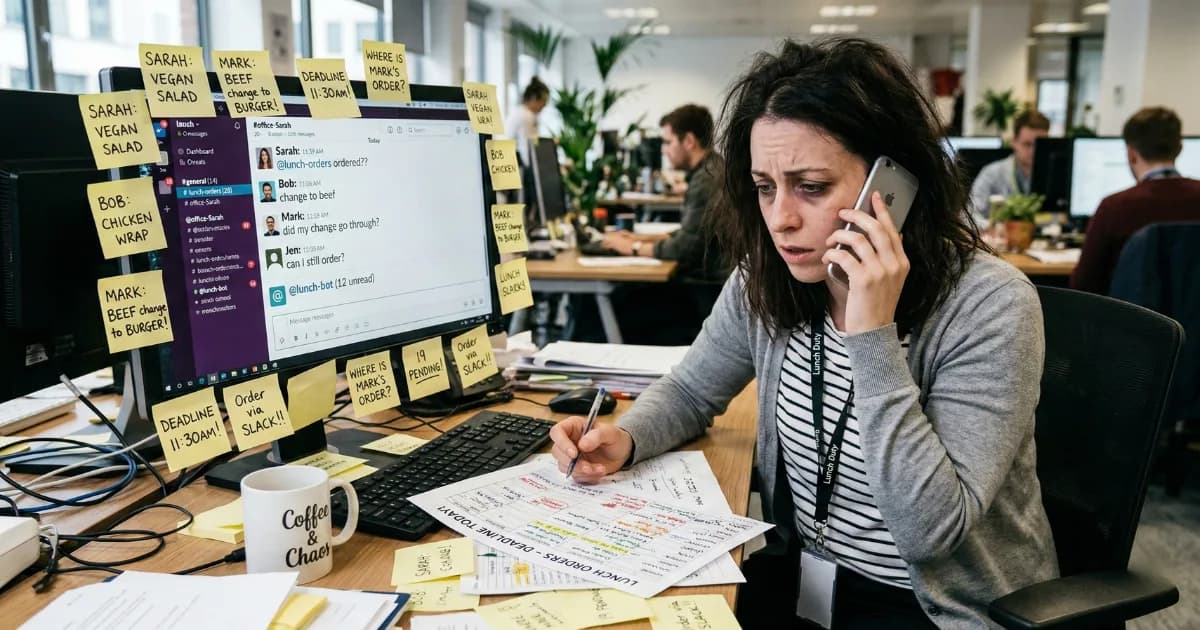
If you work in an office with 15 or more people and someone handles group lunch orders manually, I can tell you exactly what their week looks like — because I've heard the same story from office managers across Metro Vancouver, from Gastown startups to Burnaby corporate parks to Richmond professional offices.
Monday morning: a Slack message goes out. "Hey team, what do you want for lunch? Here's the menu from [restaurant]. Please reply by 10:30 AM." By 10:45, eight people have responded. Five haven't. Two responded with questions. One changed their mind. The office manager spends the next 30 minutes chasing responses, compiling the order, calling the restaurant, reading back 15 individual meals with modifications, paying on a personal credit card, and submitting an expense report.
Then the food arrives 20 minutes late because the restaurant was overwhelmed by a 15-item phone order placed at 11 AM, and three meals are wrong because "no onions" got lost in translation between the Slack thread, the office manager's notepad, and the restaurant's POS system.
The office manager does this three to five times per week. It's not in their job description. Nobody hired them for this. But somehow, "can you handle lunch?" became a permanent responsibility that consumes 4–6 hours of their week and generates more frustration than any other task on their plate.
I know this because these are the people who call us. They're not calling because they want better food. They're calling because they want their time back.
The Hidden Time Cost: 6+ Hours Per Week
Let me break down the actual time an office manager spends on manual lunch coordination for a 20-person office ordering three days per week. These numbers come from conversations with dozens of office managers across our Vancouver client base:
| Task | Time Per Occurrence | Frequency (3x/week) | Weekly Total |
|---|---|---|---|
| Sending menu/poll to team | 10 min | 3 | 30 min |
| Chasing non-responders | 15 min | 3 | 45 min |
| Compiling final order | 10 min | 3 | 30 min |
| Calling restaurant / placing online order | 15 min | 3 | 45 min |
| Handling order changes (last-minute additions/cancellations) | 10 min | 3 | 30 min |
| Receiving delivery, checking order accuracy | 10 min | 3 | 30 min |
| Distributing meals, sorting dietary items | 10 min | 3 | 30 min |
| Expense tracking / receipt management | 15 min | 3 | 45 min |
| Resolving errors (wrong items, missing orders) | 15 min | 1–2 | 20 min |
| Total | ~5.5 hours |
Add in the mental overhead — the context switching between "real work" and lunch logistics, the frustration of unanswered messages, the anxiety about getting it wrong — and the effective productivity cost easily exceeds 6 hours per week.
That's 15% of a 40-hour work week spent on lunch.
For a 20-person office paying an office manager $55,000–$65,000 per year, the labor cost of lunch coordination alone is roughly $8,000–$10,000 annually. That's the salary equivalent of hiring a part-time employee just to manage food — except the office manager is doing it on top of their actual responsibilities.
The Five Things Office Managers Hate Most
After talking to hundreds of office managers in Vancouver, these complaints come up in the same order, almost without exception:
1. "Nobody responds to the lunch poll on time."
This is the universal complaint. You send a message at 9:30 AM asking for lunch orders by 10:30. By 10:30, 60% of people have responded. The other 40% are in meetings, busy, or simply don't check Slack until noon. The office manager now has a choice: wait and risk ordering too late, or order without the stragglers and deal with complaints when they emerge at 11:45 asking "where's my lunch?"
The chase itself is degrading. You're a professional with a full-time job, and you're sending follow-up messages asking adults what they want to eat. I've had office managers describe it as feeling like a parent managing picky children. That's not a morale boost.
2. "Everyone has a different modification."
"No onions." "Extra sauce." "Gluten-free bun." "Can I get the chicken but with the salad dressing from the other dish?" "Is the pad thai nut-free? Actually, can you call and ask?" Multiply this by 15 people and each order becomes a custom project. Communicating these modifications accurately to a restaurant — especially over the phone — is where errors are born.
I should be honest: our platform simplifies this but doesn't eliminate it entirely. Individual meal selection through our system means each person's order is captured digitally with their specific preferences, reducing the telephone-game errors. But for teams with extremely complex individual modifications beyond standard dietary categories (vegetarian, halal, gluten-free), there's still a limit to what any bulk ordering system handles gracefully. We focus on regular dietary accommodations, not bespoke meal customization.
3. "The expense tracking is a nightmare."
The office manager pays on their personal credit card (because the company card is with the CEO), submits a receipt, and waits for reimbursement. Or they use the company card and have to code the expense to the right department, split it between teams, and reconcile it with a monthly statement that doesn't break out individual lunches from office supplies from printer paper.
When you're ordering from three different restaurants per week, that's 12+ receipts per month from different vendors, in different formats, some digital and some crumpled paper handed to the driver. Finance asks for itemized breakdowns. The office manager is now an unpaid bookkeeper.
Our consolidated monthly billing exists specifically because of this pain point. One invoice. One vendor. Clear per-meal, per-person breakdowns. Every office manager I've onboarded has told me this single feature saves them more frustration than anything else.
4. "When the order is wrong, it's somehow my fault."
The restaurant forgot Sarah's vegetarian bowl and sent a regular chicken one instead. Sarah is annoyed, and she's annoyed at the office manager — not the restaurant — because the office manager is the face of the lunch program. The office manager now has to call the restaurant, argue about the error, arrange a replacement or refund, and manage Sarah's frustration, all while their actual work piles up.
This accountability-without-authority dynamic is what burns office managers out fastest. They're responsible for outcomes they can't control. They didn't cook the food, pack the order, or drive the van — but they're the point of failure in everyone's eyes.
5. "I didn't sign up for this."
This one cuts deepest. Office managers were hired to run operations, coordinate schedules, manage facilities, support executives, handle HR intake — not to be a personal lunch concierge for 20 adults. But "handling lunch" started as a casual favor ("Can you just order pizza this one time?") and metastasized into a permanent, time-consuming, thankless responsibility that nobody acknowledges as real work.
The office managers who call us aren't looking for a food upgrade. They're looking for a liberation. They want the lunch problem solved so completely that they can forget it exists.
What Manual Lunch Ordering Actually Costs the Company
Beyond the office manager's time, manual lunch coordination creates hidden costs that most companies never calculate:
1. Team productivity loss
When 20 people spend 5 minutes each deciding what they want, responding to a poll, and changing their minds — that's 100 minutes of collective team time, three times per week. Over a year, that's roughly 250 hours of aggregate team time spent on lunch decisions. At an average blended rate of $40/hour, that's $10,000 in decision-making time — just picking food.
2. Delivery app markup
If the office manager is ordering through UberEats or DoorDash, the company is paying a 25–30% platform commission on every order. A $300 lunch becomes $375–$390. Over three days per week for a year, that's $3,750–$4,680 in pure platform fees — money that doesn't improve the food, the service, or the experience. It goes to the platform.
3. Error and resolution costs
Wrong orders, missing items, late deliveries — each incident costs 15–30 minutes of the office manager's time plus whatever remedy is required (reorder, refund request, substitute). At two incidents per week across three ordering days, that's another $2,500–$3,000 in annual resolution time.
4. Office manager turnover
This is the cost nobody tracks. Office managers who feel overburdened by non-core tasks like lunch coordination leave faster. Replacing an office manager costs $15,000–$25,000 when you factor in recruitment, training, and the institutional knowledge they take with them. If lunch coordination contributes to even one accelerated departure over a three-year period, the hidden cost exceeds the total investment in a proper meal program.
Total hidden annual cost of manual lunch ordering for a 20-person office:
| Cost Category | Annual Estimate |
|---|---|
| Office manager time (6 hrs/week) | $8,000–$10,000 |
| Team decision time (250 hrs/year) | $10,000 |
| Delivery app markup (25–30%) | $3,750–$4,680 |
| Error resolution | $2,500–$3,000 |
| Total hidden cost | $24,250–$27,680 |
A dedicated meal program through My Great Pumpkin for the same office costs $30,000–$36,000 per year at $10–$12 per person, three days per week. But the net new cost — after subtracting the hidden costs of manual ordering — is only $2,000–$8,000 per year. And for that incremental spend, you get: professional food, reliable delivery, zero office manager burden, and a team benefit that actually improves morale and retention.
For many offices, a dedicated program is actually cheaper than manual ordering when you count all the costs.
Summary: Manual lunch ordering costs a 20-person office $24,000–$28,000 annually in hidden costs: office manager time (6+ hrs/week), team decision overhead, delivery app markups, and error resolution. A dedicated meal program at $30,000–$36,000/year eliminates these hidden costs, making the net additional investment only $2,000–$8,000 for dramatically better outcomes.
Introduction
Office managers across Vancouver consistently identify meal coordination as their most time-consuming non-core responsibility, consuming 5–6 hours weekly in a role already stretched thin by administrative demands, according to workplace operations research.[1] For a professional earning $55,000–$65,000 annually, that represents roughly $8,000–$10,000 per year in labor cost dedicated exclusively to asking people what they want to eat.
After onboarding dozens of Vancouver offices onto our meal platform, I've noticed that the initial inquiry almost never comes from a CEO or operations director. It comes from the office manager. And the request isn't about food quality or restaurant variety — it's about time. "I spend my Monday mornings chasing people for lunch orders instead of doing my actual job." "I'm a human menu distributor three days a week." "If one more person changes their order at 11:15 after I've already called the restaurant, I'm going to snap."
My Great Pumpkin was built to solve this problem operationally. As a B2B platform connecting 120+ Vancouver restaurants with corporate clients, we replace the entire manual process — polling, compiling, ordering, tracking, expensing — with a system where the office manager's only task is confirming headcount by 9 AM. Everything else is handled: menu rotation, restaurant coordination, delivery, dietary accommodation, and consolidated monthly billing. The office manager's lunch-related time drops from 6 hours per week to about 10 minutes.
But I want to be honest about what we're not fixing. If your office has three people and orders lunch once a week, a delivery platform is overkill — just call a restaurant. Our model makes sense for teams of 15+ ordering regularly, where the coordination overhead is real and the volume justifies structured delivery. Below that threshold, the manual approach is annoying but manageable.
What follows is a detailed breakdown of why manual lunch ordering is unsustainable, what it actually costs, and how offices across Metro Vancouver are solving it.
Quick Answer
How Do You Stop Wasting Time on Office Lunch Orders?
Replace manual polling and individual ordering with a platform-based meal program that automates menu rotation, captures orders digitally, handles delivery logistics, and consolidates billing into one monthly invoice — an approach consistent with BC Employment Standards guidance on efficient workplace administration.[1] At My Great Pumpkin, office managers confirm headcount by 9 AM and we handle everything else, reducing lunch coordination from 6+ hours weekly to under 10 minutes.
The fastest way to stop the bleeding is to remove the decision loop. When 20 people have to individually choose from a menu every day, you've created 20 decision points that need to be collected, compiled, communicated, and verified — every single time. Our standing order system eliminates this: the team pre-selects from a rotating weekly menu, headcount is confirmed once in the morning, and meals arrive at the set time. No polls. No chasing. No last-minute changes that require calling the restaurant.
At $10–$15 per person, the per-meal cost is competitive with — and often lower than — what offices spend through delivery apps that add 25–30% commission. The real savings come from eliminating the hidden costs: office manager time, team decision overhead, error resolution, and the fragmented expense tracking that consumes another hour per week.
For Vancouver offices across downtown, East Van, Burnaby, and Richmond, our delivery network covers the major commercial zones with route-familiar drivers. The office manager's role in the lunch program becomes purely administrative: confirm the number, done. Everything else — menu variety, dietary accommodations (vegetarian, halal, gluten-free), packaging, delivery timing — is handled by our platform and restaurant partners.
Ready to simplify office meals?
Join 100+ Vancouver offices enjoying hassle-free lunch delivery. Free tasting, no contract.
Request a Demo →The Anatomy of a Broken Lunch System
Stage 1: The Innocent Beginning
Every miserable lunch system started the same way. An office of 8 people. Someone says, "Hey, want to do a group lunch?" A colleague volunteers to collect orders. It takes 10 minutes. Everyone's happy.
Then the office grows to 15. The volunteer becomes the default lunch coordinator. The 10 minutes becomes 30. Dietary restrictions appear. The restaurant can't handle the volume. Someone switches to DoorDash. Now there are fees. The volunteer stops volunteering. The office manager inherits the task.
The office hits 20+ people. The office manager is now spending an hour per lunch event managing a process that was designed for 8 people and never scaled. But nobody redesigns it because "it works" — meaning the food eventually arrives, even though the process behind it is a slow-motion disaster.
Stage 2: The Workarounds
I've seen every workaround Vancouver offices have tried:
The spreadsheet approach: A shared Google Sheet where people enter their orders. Works until people forget, enter wrong items, or edit someone else's row by accident. The office manager still has to compile and call the restaurant.
The rotation approach: "Monday is Thai, Tuesday is sushi, Wednesday is Chinese." Removes the daily restaurant decision but not the individual order collection. And after four weeks, people are bored of the rotation and want to change it, creating a meta-coordination problem on top of the lunch problem.
The "just use DoorDash" approach: Each person orders individually through the app. No coordination needed — except now you have 15 separate deliveries arriving between 11:45 and 12:30, 15 separate receipts to expense, and a 25–30% markup on every order. The front desk becomes a DoorDash staging area. Drivers are coming and going. The total cost is 30% higher than a coordinated order, and the "convenience" created a different kind of chaos.
The "someone just decides for everyone" approach: The office manager picks a restaurant and orders the same thing for everyone, with a vegetarian option. Fast, efficient — and resented within two weeks because people want choice. This is the approach that generates the most passive-aggressive Slack messages.
None of these workarounds address the fundamental problem: manual lunch coordination doesn't scale past 10 people without consuming someone's time disproportionately. Every workaround just shifts the burden — from one person to another, from time cost to financial cost, from coordination overhead to team dissatisfaction.
Stage 3: The Breaking Point
The breaking point usually arrives as one of these events:
- The office manager puts in their two weeks, and in the exit interview mentions lunch coordination as a contributing factor to their frustration
- A botched order during a client lunch embarrasses the company in front of a prospect
- The finance team flags $4,000 in annual delivery app fees and asks why the company is paying UberEats commissions
- The CEO notices the office manager is unavailable every day from 10:30–12:30 and asks what's consuming their time
- A team-wide survey reveals that lunch logistics is the number one complaint about office operations
At this point, someone Googles "corporate meal delivery Vancouver" and finds us. Or they hear from another office manager who's already made the switch. The conversation goes the same way every time: "Can you just... make this go away?"
Yes. That's literally what we do.
Summary: Manual lunch systems that worked for 8 people break catastrophically at 15–20+. Every workaround — spreadsheets, rotations, individual app ordering, one-person-decides — shifts the burden rather than solving it. The breaking point arrives when the hidden costs become visible through office manager frustration, financial audits, or client-facing failures.
The Solution: Platform-Based Meal Programs
How It Works With My Great Pumpkin
Here's what replaces the entire manual process:
Setup (one-time, 2–3 days):
- We meet with the office manager or operations lead to understand the team size, dietary needs, preferred cuisine styles, budget, and delivery logistics
- We build a rotating weekly menu from our 120+ restaurant network — typically 2–3 options per delivery day
- We set the delivery schedule, confirm building access, and establish the ordering coordinator workflow
- First delivery is a pilot; we adjust based on feedback
Daily process (10 minutes total for the coordinator):
- 8:45 AM: Coordinator gets a reminder notification
- 9:00 AM: Coordinator confirms headcount (text, app, or a 30-second Slack check)
- 11:30 AM–12:15 PM: Food arrives, staged in the kitchen/break room
- Done. No polling. No compiling. No calling restaurants. No chasing responses. No expense reports.
Monthly billing: One invoice. One vendor. Per-meal and per-person breakdowns clearly itemized. Finance processes it like any other recurring vendor payment. No more shoebox of DoorDash receipts.
What Changes for the Office Manager
| Before (Manual) | After (Platform) |
|---|---|
| 6+ hours/week on lunch | <10 minutes/week |
| Chasing non-responders daily | Headcount confirmation only |
| 12+ receipts/month from multiple vendors | 1 invoice/month |
| Personally liable for order errors | Account manager handles issues |
| Mental overhead of daily restaurant selection | Menu rotation pre-set |
| Dietary accommodation research per order | Dietary profiles stored in system |
| Credit card advances and reimbursement requests | Company billed directly |
The office manager I remember most vividly was at a Burnaby professional services firm. She told me that switching to our platform gave her back her Tuesday and Thursday mornings entirely — those were the days lunch coordination consumed the most time because the team was largest and the restaurant options needed to accommodate the most dietary variety. She used that recovered time to implement a new filing system that the office had needed for months but nobody had time to build. That's the real value: not just saving time, but freeing a skilled professional to do skilled work.
The Food Itself
Since this article is about the coordination problem, let me address the food briefly:
Our Chinese-cuisine-focused restaurant partners deliver meals at $10–$15 per person that are filling, reliably good, and culturally appropriate for Metro Vancouver's diverse office demographics. A standard delivery includes 2–3 options (e.g., teriyaki chicken rice, braised pork rice, vegetable curry rice) with clear labeling.
At these price points:
- $10: Rice box with protein, one vegetarian alternative, functional packaging
- $12: Broader variety, larger portions, better suited for offices that eat at desks
- $15: Multiple cuisine options, presentation-grade packaging for client-facing days
We handle vegetarian, halal, and gluten-free as standard dietary accommodations. We don't guarantee nut-free environments — our restaurant partners use kitchens where nuts are present. For individual team members with nut allergies, we select naturally nut-free dishes, but a blanket certification isn't available.
The offices that value variety most can rotate across different restaurant partners weekly. The offices that value consistency — and many do — can stick with a few trusted partners and rotate menu items within that narrower set. Either approach works because the coordination is handled by the platform, not by a person.
Summary: Platform-based programs replace 6+ hours/week of manual coordination with a 10-minute daily headcount confirmation. One monthly invoice replaces 12+ receipts. The office manager goes from lunch concierge to confirming a number each morning — and gets their professional capacity back for actual work.
Making the Business Case to Leadership
The Conversation That Works
When an office manager wants to propose a meal program to their boss, I recommend framing it around three numbers:
Current hidden cost of lunch coordination: $24,000–$28,000/year (office manager time + team decision overhead + delivery app markup + error resolution)
Cost of a structured meal program: $30,000–$36,000/year (at $10–$12/person, 20 people, 3 days/week)
Net new investment: $2,000–$8,000/year after hidden cost offset
That third number is the one that gets budget approval. When leadership sees that they're already spending $24,000+ on a broken process, the additional $2,000–$8,000 to make it work properly isn't a new expense — it's a process improvement with a marginal cost.
Additional Benefits to Highlight
Employee satisfaction. Office meal programs consistently rank among the most valued workplace benefits in surveys. For a relatively modest investment, you're delivering a daily visible benefit that every team member experiences.
Retention. A reliable lunch program contributes to the workplace environment that keeps employees from looking elsewhere. I'm not claiming lunch prevents turnover by itself — but it's one thread in the fabric of a workplace that feels like it takes care of its people.
Reduced lunch break duration. When food is delivered to the office, the average lunch break drops from 45–60 minutes (leaving to find food, waiting in line, returning) to 20–30 minutes (walk to break room, eat, return to desk). For a 20-person team, that's 5–10 additional productive hours per week across the group.
Office manager retention specifically. This one resonates with leadership more than you'd expect. A good office manager is hard to find and expensive to replace. Removing a major source of daily frustration — especially one that isn't in their job description — directly improves their job satisfaction and longevity in the role.
Starting Small
If leadership says "let's try it before we commit," here's the minimum viable pilot:
- Duration: 4 weeks
- Frequency: 1 day per week (team meeting day)
- Cost: ~$200–$240/week for 20 people at $10–$12/person
- Total pilot investment: $800–$960
- Success metrics: Office manager time saved, team participation rate, satisfaction survey
A $1,000 pilot investment over four weeks generates enough data to make a go/no-go decision on a full program. For most companies, that's a trivially small investment against the potential time savings.
Summary: The business case reduces to one number: $2,000–$8,000/year in net new cost after offsetting $24,000–$28,000 in hidden manual ordering expenses. A 4-week pilot at $800–$960 generates enough data for a go/no-go decision without requiring significant budget commitment.
Conclusion
The office managers who call us aren't food enthusiasts looking for better cuisine. They're professionals drowning in a task that was never supposed to be their job, watching 6+ hours of their week disappear into lunch coordination that nobody acknowledges as real work. The frustration isn't about the food — it's about the time, the mental overhead, the accountability without authority, and the daily grind of managing a process that breaks down as soon as the team grows past 10 people.
My Great Pumpkin replaces that entire process with a 10-minute daily task: confirm the headcount. Our platform handles menu rotation across 120+ restaurant partners, delivery logistics with route-familiar drivers, dietary accommodation through standardized profiles, and consolidated monthly billing that eliminates receipt chaos. The office manager gets their time back. The team gets reliable meals. Finance gets one clean invoice instead of a shoebox of DoorDash receipts.
At $10–$15 per person across downtown Vancouver, East Van, Burnaby, and Richmond, the per-meal cost is competitive with what offices already spend through delivery apps — minus the 25–30% platform commission, minus the error rate, minus the coordination overhead. When you subtract the hidden costs of manual ordering ($24,000–$28,000/year for a 20-person office), a structured program often costs less than the broken system it replaces.
I'll be honest about fit: if your team is under 10 people, our platform is more infrastructure than you need. Just call a restaurant. But if you're north of 15 people and someone in your office is currently spending their mornings managing lunch instead of managing operations, the problem is systemic — and it has a solution.
The best office managers I've worked with aren't the ones who manage lunch logistics brilliantly. They're the ones who've set up systems so they don't have to manage them at all.
Free Your Office Manager
Stop manual lunch coordination for your Metro Vancouver office: https://www.mygreatpumpkin.com/demo
Summary: Office managers calling us aren't seeking better food — they're seeking liberation from 6+ hours/week of coordination work that was never in their job description. At $10–$15/person with platform-handled logistics and consolidated billing, structured meal programs often cost less than the broken manual system when hidden costs are counted.
References
[1] Government of British Columbia, "BC Employment Standards Act — Workplace Administration Requirements," 2026. Guidelines on employee role definitions, administrative workload standards, and efficient workplace operations. https://www.bclaws.gov.bc.ca/
[2] International Facility Management Association (IFMA), "Workplace Operations and Administrative Efficiency Standards," 2026. Research on office management time allocation, non-core task burden, and operational best practices. https://www.ifma.org/
Frequently Asked Questions
How much time does the ordering coordinator actually spend per day with your platform?
About 2–3 minutes. The daily task is confirming headcount by 9 AM — that's usually a quick check with the team via Slack or a group text, then updating the number in our system. There's no menu selection, no calling restaurants, no tracking modifications, no managing deliveries, no filing receipts. If the standing order is unchanged (same headcount as yesterday), it's literally a 30-second confirmation. The only time the coordinator spends more than 5 minutes is during the initial setup week when we're dialing in preferences.
What happens when someone has a last-minute dietary request we didn't plan for?
For standard accommodations — someone realizes they need a vegetarian or halal option that day — we can adjust up to 9 AM on the day of delivery because those options are already part of our menu rotation. Beyond 9 AM, menu flexibility narrows but we can usually substitute from available options. For complex or specialized dietary needs (allergies requiring kitchen-level segregation), those need to be registered in the system in advance so we can route meals through the right restaurant partners. We handle regular dietary categories well — vegetarian, halal, gluten-free — but we don't manage highly specialized programs like keto or AIP at the bulk-order level.
Can we start with just one day per week to test it?
Absolutely, and I actually recommend it. Start on a day when most of the team is in the office — usually a team meeting day. One day per week for a 20-person office costs about $200–$240 at $10–$12/person. Run it for four weeks, measure the office manager's time savings, survey the team, and use that data to decide whether to expand. Most offices that start with one day expand to three within the first month because the feedback is immediately positive — the team loves it and the office manager doesn't want to go back to manual ordering on the other days.
How do you handle offices where people work different schedules (hybrid, flex hours)?
This is increasingly common in Vancouver offices post-pandemic. Our headcount confirmation system is designed exactly for this — the coordinator confirms how many people are actually in the office that day, not how many are on the roster. If your 25-person team has 15 in-office on Tuesdays and 22 on Thursdays, the coordinator reports 15 and 22 respectively, and that's what we deliver. You only pay for meals ordered, not for full roster capacity. For offices with very irregular patterns, we set a lower standing baseline and the coordinator adjusts up on heavier days.
What if our current system works fine — we just use a shared spreadsheet?
If it genuinely works and the person managing it isn't frustrated, keep it. I'm not going to pretend every office needs our platform. But I'd suggest asking that person directly — not in a group setting — whether the lunch coordination feels sustainable. In my experience, the spreadsheet approach works at 10–12 people and starts breaking down at 15+. The signs it's failing: the coordinator chases responses every day, orders arrive with errors regularly, expense tracking takes more than 10 minutes per order, or the coordinator has mentioned wanting to hand it off. If any of those are true, the spreadsheet isn't working — it's just surviving.
Related Articles

Office Catering in Downtown Vancouver Financial District
Daily office catering for Downtown Vancouver. Delivery to Burrard, Granville, and Waterfront offices

Busy Season Catering for Accounting Firms in Vancouver
Keep your accounting team fueled during tax season. Daily catered lunches and late-night dinners fro

Staff Lunch Solutions for Dental Clinics in Vancouver
Dental clinic staff meals in Vancouver. Quick, mess-free lunch delivery between appointments. Plans
Ready to streamline your office meals?
Join 100+ Vancouver offices enjoying hassle-free lunch delivery.
Request a Demo